✦
THE LIFESTYLEMINE NEWSLETTER
Simple wellness tips, healthy recipes, and
everyday inspiration delivered to your inbox.
Your Email Address
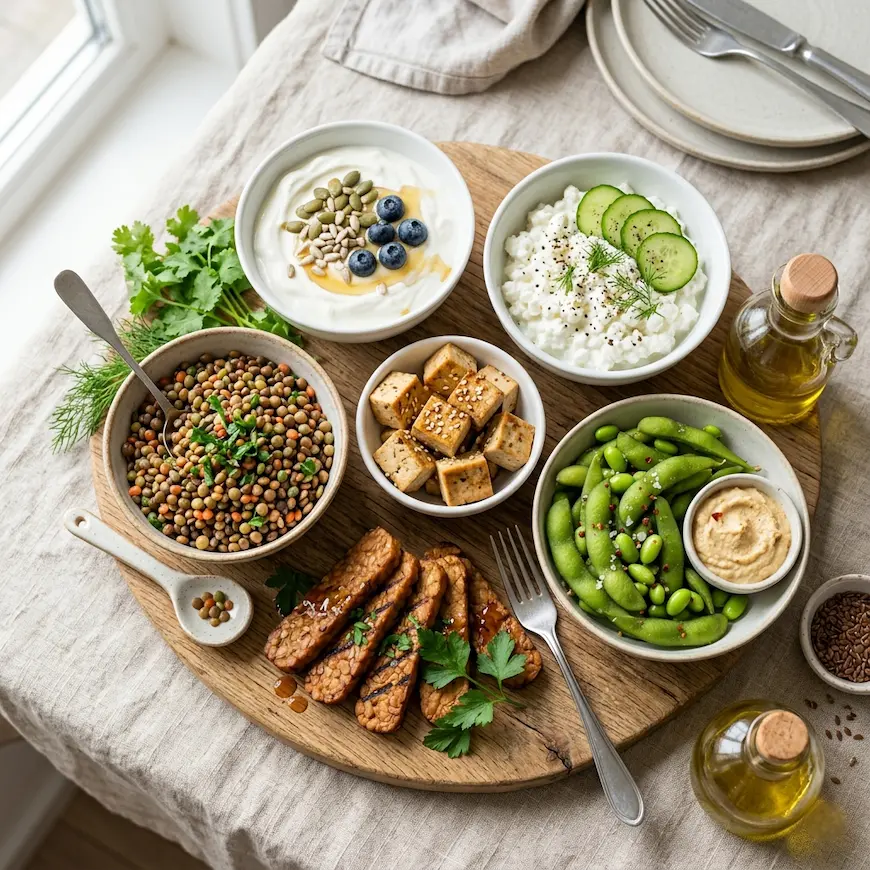
Quick Answer: Ranked per 100 grams, the strongest options are seitan (25g), tempeh (19g), edamame (17g), cottage cheese (11g), Greek yogurt (10g), lentils (9g cooked), and tofu (8g, with high-protein varieties reaching 13 to 16g).
Here is the list of high protein vegetarian foods ranked by grams per 100 grams, with calories included so the per-calorie picture is visible at a glance:
Food
Protein per 100g
Calories per 100g
Protein per 100 cal
Seitan
25g
120
20.8g
Tempeh
19g
190
10.0g
Edamame (shelled)
17g
120
14.2g
Cottage cheese (low-fat)
11g
90
12.2g
Greek yogurt (plain, nonfat)
10g
60
16.7g
Lentils (cooked)
9g
115
7.8g
Tofu (firm)
8g
76
10.5g
Tofu (high-protein/super-firm)
13–16g
90–110
14.5g
Black beans (cooked)
8.9g
132
6.7g
Chickpeas (cooked)
9g
164
5.5g
Quinoa (cooked)
4.4g
120
3.7g
Almonds
21g
579
3.6g
Peanut butter
25g
588
4.3g
Look at the last two rows against the first two. Peanut butter and seitan tie on protein per 100 grams, and peanut butter loses by a factor of five per calorie. That gap is the entire argument for ranking high protein vegetarian foods this way, and it is why nut butters keep topping lists they have no business topping.
Quick Answer: These three high protein vegetarian foods are the most protein-dense whole plant options available. Seitan has the highest protein content but is pure wheat gluten, ruling it out for anyone avoiding gluten. Tempeh brings the most fiber plus a fermentation advantage. Tofu is the mildest and most versatile.
These three do the heaviest lifting in a well-planned diet, and each has a distinct profile.
Seitan is vital wheat gluten, essentially wheat protein with the starch washed out, which is how it reaches roughly 25 grams per 100 grams. Cooked properly it goes genuinely chewy and meat-like, which is why it anchors so many dishes aiming to replicate that texture. The catch is unavoidable: it is pure gluten, so it is off the table entirely for anyone with celiac disease or gluten sensitivity. Making it at home from vital wheat gluten, costs a fraction of what pre-made seitan runs and takes about twenty minutes.
Tempeh is fermented whole soybeans pressed into a block, and keeping the whole bean is what separates it from tofu. It carries roughly 9 grams of fiber per 100 grams alongside its 19 grams of protein, and the fermentation appears to improve mineral bioavailability compared with unfermented soy. The flavor is nuttier and more assertive than tofu. Some people take to it immediately. Others need a few tries and a strong marinade.
Tofu stays the most versatile of the three because it tastes like almost nothing and takes on whatever you put with it. Firm and extra-firm hold up to pan-frying and baking; silken blends into sauces, smoothies, and desserts. The newer high-protein varieties, pressed harder to drive out more water, reach 13 to 16 grams per 100 grams, which is a meaningful step up from standard firm tofu and worth looking for on the label.
Quick Answer: Among high protein vegetarian foods, lentils, black beans, and chickpeas rank below tofu and tempeh on density but are the most practical daily option because they are cheap, need no special shopping, and bring substantial fiber alongside protein, which supports fullness in a way isolated protein does not.
Legumes lose to tempeh and seitan on a pure per-calorie basis, and they still deserve their own section, because density is not the only thing that determines what you actually eat.
A cup of cooked lentils gives you about 18 grams of protein and 15 grams of fiber, for a food that costs pennies a serving and requires no specialty trip. The fiber does work beyond digestion. High-fiber, moderate-protein meals tend to be more satiating than protein by itself, which is why a lentil bowl holds people longer than its protein number predicts.
Black beans, chickpeas, and split peas follow the same shape: respectable rather than exceptional protein, meaningful fiber and minerals, and a price that makes them realistic to eat daily instead of occasionally. Pulses also sit near the centre of most anti-inflammatory foods patterns, so they earn their place twice over. For anyone assembling a routine of high protein vegetarian foods on a budget, legumes are doing more real work than their position on the table suggests.
Quick Answer: For vegetarians who eat dairy and eggs, Greek yogurt, cottage cheese, and eggs rank among the most protein-efficient high protein vegetarian foods available, often beating plant sources per calorie. One egg gives about 6 grams of complete protein for 70 calories, and Greek yogurt approaches 17 grams per 100 calories.
Lacto-ovo vegetarians should feature these rather than treating them as an afterthought behind the plant options.
Nonfat plain Greek yogurt is one of the single most protein-efficient high protein vegetarian foods on this entire list at close to 17 grams per 100 calories, ahead of nearly every plant source. Cottage cheese follows the same pattern, and its slow-digesting casein makes it a common pre-bed choice for anyone focused on overnight muscle maintenance. Our cottage cheese benefits guide covers the practical ways to work more of it in without eating it plain out of the tub.
Eggs give you roughly 6 grams of complete protein each for about 70 calories. Egg protein is complete, with an amino acid ratio so well matched to human requirements that it served for decades as the reference standard other proteins were scored against.
For vegetarians who include these, leaning on dairy and eggs alongside plant sources rather than picking one camp is usually the shortest path to a high daily total. The same logic runs through our wider list of high protein snacks , where the whole-food options consistently beat the packaged ones per calorie and per dollar.
Quick Answer: The idea that high protein vegetarian foods must be combined within every single meal is an outdated theory from the 1970s that nutrition science has since overturned. The body maintains an amino acid pool and combines proteins eaten across a whole day, so long as overall variety and quantity hold up.
This is the most persistent myth in vegetarian nutrition, and it deserves a direct answer, because it makes plant-based eating sound far more fiddly than it is.
The complementary protein theory, the rice-and-beans-in-the-same-bowl rule, came out of a 1971 book and has been walked back since. Research established that mixtures of plant proteins can serve as a complete and well-balanced amino acid source for meeting human requirements (Young VR, Pellett PL, 1994, American Journal of Clinical Nutrition , PMID 8172124 ). More recent work goes further: protein-rich plant foods like legumes, nuts, and seeds are sufficient for full protein adequacy in adults on vegetarian and vegan diets, and concerns about amino acid deficiency have been substantially overstated (Mariotti F, Gardner CD, 2019, Nutrients , PMID 31690027 ).
What matters is eating a reasonable variety of high protein vegetarian foods across the day and getting enough total protein. Lentils at lunch and tofu at dinner is fine. Neither meal needs to be independently complete, because the amino acid pool evens out by bedtime.
The distinction sharpens slightly for athletes and heavy exercisers with high protein needs. Plant proteins produce a somewhat lower muscle protein synthetic response than animal proteins, largely because of lower digestibility, greater splanchnic extraction, and less leucine (van Vliet S, Burd NA, van Loon LJ, 2015, Journal of Nutrition , PMID 26224750 ). The practical fixes are eating somewhat more total plant protein, spreading it across meals, and leaning on soy. Among high protein vegetarian foods, soy in the form of tofu, tempeh, and edamame stands out for being independently complete.
Quick Answer: A day of high protein vegetarian foods reaching roughly 100 grams might run Greek yogurt with chia at breakfast (25g), a lentil and tofu bowl at lunch (30g), edamame as an afternoon snack (17g), and a tempeh stir-fry at dinner (28g), with no protein powder involved.
Here is what a full day of high protein vegetarian foods looks like in practice, at roughly 100 grams total:
Breakfast, Greek yogurt bowl (~25g): 1 cup nonfat Greek yogurt, a tablespoon of chia seeds, berries.
Lunch, lentil and tofu grain bowl (~30g): 3/4 cup cooked lentils, 4 oz pan-fried high-protein tofu, over quinoa with vegetables.
Afternoon snack, edamame (~17g): 1 cup steamed shelled edamame, sea salt.
Dinner, tempeh stir-fry (~28g): 4 oz tempeh with vegetables over brown rice, peanut-ginger sauce.
That is roughly 100 grams from whole foods alone. Anyone with a higher target or a schedule that does not allow four cooked components can add a scoop of plant protein powder, to a smoothie, as a convenience rather than a requirement.
Notice the shape of the day as much as the total. Protein lands in four roughly even blocks instead of piling into dinner, which is the distribution point from the muscle synthesis research above.
Quick Answer: The usual failures with high protein vegetarian foods are treating vegetables as a protein source, skipping protein at breakfast, underestimating the portion sizes actually needed, never measuring intake, and leaning on bars and shakes as the primary strategy rather than a supplement.
Even people who know the right high protein vegetarian foods fall short in practice. The recurring patterns:
Treating vegetables as protein. A cup of broccoli has about 3 grams. It is a good food doing almost no protein work, and meals built on vegetables and starch without a concentrated addition run low every time.
Skipping breakfast protein. Cereal, toast, and fruit are the default vegetarian breakfast, and all three are low in protein. Opening the day with 5 grams instead of 25 makes the remaining target considerably harder.
Underestimating portions. The tofu or lentil quantity in a typical recipe is often smaller than what actually hits a meaningful number, especially for anyone with a raised target from training.
Never measuring. Most people badly misjudge their intake until they weigh it. A kitchen scale, plus tracking one representative week is usually enough to expose exactly where the gaps sit.
Leaning on bars and shakes. Convenient, yes, but expensive and less satiating per gram than whole food. As a supplement they work. As the main strategy they tend to lose on both budget and fullness.
Greek yogurt with chia and berries is among the most efficient of the high protein vegetarian foods, at roughly 25 grams for relatively few calories. Cottage cheese with fruit, or eggs alongside yogurt, land in similar territory. Any of them beats the cereal-and-toast default by about 20 grams.
They are close, at roughly 10 to 11 grams per 100 grams. Greek yogurt runs slightly lower in calories, giving it a modest per-calorie edge. In practice the choice comes down to use: cottage cheese suits savory applications, Greek yogurt swings both ways.
Seitan, at about 25 grams per 100 grams, comparable to many cuts of chicken or beef. Its dense, chewy texture is also the closest plant-based textural match, which is why it turns up in dishes built to replicate a meat-eating experience.
Yes. Plant proteins produce a somewhat weaker muscle protein synthetic response gram for gram, mostly due to digestibility and lower leucine content, but the workarounds are straightforward: eat more total protein, spread it across the day, and include complete sources like soy, dairy, or eggs. Adequate, well-distributed intake supports muscle building regardless of source.
A 4-ounce chicken breast carries roughly 26 grams. The nearest vegetarian equivalents are about 4 whole eggs (24g), 4 ounces of tempeh (21g), or roughly 5 ounces of high-protein tofu (18 to 20g), which makes any of them a reasonable swap in a recipe built around a protein target.
They work as a convenience, not as a strategy. Greek yogurt, tempeh, and legumes deliver more protein per dollar and per calorie than most bars, which often carry significant added sugar or sugar alcohols alongside the protein.
If you remember one thing from the table, make it the gap between peanut butter and seitan. Same protein by weight, five times the calorie cost. Sort your options by that ratio instead of by serving size and the daily target stops feeling like arithmetic and starts feeling like ordinary cooking.
Young VR, Pellett PL (1994). Plant proteins in relation to human protein and amino acid nutrition. American Journal of Clinical Nutrition , 59(5 Suppl):1203S–1212S. PMID: 8172124
Mariotti F, Gardner CD (2019). Dietary Protein and Amino Acids in Vegetarian Diets: A Review. Nutrients , 11(11):2661. PMID: 31690027
van Vliet S, Burd NA, van Loon LJ (2015). The Skeletal Muscle Anabolic Response to Plant- versus Animal-Based Protein Consumption. Journal of Nutrition , 145(9):1981–1991. PMID: 26224750
Mimo Karam is the founder and writer at LifestyleMine. She writes about daily habits, nutrition, sleep, and emotional wellness, turning research into practical advice for people who want to live healthier without making it complicated.