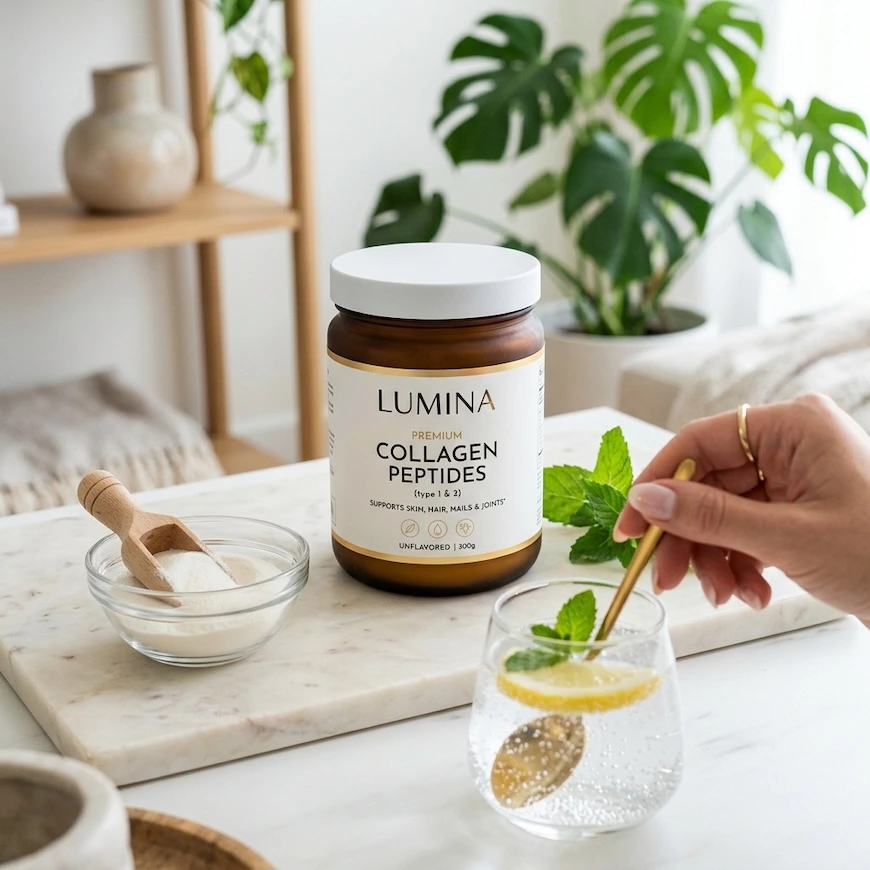
Quick Answer: Yes, collagen benefits are real and replicated, specifically for skin hydration and elasticity and for activity-related joint comfort. Effect sizes are moderate rather than dramatic, and results take 8 to 12 weeks of daily use to appear. It is not a miracle anti-aging product. It is one of the few beauty supplements with actual randomized controlled trial support behind it.
Collagen benefits sit near the top of the most-searched supplement questions in wellness, and the reason is obvious: collagen went from a niche bodybuilding ingredient to the best-selling supplement category on Amazon in a handful of years. Growth like that attracts real research and a great deal of marketing noise, and a product label will not help you tell them apart.
Collagen is the most abundant protein in the human body, making up a large share of skin, tendons, ligaments, and connective tissue. Natural production declines from the mid-20s and drops further after menopause, which is the biological basis for supplementing it in the first place.
What follows is a full accounting of the collagen benefits research, broken down by outcome, along with what to check on a label and which products earn the money.
What Collagen Actually Is and Why the Body Needs It
Quick Answer: Collagen is a structural protein, the main building block of skin, tendons, ligaments, cartilage, and connective tissue. At least 28 types are known, though supplements focus almost entirely on Types I, II, and III. The body makes its own from amino acids, but production slows with age, which is the premise underneath every claim about collagen benefits.
Before getting to specific collagen benefits, it helps to know what the protein actually does. Roughly a third of all protein in the human body is collagen. It gives skin its structure and elasticity. It gives tendons and ligaments their tensile strength, and it forms the cartilage that cushions joints. Without it none of those tissues hold their shape.
The body builds it from amino acids, mainly glycine, proline, and hydroxyproline, with vitamin C as a required cofactor. That is why some products include added vitamin C. It is not filler, it is part of the synthesis pathway, and it is also why a diet with reliable vitamin C sources matters more to collagen benefits than most supplement marketing admits.
Production peaks in the mid-20s and then falls by roughly 1% per year, accelerating around menopause as estrogen drops, since estrogen plays a direct role in collagen synthesis. That decline is the actual mechanism behind visible skin aging, joint stiffness, and slower connective tissue repair with age. The supplement premise follows from real physiology, not from marketing invention.
Does Taking Collagen Actually Work? What the Research Shows
Quick Answer: A 2021 systematic review and meta-analysis pooled 19 randomized, double-blind, controlled trials covering 1,125 participants aged 20 to 70, 95% of them women. The pooled analysis favored hydrolyzed collagen over placebo for skin hydration, elasticity, and wrinkles, with hydration and elasticity holding up most reliably in subgroup analysis. This is among the stronger evidence bases for collagen benefits in the beauty supplement category, though improvements are moderate and take months.
This is the question that matters, and it is the one most marketing around collagen benefits sidesteps by quoting a single flattering study instead of the full body of work.
The clearest answer comes from a systematic review and meta-analysis in the International Journal of Dermatology. It pooled 19 randomized, double-blind, controlled trials covering 1,125 participants aged 20 to 70, 95% women, and found that hydrolyzed collagen supplementation beat placebo on skin hydration, elasticity, and wrinkles in the grouped analysis. In the subgroup analysis, hydration and elasticity were the findings that were confirmed. The authors concluded that roughly 90 days of intake is effective for reducing signs of skin aging (de Miranda, Weimer & Rossi, 2021). Because this is a meta-analysis rather than one trial, it carries considerably more weight than the single-study citations that dominate product pages.
One of the individual trials underneath that evidence base randomized 69 women aged 35 to 55 to 2.5g of collagen peptides, 5.0g, or placebo, once daily for eight weeks. Skin elasticity improved measurably in the treatment groups compared with placebo (Proksch et al., 2014). Note the size: 69 women, 23 per group. Useful, but small, which is typical of the individual trials behind most collagen benefits claims.
What the research does not support: collagen erasing deep wrinkles, replacing retinoids or sunscreen, or doing anything visible within days. The realistic expectation, taken from the actual trial timelines, is gradual improvement in hydration and elasticity across 8 to 12 weeks of daily use.
Collagen and Skin: What Changes and How Long It Takes
Quick Answer: The skin-specific collagen benefits show up most consistently in hydration, elasticity, and skin roughness. Wrinkle findings are favorable in pooled analysis but less consistent across individual trials. Visible change in the research typically appeared between 8 and 12 weeks, and studied doses ran from 2.5g to 10g daily, with the very low doses less likely to replicate results.
Skin is where collagen benefits have the most supporting data, and the findings are fairly consistent across the literature: increased hydration, improved elasticity, meaning how well skin returns after being stretched, and reduced transepidermal water loss, which measures how well the barrier holds moisture.
Wrinkles are the messier picture. The pooled meta-analysis did favor collagen on wrinkles, but individual trials split, some showing modest wrinkle-depth improvement and others showing no significant change even while hydration and elasticity moved. So the accurate framing is that hydration and elasticity are the best-supported skin outcomes, and wrinkle reduction is a plausible secondary effect rather than the headline.
Dose matters more than brand for skin collagen benefits. The positive trials used somewhere between 2.5g and 10g of hydrolyzed peptides daily. Products dosed well under that range are unlikely to reproduce the studied results no matter how the label reads.
Collagen for Hair, Nails, and Gut Health
Quick Answer: Evidence for hair and nail collagen benefits is real but thinner than the skin research, mostly smaller trials showing reduced nail brittleness and faster growth. Gut claims are the weakest part of the category. The gut lining repair narrative is theoretical, extrapolated from collagen’s structural role rather than demonstrated in human gut trials.
Hair and nail collagen benefits work indirectly. Hair and nails are keratin, not collagen, but collagen supplies amino acids including proline that feed keratin production. That is the mechanistic basis for the claim.
Nails are the more concrete of the two. Several smaller trials have found reduced brittleness and faster growth with daily peptides over 24 weeks. Hair trials are fewer, smaller, and often bundle collagen with biotin and other nutrients, which makes collagen’s individual contribution impossible to isolate. If hair and nails are the actual goal, the foods that supply the underlying nutrients do more of the work than any single supplement.
Gut health is where claimed collagen benefits run furthest ahead of the evidence. The claim that collagen repairs the gut lining rests on collagen’s general structural role in connective tissue, not on human trials measuring gut lining integrity with collagen supplementation. It is plausible and unproven. If gut health is why you are considering this, a properly chosen probiotic strain has far more behind it.
Collagen and Joint Comfort: The Active Lifestyle Connection
Quick Answer: Joint-related collagen benefits have real randomized trial support, specifically for activity-related discomfort in physically active people rather than for diagnosed arthritis. A 24-week trial in 147 athletes found significant improvement in joint pain with 10g of daily collagen hydrolysate against placebo. This is among the better-evidenced non-skin uses.
Cartilage is largely Type II collagen, which is the mechanistic basis for the joint collagen benefits.
The best-known supporting trial ran at Penn State over 24 weeks. It randomized 147 physically active subjects with no evidence of joint disease, 73 receiving 10g of liquid collagen hydrolysate daily and 74 receiving placebo. Pain, mobility, and inflammation were tracked on visual analogue scales, and the collagen group showed statistically significant improvement against placebo (Clark et al., 2008). One caveat worth knowing: the trial used a specific commercial formulation, which is common in this field and worth factoring into how much weight you give any single supplement study.
Be precise about what this covers. It is activity-related joint comfort in people who are already active and do not have joint disease. It is not treatment for osteoarthritis or any diagnosed condition. Anyone managing a diagnosed joint problem should treat this as something to raise with a doctor, not as a substitute for care.
For healthy adults dealing with ordinary stiffness from regular exercise or age, this remains one of the more solidly evidenced collagen benefits outside of skin. And the obvious still applies. Consistent low-impact movement does more for joint comfort than any powder will.
The Types of Collagen (Type I, II, III) and Which Ones Matter for What
Quick Answer: At least 28 types exist, but supplements use Type I, II, and III almost exclusively. Type I is the most abundant and drives the skin, hair, and nail collagen benefits. Type II sits in cartilage and is the type behind the joint research. Type III appears alongside Type I in skin and blood vessels. Skin-focused products lean Type I; joint-focused products lean Type II.
This distinction matters more than most labels make clear, because different types drive different collagen benefits. A product sold for skin that is sourced mainly as Type II is not wrong exactly, since there is overlap, but it is not matched to the stated purpose either.
Type I makes up about 90% of the body’s collagen and appears in skin, tendons, bone, and ligaments. It is the type most studied for hydration and elasticity.
Type II is concentrated in cartilage and is the type behind the joint comfort research.
Type III turns up alongside Type I in skin and blood vessels, and is commonly bundled with Type I in blends.
Multi-collagen products spanning Types I, II, III, V, and X are sold as covering every one of the collagen benefits at once. That is a reasonable approach, but it also means the dose of any single type is lower than a single-type product at the same total grams, which matters if one specific outcome is your priority.
Marine Collagen vs. Bovine Collagen: The Real Differences
Quick Answer: Marine collagen is almost entirely Type I, has a smaller peptide size, and suits pescatarians or anyone avoiding beef. Bovine typically provides Type I and III together and costs less per serving. No head-to-head human trial has shown either delivers better skin collagen benefits, so the decision comes down to diet, budget, and sourcing rather than effectiveness.
This is one of the most searched collagen comparisons. Neither source has a monopoly on collagen benefits, and the honest answer will disappoint anyone hoping for a clear winner. Both sources have trial support behind their respective literatures, and there is no clean effectiveness winner.
| Marine Collagen | Bovine Collagen | |
|---|---|---|
| Primary type | Type I, almost exclusively | Type I and III |
| Peptide size | Generally smaller | Larger |
| Best for | Skin-focused use, pescatarian diets | Budget, general use, joint blends with added Type II |
| Typical cost | Higher | Lower |
| Sourcing note | Fish skin and scales, usually a byproduct | Cattle hide and bone, check grass-fed if it matters to you |
Marine collagen comes from fish skin and scales, most of it a byproduct of the fishing industry rather than fish caught for the purpose. Bovine comes from cattle hide and bone, and sourcing quality varies more, which is why grass-fed labeling is worth checking on bovine products specifically.
How to Choose a Collagen Supplement: What to Look For on the Label
Quick Answer: To get the studied collagen benefits, prioritize hydrolyzed over non-hydrolyzed, a dose matching the studied range of roughly 2.5g to 10g daily, third-party testing for purity, and a clearly stated single source or labeled blend rather than a vague “collagen complex.”
Four things separate a product that can deliver the studied collagen benefits from an underdosed one.
- Hydrolyzed form. The collagen has been broken into smaller peptides. This is what nearly every human trial used and what supports absorption. Non-hydrolyzed is a lower quality, less studied format.
- Dose in the studied range. Trials showing benefit used roughly 2.5g to 10g daily, toward the lower end for skin and the higher end for joints. Some products go above this; more is not automatically better, and nothing above about 10g has strong trial support for these outcomes.
- Third-party testing. Supplements are not FDA-regulated for potency the way drugs are, so an NSF, Informed Sport, or USP certification is the most reliable independent quality signal available to a buyer.
- Clear sourcing. A label should say marine, bovine, or a specific blend, and ideally break down the types rather than listing “collagen peptides” and leaving it there.
How to Take Collagen: Timing, Dosage, and What to Mix It With
Quick Answer: Time of day does not change results in the current research, so consistency beats timing. Unflavored hydrolyzed collagen dissolves fully in hot and cold liquids without changing taste or texture. Studied doses run roughly 2.5g to 10g daily, taken once a day, and you need a minimum of 8 weeks before judging whether the collagen benefits are showing up.
No research shows morning versus evening changes the collagen benefits you get. So the practical advice comes down to one thing: pick a time you will actually remember every day. Consistency across 8 to 12 weeks is what the trials measured, and it is the only variable you control.
Unflavored peptides dissolve completely in hot and cold liquid without altering taste, which is why stirring it into morning coffee became the default recommendation. It works the same in smoothies, oatmeal, or soup. If you are already building a morning drink around functional ingredients, collagen slots into that stack more easily than almost anything else, and it is worth seeing how it ranks against the other functional drink options before you add a fourth powder to the routine.
Pairing with vitamin C is not strictly necessary for anyone with an adequate diet, but it does feed the same synthesis pathway, so it is a low-effort pairing rather than a rule.
Give it a full 8 to 12 weeks before deciding whether the collagen benefits are real for you. This is the single most common reason people conclude collagen does nothing: they stop at two or three weeks, well short of the timeline the research actually used.
A note on safety. Collagen is well tolerated and the trials report few adverse effects, but supplements are not risk-free by default. If you are pregnant or nursing, take prescription medication, or manage a chronic health condition, check with your doctor before starting any daily supplement, collagen included.
Frequently Asked Questions
What’s the difference between collagen and collagen peptides?
Collagen peptides, also called hydrolyzed collagen, are collagen broken into smaller units for absorption. This is the form used in nearly all human trials and in most products.
How much collagen should I take daily to get the benefits?
Studied doses run roughly 2.5g to 10g daily depending on the outcome, most commonly 5 to 10g for skin and joints. Check the label against that range rather than assuming more is better.
Can I take collagen every day long-term?
Yes. Trials showing benefit used daily supplementation for 8 weeks to 6 months, and collagen is generally considered safe for ongoing daily use in healthy adults.
Is vegan collagen real?
No plant-derived collagen exists, because collagen is an animal protein by definition. Products sold as vegan collagen contain plant compounds such as vitamin C, silica, or specific amino acids meant to support your own collagen production rather than supplying collagen itself. That is a different mechanism, and it is worth understanding before paying a comparable price. Anyone eating plant-based who wants the amino acid building blocks is better served by reliable protein sources than by a product borrowing the word.
Should I take collagen if I’m on medication?
Collagen is low-risk, but anyone on medication, pregnant, nursing, or managing a chronic condition should check with a doctor before adding any new daily supplement.

Mimo Karam is the founder and writer at LifestyleMine. She writes about daily habits, nutrition, sleep, and emotional wellness, turning research into practical advice for people who want to live healthier without making it complicated.