✦
THE LIFESTYLEMINE NEWSLETTER
Simple wellness tips, healthy recipes, and
everyday inspiration delivered to your inbox.
Your Email Address
Most research into ashwagandha benefits focuses on the HPA axis, the hypothalamic-pituitary-adrenal axis, which is the body’s central stress-response system.
When stress hits, the HPA axis activates. The hypothalamus signals the pituitary gland, the pituitary signals the adrenal glands, and the adrenals release cortisol. Acute cortisol is useful. It mobilizes energy and sharpens alertness so the body can respond. The problem is chronically elevated cortisol. Over time it disrupts sleep, weakens immune function, adds visceral fat, suppresses reproductive hormones, and wears down mood.
The active compounds in ashwagandha are mostly withanolides, a class of steroidal lactones concentrated in the root. They appear to modulate HPA axis activity by reducing cortisol secretion under chronic stress. They also interact with GABA-A receptors, which probably explains some of the calming effect, and they lower inflammatory cytokines (TNF-alpha, IL-1beta, IL-6) that stay elevated during long stretches of stress.
That’s the biological basis for the best-documented ashwagandha benefits: cortisol reduction and stress relief. The mechanism is well understood. The clinical evidence is the part we can actually evaluate, so that’s what the rest of this comes down to.
See also: Anti-inflammatory eating reduces some of the same cytokines ashwagandha targets
This is where the ashwagandha benefits are most solidly established, and it’s where I’d point anyone who asks whether the herb does anything real.
Several randomized, double-blind, placebo-controlled trials have shown significant drops in serum cortisol with standardized ashwagandha extract, which makes these cortisol drops the most measurable of the ashwagandha benefits. The most cited is a 2012 study in the Indian Journal of Psychological Medicine with 64 adults under chronic stress, randomized to KSM-66 ashwagandha (300mg twice daily) or placebo for 60 days. The ashwagandha group showed a 27.9 percent reduction in serum cortisol against 7.9 percent in the placebo group. Stress scores, anxiety scores, and overall wellbeing all improved.
A 2019 study in Medicine using Sensoril ashwagandha (240mg daily for 60 days) showed a 23 percent cortisol reduction, with perceived stress scores down 44 percent in the same trial.
This has held up across multiple independent trials. As a cortisol-lowering supplement for people under genuine chronic stress, the case for these ashwagandha benefits is strong.
Related: If chronic stress is the root of your fatigue, the always-tired article covers that overlap
The stress and anxiety findings follow from the cortisol data, with one nuance worth understanding.
Most studies on ashwagandha benefits for anxiety used people with elevated everyday stress, not a clinical anxiety disorder. Those are different populations with different needs.
For everyday stress in otherwise healthy adults, the evidence is solid. A 2021 meta-analysis in PLOS ONE looked at twelve randomized trials and found significant improvements in both anxiety and stress scores, among the clearest ashwagandha benefits, compared to placebo.
What it isn’t is a fast-acting anxiolytic. It doesn’t work like a beta-blocker you take before a presentation. Effects build over four to eight weeks. If you need something for acute situational nerves, this is the wrong tool. It works on the chronic, background stress load that quietly builds up, which is a different problem on a different timeline.
The athletic ashwagandha benefits are more robust than most people expect.
A 2015 randomized trial in the Journal of the International Society of Sports Nutrition (57 men, eight weeks, 300mg KSM-66 twice daily) found greater gains in muscle strength, muscle size, and recovery compared to placebo. The cortisol-lowering effect probably contributes. Lower post-exercise cortisol means less muscle protein breakdown during recovery and faster adaptation.
One caveat. The study populations were usually resistance-trained men. The evidence for untrained people or for women is thinner, so don’t assume the numbers transfer straight to your situation.
Among the more limited ashwagandha benefits, a few trials have shown improvements in testosterone and sperm quality markers in men with stress-related or fertility issues.
A 2010 study in Fertility and Sterility found significant increases in testosterone and sperm quality in men with sub-fertile status after 90 days of supplementation. The mechanism is plausible: chronically high cortisol suppresses the hormonal cascade that drives testosterone production, so lowering cortisol may let testosterone recover toward its natural baseline.
The caveat here is the important part. Marketing of ashwagandha benefits around testosterone tends to oversell what the research shows. If your testosterone is already in a normal healthy range, ashwagandha is unlikely to push it much higher. If chronic stress has dragged it below your own baseline, it may help bring it back. Those are genuinely different claims, and the supplement industry usually doesn’t bother distinguishing them.
The sleep-related ashwagandha benefits are real but modest, and the nuance matters.
A 2019 trial in PLOS ONE (60 participants, 300mg KSM-66 twice daily for ten weeks) found improvements in sleep onset time, sleep efficiency, and total sleep time compared to placebo. The proposed mechanism involves a compound called triethylene glycol in the root, which seems to promote sleep partly through GABA signaling.
The limitation: participants had non-restorative sleep complaints, not diagnosed insomnia, and the effect sizes were moderate. More large trials are needed before this counts as a strong recommendation.
As a secondary effect, better sleep because background cortisol is lower and nighttime anxiety has eased, the improvement makes complete sense and is probably what a lot of users actually feel among the broader ashwagandha benefits. It’s just not the main reason to take it.
Beyond the core ashwagandha benefits, the herb gets marketed for immune function, cognitive enhancement, blood sugar control, thyroid support, and a grab-bag of other claims. Some preliminary data exists for each. None of it is strong enough to make the herb a primary intervention.
Blood sugar: one study showed reduced fasting glucose in diabetics, mechanism unclear, not adequately replicated. Cognitive function: one small study showed faster reaction time in healthy adults, not replicated. Immune function: one study showed higher natural killer cell activity, with no clinical outcome data behind it.
Treat all of that as early signals, not established ashwagandha benefits.
The extract vs. powder problem (read this before buying)
This is the most practically important section in the article.
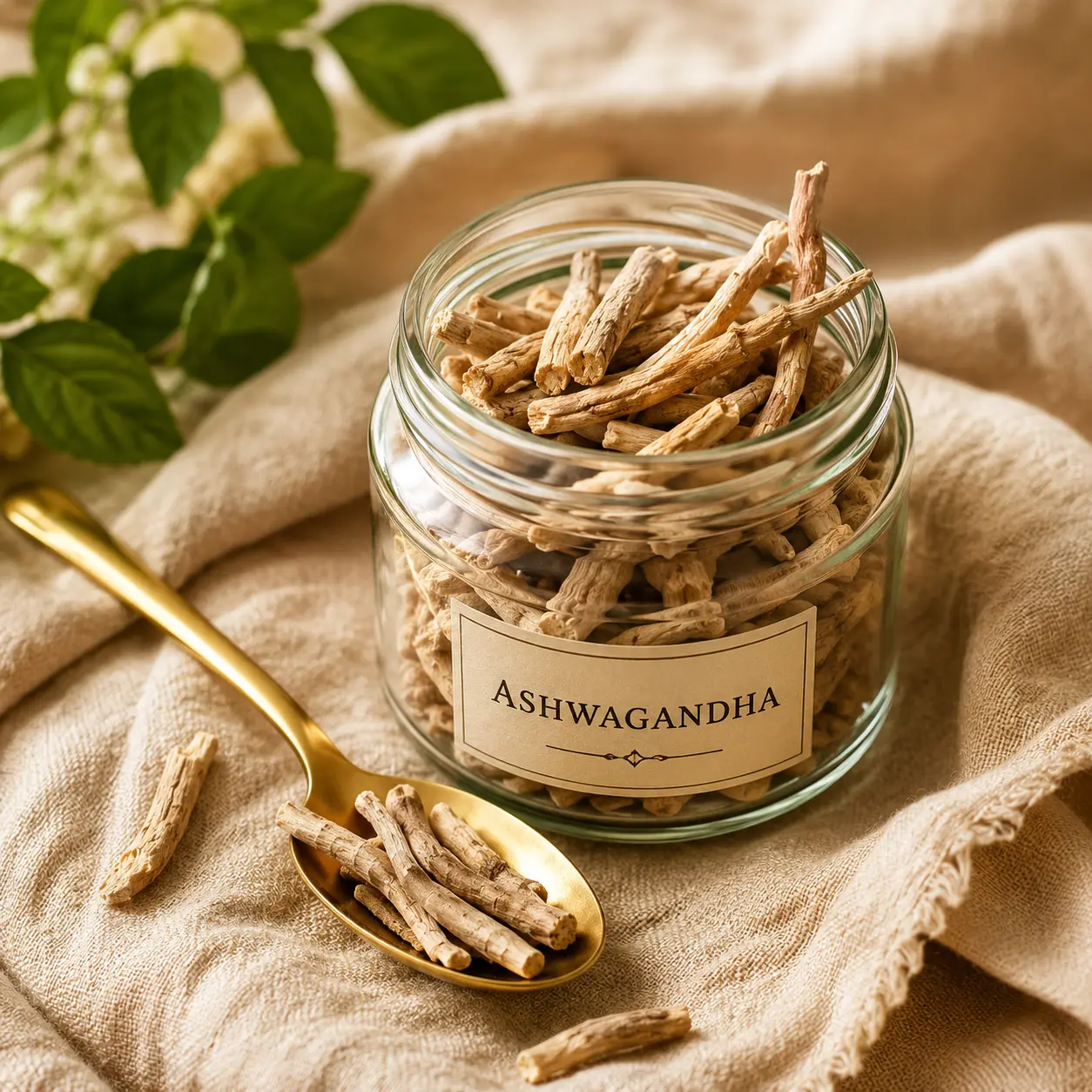
Most ashwagandha products sold on Amazon, in drugstores, and from budget supplement brands are “ashwagandha root powder,” the dried, ground root. The active withanolide content of raw root powder runs roughly 0.1 to 0.5 percent, varies a lot between batches, and isn’t standardized. Two capsules from the same bottle can carry meaningfully different amounts of active compound.
Standardized extracts are a different thing, and they’re where the documented ashwagandha benefits come from. KSM-66 (made by Ixoreal) and Sensoril (made by Natreon) are the two proprietary extract forms that show up in almost every credible clinical trial of ashwagandha benefits. Both guarantee a minimum withanolide concentration.
KSM-66 is a root-only extract standardized to at least five percent withanolides. Most of the cortisol, stress, and athletic-performance research uses this form. Standard dose: 300 to 600mg daily, usually in the morning with food.
Sensoril uses both root and leaf, standardized to at least ten percent withanolides by a different analytical method. It tends to be more sedating, and it’s better studied for anxiety and sleep. Standard dose: 120 to 250mg daily.
When a study reports ashwagandha benefits, it’s almost always using KSM-66 or Sensoril. The first product I took was raw root powder. It probably carried one-tenth or less the active compound of what those studies used, and that’s the single most common reason people decide ashwagandha doesn’t work.
What to look for on the label: “KSM-66,” “Sensoril,” or “standardized to X percent withanolides.” If the label says only “ashwagandha root powder” with no standardization, treat it as an unknown quantity.
Avoid: proprietary blends that hide the actual ashwagandha content, products under 250mg per dose without clear standardization, and potency claims that never name the extract form.
Worth trying if: you’re managing chronic everyday stress and have either never tried ashwagandha benefits with a proper extract, or had a failed run with raw powder.
Skip if: the contraindications below apply to you, or you’ve already done a real eight-week trial with KSM-66 or Sensoril and felt nothing.
Thyroid conditions. Ashwagandha can raise thyroid hormone levels (T3 and T4). For anyone with Hashimoto’s thyroiditis, Graves’ disease, or active thyroid medication management, that’s a meaningful interaction. Talk to your endocrinologist before starting.
Autoimmune conditions. Ashwagandha may stimulate immune activity. For people with rheumatoid arthritis, lupus, multiple sclerosis, or another autoimmune condition, that stimulation could in theory worsen autoimmune inflammation. The evidence is indirect, but the caution is legitimate and well established.
Pregnancy. Ashwagandha has traditionally been used in Ayurvedic practice to induce abortion, and animal studies show uterotonic effects. Avoid it entirely during pregnancy.
Liver disease history. There are published case reports of ashwagandha-associated liver injury, including cholestatic hepatitis. They’re rare but documented. Anyone with an existing liver condition should avoid it, or at least discuss it with a physician first.
Before surgery. Ashwagandha may slow CNS activity. The standard advice is to stop two weeks before any scheduled surgery.
Most clinical trials run 60 to 90 days. That’s how long the ashwagandha benefits genuinely take to build.
The most common reason people decide ashwagandha doesn’t work is stopping at two or three weeks. It isn’t a stimulant. The cortisol modulation is gradual, and weeks six to eight is usually when responders start to notice something.
Cycling protocol: eight to twelve weeks on, then four weeks off. This follows the usual adaptogen logic about preventing habituation, and it matches the durations used in the trials. It isn’t rigorously proven as a cycling schedule, but it’s widely used by long-term users and lines up with the study designs.
Don’t expect anything in the first week or two. That isn’t how this works.
The honest summary of the ashwagandha benefits backed by real evidence: cortisol reduction in people under chronic stress (strong, replicated), stress and anxiety improvement in healthy adults (moderate), athletic recovery in trained individuals (moderate). Testosterone and sleep are plausible but limited, not strong enough to be the main reason to take it.
The product matters more than most people realize. KSM-66 or Sensoril, standardized withanolides, 300 to 600mg daily for at least eight weeks before you judge the ashwagandha benefits for yourself. Raw root powder at the same dose delivers a fraction of the active compounds.
If none of the contraindications above apply to you, and you’re carrying the kind of chronic background stress most adults are, the evidence is solid enough that a properly run eight-week trial is worth it.
KSM-66 for cortisol reduction, stress management, and athletic performance. Sensoril for anxiety and sleep support. Both are standardized extracts with serious clinical trial backing. Raw ashwagandha root powder has no guaranteed withanolide concentration and is where most failed experiences come from. If the label doesn't specify KSM-66, Sensoril, or a withanolide percentage, assume it's raw powder.
Most people who respond to the ashwagandha benefits first notice something around week six to eight, some as early as week three. Stopping at two weeks and deciding it does nothing is the most common way to miss the actual effect window. Give any proper extract at least eight weeks at the correct dose before you evaluate it.
Yes, with a standardized extract and in people under genuine chronic stress. The 2012 KSM-66 trial showed a 27.9 percent cortisol reduction over 60 days against 7.9 percent for placebo. The 2019 Sensoril trial showed a 23 percent cortisol reduction with a 44 percent drop in perceived stress scores. This is one of the best-replicated ashwagandha benefits across independent trials.
Most clinical research uses daily dosing for 60 to 90 days. Long-term use beyond six months isn't well studied. A cycling protocol of eight to twelve weeks on and four weeks off is the standard adaptogen approach and lines up with how the research is structured. Taking it every day indefinitely without breaks isn't the convention in the research or among long-term users.
For everyday stress and anxiety in otherwise healthy adults, the evidence for these ashwagandha benefits is moderately strong. A 2021 meta-analysis in PLOS ONE covering twelve randomized trials found significant improvements in anxiety and stress scores against placebo. For a clinical anxiety disorder, the evidence isn't enough to use it as a primary treatment. See a doctor for clinical anxiety.
People with thyroid conditions (Hashimoto's, Graves'), autoimmune conditions, anyone who is pregnant, anyone with a liver disease history, and anyone within two weeks of surgery. If you're on prescription medication, talk to your pharmacist or doctor before adding any supplement, including ashwagandha.
All content on LifestyleMine is for informational and educational purposes only. It is not a substitute for advice from a qualified healthcare professional. Please consult a doctor before starting any supplement, especially if you are pregnant, nursing, on medication, or have a pre-existing health condition.
Mimo Karam is the founder and writer at LifestyleMine. She writes about daily habits, nutrition, sleep, and emotional wellness, turning research into practical advice for people who want to live healthier without making it complicated.