What is fibermaxxing?
Quick Answer: Fibermaxxing is the practice of deliberately pushing your daily fiber intake as high as you comfortably can, usually by adding beans, oats, chia seeds, vegetables, and whole grains to almost every meal. The term took off in 2026, driven by the fact that more than 90 percent of adults fall short of their daily fiber target.
If your feed has filled up with people eating raw broccoli on camera, stirring chia into everything, and counting grams of fiber the way they used to count protein, you have already watched fibermaxxing happen in real time.
The name mashes “fiber” together with “maxxing,” internet shorthand for pushing something as far as it goes. Most nutrition trends do not survive contact with actual evidence. Fibermaxxing is the rare one that does. PepsiCo’s CEO has called fiber the next protein out loud, in public. McDonald’s leadership expects fiber to be a big story in 2026. Thrive Market logged a 30 percent jump in fiber-related searches over the past year.
Fibermaxxing sticks because fiber is the most under-eaten nutrient in the modern diet and almost nobody realises how badly they are missing it. The average shortfall is not a matter of doing slightly better. It is roughly half.
What follows is what fibermaxxing means in practice, how wide the gap really is, which foods close it fastest, and the one mistake that turns a solid habit into a miserable week.
Why almost nobody hits their daily fiber target
Quick Answer: Over 90 percent of women and 97 percent of men in the US fall short of recommended fiber intake. The average adult eats around 15 grams a day, roughly half the 25 to 38 grams the guidelines call for. The cause is structural: modern diets run on refined grains and processed foods that have had the fiber stripped out.
People are not failing at fiber on purpose. The food supply is built this way. Refining wheat into white flour strips out the bran and germ, which is where the fiber lives. Juicing removes the pulp. Snack foods start from refined starch. Plenty of things marketed as healthy, granola bars and flavored yogurts especially, carry under a gram of fiber per serving.
The size of the shortfall surprises most people. National nutrition surveys put the average American adult around 15 grams a day. The Dietary Guidelines for Americans ask for 25 grams for women and 38 grams for men under 50, dropping to 21 and 30 grams after 50. Most adults are eating less than half of what they need, which is the entire reason fibermaxxing found an audience.
That gap is also why fibermaxxing gets treated as a real intervention rather than a passing hashtag. Doubling your fiber is a genuine dietary change. The rest of this guide is about doing it without hating the process.
What fiber actually does in your body
Quick Answer: Fiber feeds gut bacteria, slows sugar absorption, binds cholesterol for removal, adds bulk for regularity, and keeps you full longer. Soluble fiber dissolves and forms a gel. Insoluble fiber adds bulk and speeds transit. Most whole foods carry a mix.
Fiber is the part of plant food your digestive system cannot break down. That sounds like a knock against it. It is the opposite. Because fiber passes through mostly intact, it spends hours doing work in the gut that digestible food never gets the chance to do, and that is the mechanism fibermaxxing is really betting on.
Soluble fiber dissolves in water and thickens into a gel. That gel slows how fast sugar hits your bloodstream after a meal, which is why a high fiber meal produces a flatter glucose curve than the same calories without it. Soluble fiber also grabs onto cholesterol-carrying bile acids so the body excretes them instead of recycling them, which lowers LDL over time. Oats, beans, chia, and citrus are loaded with it. McRorie and McKeown’s review of fiber physics in the gut makes an important distinction here: viscosity is what drives the cholesterol and glucose effects, and not every soluble fiber is viscous.
Insoluble fiber does not dissolve at all. It bulks up stool and moves things along faster, which is the regularity effect everyone knows fiber for. Whole wheat, nuts, and fruit and vegetable skins are the concentrated sources.
Fermentable fiber overlaps with both categories and feeds your gut bacteria directly. Bacteria ferment it into short chain fatty acids, butyrate among them, which is the main fuel for the cells lining your colon and helps calm intestinal inflammation. This is the bridge between fibermaxxing and gut health that the trend keeps circling back to.
Satiety is the fourth mechanism and the one you notice first. Fiber-rich food takes up room in your stomach, slows gastric emptying, and triggers satiety hormones like GLP-1 harder than the same calories in low fiber form. Reynolds and colleagues found in a Lancet series of systematic reviews and meta-analyses that people eating the most fiber had lower body weight along with lower rates of heart disease, type 2 diabetes, and colorectal cancer, with the strongest results clustering around 25 to 29 grams a day and no sign the benefit stopped there. That last detail, the absence of a clear ceiling, is what gives fibermaxxing its scientific footing.
The foods that deliver the most fiber
Quick Answer: The highest-fiber foods per serving are split peas, lentils, black beans, raspberries, and chia seeds, several landing between 8 and 16 grams in one serving. Building meals around legumes, intact whole grains, and a wide range of vegetables closes the gap faster than any supplement.
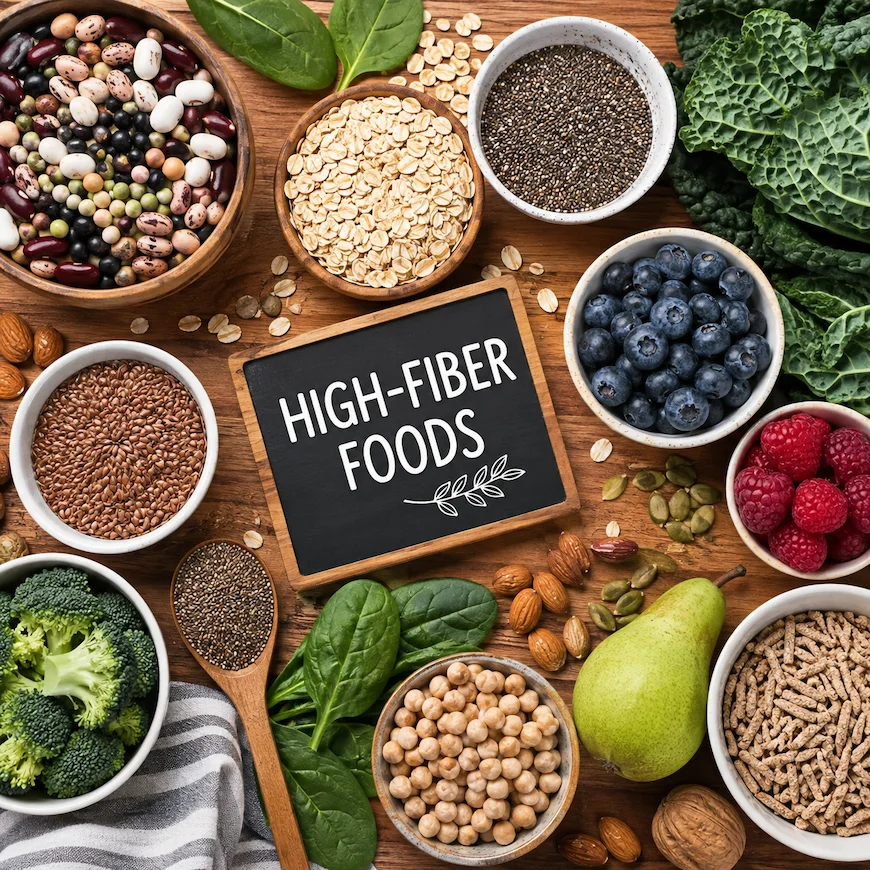
Fibermaxxing works best when it runs on whole, barely processed plant food. These are the highest-yield options:
| Food | Serving | Fiber (grams) |
| Split peas (cooked) | 1 cup | 16.3 g |
| Lentils (cooked) | 1 cup | 15.6 g |
| Black beans (cooked) | 1 cup | 15.0 g |
| Chia seeds | 1 oz (2 Tbsp) | 9.8 g |
| Raspberries | 1 cup | 8.0 g |
| Artichoke (cooked) | 1 medium | 7.0 g |
| Avocado | 1 medium | 6.7 g |
| Whole wheat pasta (cooked) | 1 cup | 6.3 g |
| Pear (with skin) | 1 medium | 5.5 g |
| Broccoli (cooked) | 1 cup | 5.1 g |
| Oats (dry) | 1/2 cup | 4.0 g |
| Almonds | 1 oz (23 nuts) | 3.5 g |
You do not need to rebuild your diet to start fibermaxxing. Four moves cover most of the distance: put a legume into lunch or dinner, leave the skin on your fruit and vegetables, swap one refined grain for the whole grain version, and stir a tablespoon of chia or ground flax into something you already eat every morning.
The legume line is doing the heavy lifting there. A cup of lentils carries more fiber than six cups of cooked broccoli. Anyone fibermaxxing on salad alone is going to have a frustrating week.
For a wider view of foods that also help with inflammation, the site’s anti-inflammatory foods guide covers a lot of the same plants from another angle.
How much fiber you actually need per day
Quick Answer: The Dietary Guidelines for Americans recommend 25 grams of fiber daily for women and 38 grams for men, with lower targets after age 50. Many dietitians prefer 14 grams per 1,000 calories, which scales the number to what you actually eat.
The standard fibermaxxing target comes straight from the Dietary Guidelines:
| Group | Daily Fiber Target |
| Women, 19–50 | 25 g |
| Men, 19–50 | 38 g |
| Women, 51+ | 21 g |
| Men, 51+ | 30 g |
Clinical practice often uses a simpler rule: 14 grams of fiber for every 1,000 calories. Eat 2,000 calories and you are aiming at roughly 28 grams. Eat 2,500 and it is closer to 35. That scales better than a flat number for anyone eating well above or below average.
Start from 15 grams and the math is blunt. Most people fibermaxxing are trying to double their intake, and that is where it usually goes wrong, because they try to do the whole jump in an afternoon.
The fibermaxxing mistake everyone makes
Quick Answer: The most common fibermaxxing mistake is ramping fiber up too fast without raising water intake alongside it. Jumping from 15 grams to 35 or more in one day outpaces the gut microbiome’s ability to adapt, which produces gas, bloating, and cramping. That is a pacing problem, not a fiber problem.
Viral fibermaxxing content skips this part almost every time, and it is why so many people quit on day three convinced fiber hates them.
When fiber intake spikes, the bacteria that ferment it have to multiply fast to handle the new fuel supply, and fermentation produces gas. Ramp up slowly and the microbiome scales up with you. Ramp up overnight and you generate more gas than your gut knows what to do with, which arrives as bloating, cramping, and sometimes diarrhea or constipation depending on which type of fiber you piled on.
Two rules prevent it.
Go slow. Add about 5 grams every few days instead of sprinting to the target. Fifteen grams to 20 this week, 25 next week. That gives your bacterial populations time to build up to the new load.
Drink more water. Fiber, insoluble fiber in particular, pulls water in as it moves through you. Without enough water, more fiber makes constipation worse rather than better, which is the single most counterproductive outcome fibermaxxing can produce. Add at least one extra glass for every meaningful bump in fiber.
If you have IBS, IBD, diverticulitis, or any other digestive condition, talk to your doctor before a big fiber increase. The right approach genuinely differs by condition, and generic fibermaxxing advice is not a substitute for that conversation.
A 7-day gradual fiber increase plan
Quick Answer: A safe fibermaxxing ramp adds 3 to 5 grams every one to two days, moving from a typical 15 gram baseline to 25 or 30 plus grams within a week, with water intake rising alongside it.
This is the on-ramp version of fibermaxxing, built to avoid the bloating spike:
Days 1–2, aiming for 18 to 20 grams. Swap one refined grain for its whole grain version. White rice to brown, white bread to whole wheat. Add a piece of fruit with the skin on.
Days 3–4, aiming for 22 to 25 grams. Half a cup of beans or lentils into one meal. A tablespoon of chia or ground flax into breakfast.
Days 5–6, aiming for 28 to 30 grams. Add vegetables to a meal that had none. Push the beans from half a cup to a full cup.
Day 7, aiming for 30 to 35 grams. Stack everything: whole grains, a full serving of legumes, fruit with skin, vegetables at two meals, seeds in one.
Water. Add roughly 16 ounces across the week, spread out alongside the fiber increases rather than dumped in at the end.
Seven days of this and most people land at or near target. Same destination as aggressive fibermaxxing, minus the part where you cancel your evening plans.
Fiber supplements: when food isn’t enough
Quick Answer: Psyllium husk is the best-researched fiber supplement, with solid evidence for both regularity and cholesterol reduction. Supplements are a reasonable bridge when food alone will not close the gap, but they should not replace whole food fiber, which brings a wider mix of fiber types plus nutrients no capsule replicates.
If you have pushed food-based fibermaxxing as far as it goes and are still coming up short, a supplement can cover the rest.
Psyllium husk comes from Plantago seeds and has the deepest research base of any fiber supplement. It is mostly soluble fiber, with clinical evidence behind both improved regularity and modest LDL reductions when taken consistently. Mix it into water once or twice a day.
Chia and ground flaxseed sit somewhere between food and supplement. Both disappear into smoothies, oatmeal, or yogurt without changing the taste much, and a tablespoon of chia carries close to 5 grams of fiber.
Fiber gummies and capsules are everywhere now, but they usually deliver 3 to 5 grams per serving, which barely moves the needle on a 25 to 38 gram target. They work fine as a top-up but they will not carry the whole plan.
One caution: fiber supplements can block absorption of some medications taken at the same time. Two hours of spacing is the standard precaution, and it is worth confirming with your doctor or pharmacist.
Fibermaxxing and gut health: the long-term payoff
Quick Answer: Consistently higher fiber intake is among the best-supported ways to build gut microbiome diversity, which tracks with immune function, mood regulation through the gut-brain axis, and lower risk of several chronic diseases. These benefits build over months.
Fiber is the primary fuel for a diverse gut microbiome, and microbiome diversity is one of the more consistently replicated markers of long term health. That is the real argument for fibermaxxing, and it is a slower argument than the trend usually admits.
Makki and colleagues, in a Cell Host & Microbe review of dietary fiber and gut microbiota, describe what happens when fiber runs short: bacteria that would otherwise ferment it start feeding on the intestinal mucus layer instead, thinning the barrier between gut contents and the gut lining. Low fiber diets track with less diverse microbiomes, weaker barrier integrity, shakier blood sugar regulation, and altered immune signaling. Because the microbiome talks to the brain through the gut-brain axis, the same short chain fatty acids produced during fermentation have been studied for their role in mood and stress.
None of this lands overnight. Meaningful shifts in microbiome composition usually take weeks to months of steady intake before they show up in measurements. Worth setting expectations honestly: fibermaxxing pays out slowly. The seven day plan is just the on-ramp. The benefit comes from high fiber eating becoming your default rather than a week you survived.
For more on how food shapes overall wellbeing, the site’s mood-boosting foods article picks up the gut-brain thread.
Frequently asked questions
How do I start fibermaxxing without getting bloated?
Ramp gradually. Roughly 5 grams every few days rather than jumping to the full target at once. Pair every increase with more water, since fiber needs water to move properly. The seven day plan above gives you the gram-by-gram version.
What foods have the most fiber per serving?
Legumes lead: split peas, lentils, and black beans each deliver 15 grams or more per cooked cup. Chia seeds hit nearly 10 grams per ounce. Raspberries and pears with the skin on lead the fruit. Building meals around these closes the gap faster than fibermaxxing on vegetables alone.
Is 30 grams of fiber a day enough?
For most adult women, 25 grams meets the guideline and 30 gives you comfortable margin. For most adult men, the guideline is 38, so 30 falls short. The 14-grams-per-1,000-calories rule gives you a more personal number.
Do fiber supplements work as well as high-fiber foods?
For the specific things they target, psyllium especially, supplements work and the clinical research backs them. But whole foods bring a broader mix of fiber types plus vitamins, minerals, and plant compounds no isolate reproduces. Treat supplements as a bridge inside a food-first fibermaxxing approach rather than the approach itself.
Can fibermaxxing help with blood sugar?
Yes. Soluble fiber slows how fast sugar from a meal reaches your bloodstream, flattening the post-meal curve compared to the same food without it. It is one of the faster benefits to show up, often within days of eating consistently more fiber.

Mimo Karam is the founder and writer at LifestyleMine. She writes about daily habits, nutrition, sleep, and emotional wellness, turning research into practical advice for people who want to live healthier without making it complicated.