✦
THE LIFESTYLEMINE NEWSLETTER
Simple wellness tips, healthy recipes, and
everyday inspiration delivered to your inbox.
Your Email Address
Quick Answer: A typical sleepmaxxing routine layers environmental changes (blackout curtains, cooling mattress pads), behavioral additions (mouth taping, magnesium), and tracking tools (rings, mattress sensors). Most people who identify with the trend are not doing all of it. The routines shown online are a highlight reel of someone’s full stack, not a starting point.
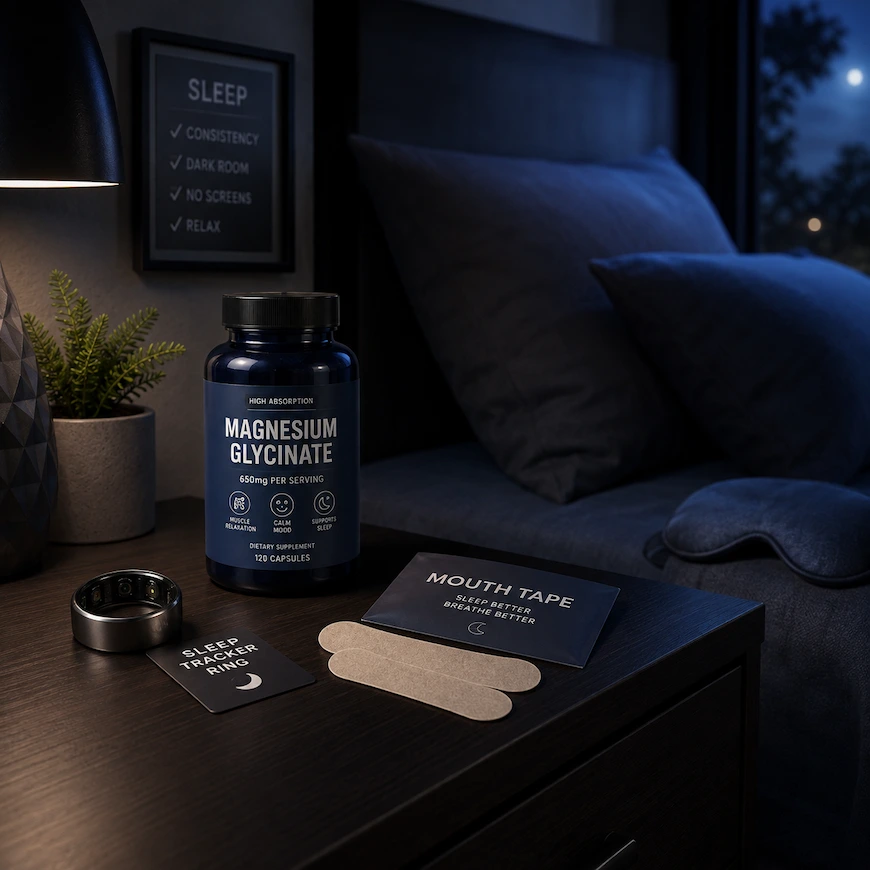
The sleepmaxxing routine that circulates online usually pulls from four categories at once.
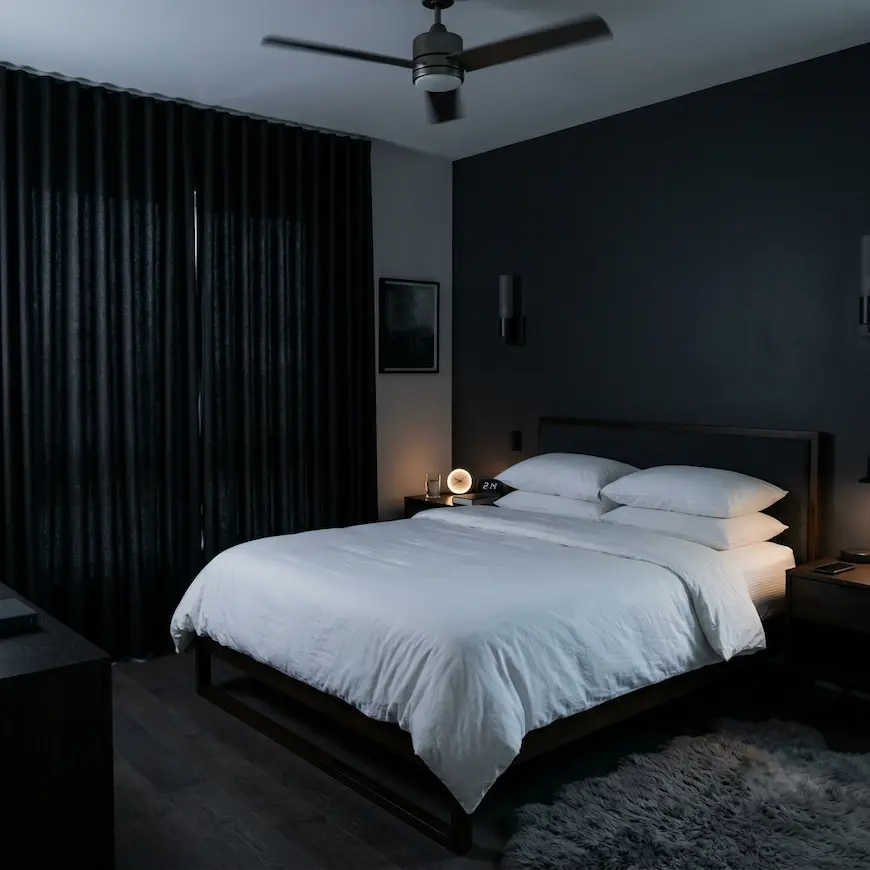
Environment. Blackout curtains or an eye mask, a cooling mattress pad or pillow, a white noise machine, and a bedroom held somewhere around 65 to 68°F.
Behavior. Mouth taping to encourage nasal breathing, a consistent wind down, a fixed wake time including weekends, and cutting caffeine 8 to 10 hours before bed.
Supplements. Magnesium glycinate leads by a wide margin, with occasional mentions of L-theanine, apigenin and glycine.
Tracking. A ring or wearable, a mattress sensor, or a bedside device that hands you a nightly sleep score.
Nobody needs every item on that sleepmaxxing list, and starting with all of it at once is more likely to create anxiety about sleep than to improve it. Search interest in the best sleep gadgets of 2026 reflects real curiosity about individual sleep optimization tips and tools, but the routine in a 60 second video is a stack accumulated over months. It is not a checklist for week one.
Quick Answer: Mouth taping is meant to encourage nasal breathing during sleep by gently holding the lips closed, on the theory that nasal breathing filters and humidifies air better than mouth breathing and may reduce snoring and dry mouth. Direct clinical research on mouth taping specifically is limited, and it is not appropriate for anyone with nasal congestion, sleep apnea, or any condition affecting normal breathing.
Mouth taping is the most visible and most argued over piece of the sleepmaxxing toolkit, and it deserves an honest answer rather than a trend following endorsement.
The logic underneath this piece of sleepmaxxing holds up. Nasal breathing filters, warms and humidifies incoming air better than mouth breathing, and it is associated with better diaphragm use. People who breathe through their mouth at night, usually from congestion or habit, often report more snoring, morning dry mouth and worse sleep quality.
Where the evidence thins out: well controlled clinical research testing mouth tape itself as an intervention is limited. Most of what circulates online points to research on nasal breathing in general, not on the tape. That distinction matters. Nasal breathing being good for you does not mean an adhesive strip is the right way, or the only way, to get there.
Who should skip it entirely: anyone with diagnosed or suspected sleep apnea, chronic nasal congestion, a deviated septum, or any condition that makes nasal breathing difficult. Taping your mouth shut in those cases can restrict airflow rather than improve it. That is not a footnote. It is the line between a low risk experiment and an unsafe one.
If you want to try it carefully, use purpose made mouth tape rather than household tape, which should never be used for this. Start with a small patch instead of covering the whole mouth, and stop straight away if it causes any breathing discomfort, anxiety or disrupted sleep.
Quick Answer: Orthosomnia is a term coined by sleep researchers for the obsessive pursuit of a perfect sleep score, where anxiety about tracking data makes sleep worse. It was described in a 2017 paper in the Journal of Clinical Sleep Medicine and is the clearest documented downside of sleepmaxxing.
This is the section most sleepmaxxing content leaves out, and it may be the most useful part of this guide.
Researchers led by Kelly Glazer Baron coined the term “orthosomnia” after seeing patients arrive at a sleep clinic not with typical insomnia symptoms but with distress caused by their own tracker data. Many had objectively normal sleep. The gap between what the device reported and what “good sleep” was supposed to look like created enough anxiety to make falling and staying asleep harder.
The mechanism is a feedback loop. Checking a score creates pressure to hit a number. That pressure triggers the same stress response that interferes with sleep onset. A bad night produces a bad score, which feeds the anxiety the next day. This is what happens when sleepmaxxing gets treated as a competition instead of a set of tools.
Signs it may be happening to you: checking your sleep score before anything else in the morning, feeling like the day is ruined by a low score even though you feel fine, or changing your behavior, like staying in bed longer than you want, to move a number rather than because your body is asking for it.
The practical fix is simple. If you use a tracker, read it as a weekly or monthly trend rather than a nightly report card. One night’s score is noisy. A month of data tells you something. If the tracking itself is what is stressing you out, the recommendation from sleep researchers is to stop checking daily, or take the thing off for a while.
Quick Answer: Bedroom temperature and light control have the strongest research support of anything in the sleepmaxxing toolkit. A cool room, usually cited at 65 to 68°F, supports the natural drop in core body temperature that helps trigger and maintain sleep, and consistent darkness supports melatonin production. These two often produce more noticeable improvement than any gadget or supplement.
Of everything in sleepmaxxing, the environmental category has the most consistent research behind it. It is also the cheapest and least complicated to act on, which is why it belongs at the top of any list of sleep optimization tips rather than buried under hardware recommendations.
Core body temperature drops by 1 to 2 degrees Fahrenheit as part of falling asleep, and a warm room works directly against that. A review by Okamoto-Mizuno and Mizuno in the Journal of Physiological Anthropology found that heat exposure during sleep increases wakefulness and reduces both slow wave and REM sleep , with humid heat making the effect worse. The commonly quoted 65 to 68°F window is a practical recommendation rather than a finding from any single study, but the direction of the evidence is consistent: cooler helps, warm rooms hurt. Our best temperature for sleep guide goes deeper on how to apply this.
Light works through a related mechanism. Darkness signals the brain to produce melatonin, and light, especially blue spectrum light from screens, suppresses it. A review of sleep hygiene evidence by Irish and colleagues in Sleep Medicine Reviews looked at exactly these kinds of everyday recommendations and found the individual components have real support behind them, even though bundling them into generic advice has a weaker track record as a standalone treatment. Blackout curtains and less screen time in the hour before bed are the least glamorous sleep optimization tips on any list, and they sit next to a $300 ring, but they act on the same biology the ring is only measuring.
A cooling mattress pad and decent blackout curtains are reasonable first purchases precisely because they target two of the best supported variables in sleep science rather than the most heavily marketed ones.
Quick Answer: Magnesium glycinate is the most commonly recommended supplement in sleepmaxxing content, with reasonable evidence for a role in relaxation and sleep quality, particularly for people running a magnesium shortfall. L-theanine and apigenin have smaller and more preliminary research behind them and belong as secondary additions rather than starting points.
Supplements show up constantly in sleepmaxxing content, and magnesium glycinate leads the pack.
Magnesium helps regulate the nervous system and has a documented relationship with sleep quality, especially in people who are not getting enough from their diet, which is a meaningfully large share of adults. The glycinate form gets favored in sleep contexts because glycine has a mild calming effect of its own and the compound absorbs well without the digestive side effects that come with some other forms. Our guide to magnesium glycinate for sleep covers dosing and timing properly.
Past magnesium, the supplement layer of sleepmaxxing gets much less certain. L-theanine, an amino acid found in tea, has some support for promoting relaxation without sedation, which makes it a fair secondary addition if a racing mind is your specific problem. Apigenin, a compound in chamomile, has thin human research despite showing up in almost every sleep stack online.
Start with magnesium if you suspect a shortfall, and start with it alone. Adding four supplements at once makes it impossible to tell which one, if any, is doing anything.
Quick Answer: The best supported parts of sleepmaxxing are room temperature control, light management and a consistent sleep schedule. The weakest are specific gadget claims and stacking several unproven supplements at once. Mouth taping and sleep tracking sit in between, with sound logic but limited direct research or a real risk of overuse.
Pulling sleepmaxxing into a framework:
Strong evidence. Consistent sleep and wake times, a cool bedroom around 65 to 68°F, darkness and reduced blue light before bed, and magnesium for people with a likely shortfall. These are the boring parts of sleepmaxxing, and also the parts with the most research behind them.
Reasonable but limited evidence. Mouth taping, which has a sound mechanism, thin direct research and real safety caveats for some people. L-theanine and other secondary supplements. Sleep tracking used as an occasional trend check rather than a nightly ritual.
Mostly trend. Gadget claims promising dramatic overnight improvement, four or more supplements taken at once, and reading a nightly sleep score as a meaningful daily measurement when it is noisy data that only means something in aggregate.
None of this is an argument against trying any of it. It is a suggestion to rank your sleep optimization tips by evidence and put your time and money into the strongest categories first, because that is where the improvement is most likely to come from.
Quick Answer: The most effective way to start sleepmaxxing is to pick three changes from the strong evidence category rather than the full stack shown online: fix your room temperature, block out light, and set a consistent wake time. Give those two to three weeks before adding anything, since layering many changes at once makes it impossible to know what is working.
Here is a realistic sleepmaxxing sequence, rather than the all at once version that circulates online. Most sleep optimization tips fail not because they are wrong but because people try eleven of them in the same week.
Start with three things. Set your thermostat or fan to hold the bedroom between 65 and 68°F. Add blackout curtains or a sleep mask. Pick a wake time you can hold seven days a week, weekends included. These three address the strongest evidence variables in sleepmaxxing, and most people notice a difference inside one to two weeks.
Then add one thing at a time. If sleep still feels off after three weeks of the environmental basics, add magnesium glycinate and give it two to three weeks before judging it. Only after that would mouth taping or a tracker be worth introducing, and only if you have a specific reason, like snoring or real curiosity about your patterns.
Skip the score checking habit from day one. If you do add a tracker, decide in advance that you will look at trends weekly rather than checking a score every morning. This single decision is the most effective way to get the benefit of tracking without the orthosomnia risk described above.
A sleep tracker ring is a reasonable late addition to a sleepmaxxing routine if you are curious about your patterns, as long as you use it with that weekly review mindset instead of a daily scorecard.
Sleepmaxxing is a 2026 wellness trend describing the deliberate, often elaborate optimization of sleep through environmental changes, behavioral habits, supplements and tracking technology. Sleepmaxxing reflects a shift toward treating sleep as something to manage and measure rather than something that simply happens.
No. Mouth taping should not be used by anyone with sleep apnea, chronic nasal congestion, a deviated septum, or any condition affecting normal nasal breathing, since it can restrict airflow and make breathing harder rather than easier. If you are unsure about your nasal breathing, talk to a doctor before trying it, and use purpose made gentle tape rather than household tape.
Most guidance points to a bedroom between 65 and 68°F for adults, since that range supports the natural drop in core body temperature that helps initiate and maintain sleep. Individual preference varies, but it is a reliable starting point.
Environmental changes like temperature and light control often show up within one to two weeks. Supplement effects, magnesium included, usually take two to three weeks of consistent use to assess properly. Behavioral changes like a fixed wake time can take several weeks for your internal clock to adjust.
Some parts of sleepmaxxing overlap with cognitive behavioral therapy for insomnia (CBT-I), the gold standard clinical treatment, particularly consistent scheduling and stimulus control. But sleepmaxxing as a trend is not a substitute for clinical treatment of diagnosed insomnia, and anyone with persistent, significant sleep difficulty should see a doctor rather than relying on trend based self treatment.
Start with the lowest cost, highest evidence items: a way to control bedroom temperature, meaning a fan or an adjusted thermostat, plus blackout curtains or a sleep mask. Those two address the best supported variables in sleep science and cost far less than a tracking ring or a supplement stack, which makes them the sensible first step before spending on anything else.
Baron KG, Abbott S, Jao N, Manalo N, Mullen R (2017). Orthosomnia: Are Some Patients Taking the Quantified Self Too Far? Journal of Clinical Sleep Medicine , 13(2):351-354. PMID: 27855740
Irish LA, Kline CE, Gunn HE, Buysse DJ, Hall MH (2015). The role of sleep hygiene in promoting public health: A review of empirical evidence. Sleep Medicine Reviews , 22:23-36. PMID: 25454674
Okamoto-Mizuno K, Mizuno K (2012). Effects of thermal environment on sleep and circadian rhythm. Journal of Physiological Anthropology , 31(1):14. PMID: 22738673
General information only, not medical advice. If you have persistent sleep difficulty, suspected sleep apnea, or any condition affecting your breathing, speak to a doctor before changing your routine.
Mimo Karam is the founder and writer at LifestyleMine. She writes about daily habits, nutrition, sleep, and emotional wellness, turning research into practical advice for people who want to live healthier without making it complicated.