✦
THE LIFESTYLEMINE NEWSLETTER
Simple wellness tips, healthy recipes, and
everyday inspiration delivered to your inbox.
Your Email Address
Step outside the band and sleep measurably suffers:
Temperature
Effect on sleep
Below 55°F (12.8°C)
Cold stress; vasoconstriction; fragmented sleep; more arousals
55–60°F (12.8–15.6°C)
Suboptimal; mild thermal discomfort; some slow-wave sleep lost
60–67°F (15.6–19.4°C)
Optimal for most adults; most slow-wave sleep; stable REM
67–72°F (19.4–22.2°C)
Slightly warm; more arousals; some REM suppression
Above 72°F (22.2°C)
Measurable quality decline; significant REM suppression; more waking
Above 77°F (25°C)
Clinically significant disruption; less total sleep
Baniassadi et al. (2023, Science of the Total Environment , PMID 37474050 ) tracked sleep across an extended monitoring period in a cohort of community-dwelling older adults and found that sleep efficiency fell in a dose-dependent way once nighttime temperatures climbed past 25°C (77°F), with the steepest drop between 25 and 30°C. That study’s own optimum sat a little warmer than the headline range, a reminder that the best temperature for sleep shifts with age, covered in the special-cases section below.
Quick Answer: Heat mainly eats into slow-wave (deep) sleep and REM, the two stages that handle physical recovery, memory consolidation, and emotional regulation. Sleeping above 72°F reliably cuts total sleep time and adds night-time awakenings, even when time in bed does not change.
Sleeping too warm is not just “feeling hot.” It selectively degrades your most restorative sleep, which is exactly why the best temperature for sleep matters more than total hours for how rested you feel.
Okamoto-Mizuno and Mizuno (2012, Journal of Physiological Anthropology , PMID 22738673
Slow-wave sleep takes the first hit, and it is the stage you can least afford to lose. N3 is where growth hormone is released, immune function gets consolidated, and cellular repair speeds up, all at the lowest arousal threshold of the night. Thermal discomfort nudges that threshold up just enough to slide the brain into lighter sleep without fully waking you. You feel like you slept; you spent less time in the stage that actually repairs you.
REM is the second casualty. During REM, humans go briefly poikilothermic: we lose active thermoregulation and body temperature drifts toward the room. In a warm room that drift pushes core temperature up instead of holding it level, which trips the arousal systems. The brain bails out of REM into lighter sleep or wakes outright. Since REM is where emotional memory gets processed, fragmenting it shows up the next day as shorter fuse and foggier recall. Get the best temperature for sleep wrong and REM is usually the first thing to go.
Chronic hot-room sleeping tends to surface as a cluster of complaints: waking unrefreshed despite enough hours in bed, a harder time managing emotions the next day, weaker memory consolidation (rough if you are studying), and reduced growth hormone release (rough if you are training and trying to recover).
Quick Answer: Core body temperature runs on a 24-hour circadian cycle, peaking in late afternoon and bottoming out around 4–5 AM. Sleep is timed to the falling phase of that curve. All night the hypothalamus watches skin and core temperature and tunes vasodilation to hold the conditions sleep needs.
The circadian temperature rhythm is one of the body’s most precise clocks, and once you see it, two things make sense: why sleeping at the wrong time of day is so hard, and why anything that moves your body temperature can move your sleep.
Across 24 hours the curve runs roughly like this. Core temperature peaks around 6–9 PM (about 37.2°C / 99°F), sits near 37.0°C / 98.6°F at sleep onset while still falling, bottoms out around 4–5 AM (36.4–36.6°C / 97.5–97.9°F), then climbs again as you wake, which helps make you alert.
That rhythm has practical consequences. A warm bath or shower one to two hours before bed speeds the core-temperature drop through rebound vasodilation: the warm water heats your skin, the vessels open to dump that heat, and core temperature falls about 0.2–0.4°C faster than it would on its own, trimming sleep-onset time by roughly 10 minutes in study after study. Morning exercise helps too, by a different route: raising core temperature early builds a steeper evening decline, and a bigger daytime peak means a bigger evening drop and a stronger pull toward sleep. The same rhythm explains why shift work and jet lag wreck sleep. The temperature curve does not reset as fast as your light exposure changes, so when you try to sleep at a biologically “wrong” hour, your core temperature is still rising and slow-wave sleep gets suppressed no matter how dark the room is. Timing can override even the best temperature for sleep.
Quick Answer: The average American bedroom sits around 68–72°F (20–22°C), at or above the upper edge of the optimal band. Energy-efficient homes hold heat better than older construction, and nighttime temperatures have risen about 0.3°C per decade since 1950, pushing baseline bedroom temperatures steadily up.
The best temperature for sleep is 60–67°F. Most American bedrooms run warmer than that, and a few ordinary things keep them there.
Thermostats are set for daytime comfort, usually 68–70°F, and in a well-insulated modern home that setting means the bedroom holds its heat overnight instead of cooling on its own, parking it at or above the top of the range. A sleeping partner does not help: a second adult throws off roughly 100 watts of body heat, which is enough to raise the ambient temperature noticeably and is exactly why couples argue about the thermostat. Electronics pile on a little more, with TVs, chargers, and standby gear adding low-level heat; a big TV in a small room can lift the temperature by 1–2°F on its own, quietly nudging you off the best temperature for sleep.
Then there is the longer trend. A 2023 study found that warming nights are already trimming sleep worldwide. In warm climates without air conditioning, people lose 2–11 minutes of sleep a night for every night the temperature climbs above 25°C, and those losses stack up across a heat wave. Baniassadi et al. 2023 documented the same thing at the population level, with the heaviest toll on the oldest participants, the ones least able to adapt to heat and the hardest to get to the best temperature for sleep without help.
Screens make the temperature problem worse on two fronts at once, adding both blue light (which suppresses melatonin) and a bit of heat. Our digital detox guide at digital detox guide at How to Do a Digital Detox: A Step-by-Step Guide covers the screen-time side of getting the bedroom right.
Quick Answer: Light, temperature, and sound are not independent dials. Blue light from screens suppresses melatonin by up to 55% and shifts circadian phase by about 1.5 hours, so a room can sit at the best temperature for sleep and still produce bad nights if light exposure in the two hours before bed is not handled.
Temperature does not work alone. It sits inside a system, and light and sound either support it or sabotage it.
Take light first. Chang et al. (2015, PNAS , PMID 25535358
NICETOWN 100% Blackout Curtains (room-darkening window panels for complete light control): [Check on Amazon ]
Sound matters less than light but is not nothing. Steady low-level noise (white, pink, or brown) cuts fragmentation by masking the sudden sounds, traffic, neighbors, a passing car, that trigger micro-arousals without fully waking you. It earns its keep most in cities and for light sleepers, and it lets the best temperature for sleep do its job uninterrupted.
LectroFan EVO White Noise and Fan Sound Machine: [Check on Amazon ]
Humidity is the quiet variable. Above about 75% relative humidity, the room feels worse even when the thermometer says you are in range, because high humidity stops sweat from evaporating, and evaporation is your main cooling route on a warm night. Aim for 40–60% relative humidity to keep the best temperature for sleep feeling like it should.
Quick Answer: The cheapest effective trick is the warm-bath protocol: a 10-minute warm bath one to two hours before bed speeds the core-temperature drop through rebound vasodilation and shaves about 10 minutes off sleep onset, for free. For cooling the room itself, each step up in spending buys a measurable bit more.
You do not have to spend anything to start. A warm shower or bath about 90 minutes before bed improves sleep through rebound cooling,. Lighter natural-fiber bedding (cotton or bamboo, not heat-trapping synthetics) helps, as does opening the bedroom door for airflow during the day and closing it before sleep to hold the temperature. Point a fan at your body rather than oscillating it around the room, and sleep with your feet outside the covers, since feet shed heat efficiently thanks to their surface area. None of that costs a cent, and together it gets a lot of people close to the best temperature for sleep without touching the thermostat, no purchase required to reach the best temperature for sleep at all.
If you have a little to spend, the ladder looks like this.
Under $30:
Bamboo or cooling cotton sheets (lower thermal resistance than standard cotton or synthetic)
$30–$100:
A cooling pillow (gel- or copper-infused foam to stop heat pooling under your head): [Check on Amazon] Coop Home Goods Original Cooling Pillow (adjustable fill, phase-change material for heat dissipation): [Chek on Amazon ]
$100–$250:
A smart thermostat that drops the room to 65°F at your target sleep time on its own. [Check on Amazon ] Ecobee SmartThermostat Premium (schedules cooling before sleep; works with Alexa and Google): [Check on Amazon ]
A cooling mattress pad is the highest-impact buy for someone who runs hot every night. Lowering the whole room also cools a partner who may want it warmer, but a mattress system cools only your side of the bed, which lets two people share one bed at two different ideal temperatures. For a lot of couples that is the only realistic path to the best temperature for sleep without a nightly standoff.
Quick Answer: The 60–67°F range is for average adults. Menopausal women with vasomotor symptoms usually need it cooler (around 60–64°F) and often do best with a mattress cooling system that cools the surface without freezing the whole room. Infants need it slightly warmer, 68–72°F (20–22°C), with no loose bedding.
The best temperature for sleep is not one number for everyone, and a few groups need their own.
Menopause is the clearest example. Hot flashes and night sweats hit up to 75% of menopausal women and badly disrupt sleep architecture. The mechanism is a hypothalamic thermostat that has lost its calibration: small rises in core temperature that would not wake a younger adult set off intense vasodilation and sweating. The fixes are to bring ambient temperature below 65°F, switch to moisture-wicking bedding, and consider a mattress cooling system that can take the sleep surface below room temperature. For the hormonal and inflammatory side, see our guide at anti-inflammatory foods , which covers dietary approaches to inflammation.
Night sweats that show up in a cool room are a different matter and deserve attention. They can point to infections, certain medications, low blood sugar, acid reflux, or occasionally something more serious. This article is about behavioral and environmental fixes; persistent unexplained night sweats should be checked by a healthcare provider.
In hot climates without air conditioning, the goal shifts to working with what you have. Cross-ventilate by opening windows on opposite sides of the home after sunset, run a ceiling fan to make the room feel 4–6°F cooler, and sleep on breathable natural fibers rather than heat-hoarding memory foam. A frozen water bottle wrapped in a cloth near your feet works as a small heat sink, and keeping curtains closed through the day stops the sun from loading the room with heat before night even starts. None of it hits the best temperature for sleep on paper, but it narrows the gap.
Infants are the exception that runs the other way. They cannot thermoregulate well and can get dangerously cold at temperatures that feel fine to adults, so the safe range is a touch warmer, 68–72°F (20–22.2°C). Overheating matters just as much, since it is linked to higher SIDS risk. The American Academy of Pediatrics recommends no loose blankets, a sleep sack instead, and an eye on the baby’s temperature.
The mood and cognitive fallout of chronically broken sleep is covered at mood-boosting foods ; many of the pathways that suffer from sleep loss also respond to nutrition.
Quick Answer: The most effective setup stacks the best temperature for sleep (60–67°F), full darkness, steady sound masking, and a two-hour wind-down that strips out blue light, lowers stimulation, and triggers the cooling cascade with a warm bath and a thermostat drop.
Temperature is the foundation, not the whole house. To build a setup that actually works, handle each variable on purpose rather than hoping they sort themselves out. The best temperature for sleep does most of the heavy lifting, but only if light, sound, humidity, and timing line up behind it.
Variable
Target
Intervention
Temperature
60–67°F (15.6–19.4°C)
Smart thermostat scheduled drop; cooling pad if needed
Light
Complete darkness
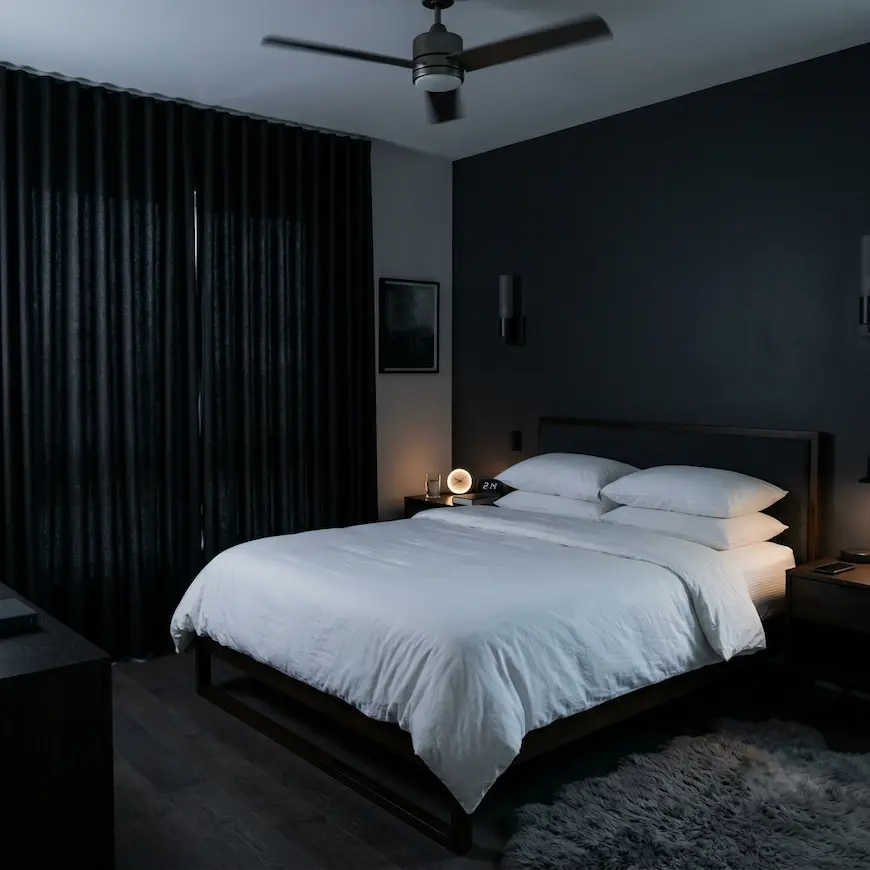
Blackout curtains; cover or remove LED standby lights
Sound
Steady ambient noise or silence
White noise machine in a noise-variable space
Humidity
40–60% relative humidity
Dehumidifier in summer; humidifier in dry climates
Screens
No blue light 2 hours before bed
Blue-light glasses or a screens-off rule
Pre-bed warming
Warm bath 90 min before sleep
10-minute bath near 104°F speeds core cooling
Bedding
Low thermal resistance
Cotton or bamboo; 1–2 light layers
The wind-down runs over the last two hours. Two hours out, dim the lights and end screen use (or switch on a blue-light filter). At 90 minutes, take the warm bath or shower and let the thermostat start dropping toward your target. At an hour out, stop eating, since digestion raises core temperature, and start lowering stimulation. At 30 minutes, do the same small anchor habit each night: a paper book, light stretching, a few minutes of slow breathing. At bedtime the room should already be at target, dark, and quiet or masked. Done consistently, this is what locks in the best temperature for sleep night after night instead of leaving it to chance.
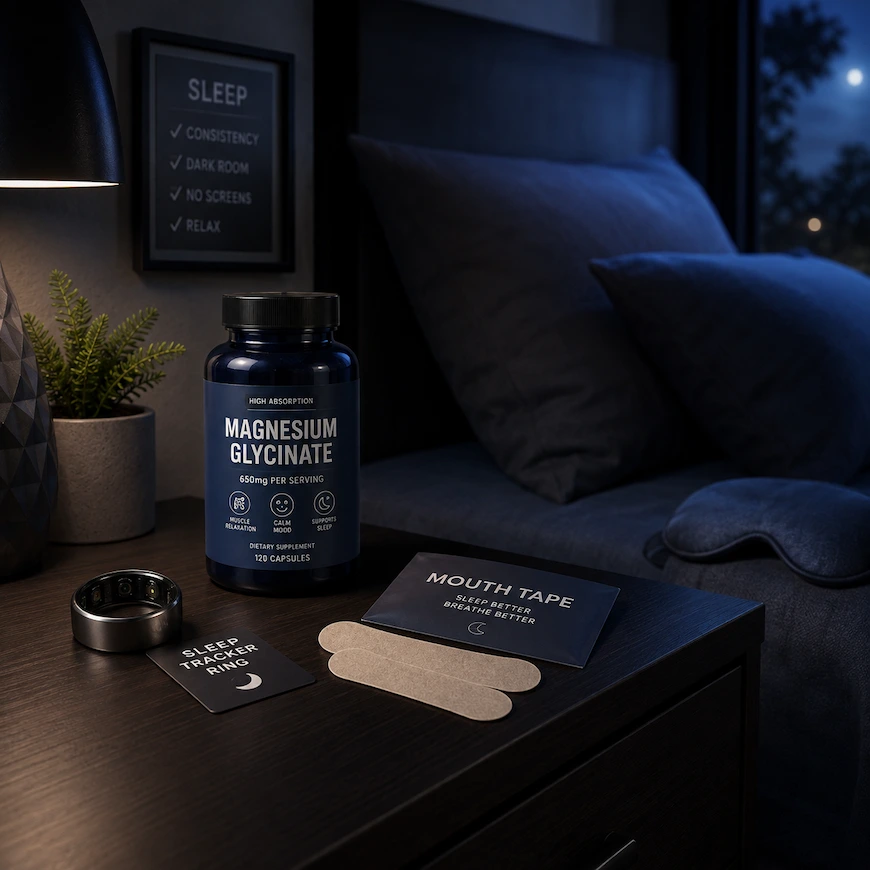
For the magnesium side of sleep support, magnesium glycinate in particular backs up GABA signaling and shortens sleep onset, see magnesium article . And for cutting the screen exposure that undermines all of this, see our digital detox guide at How to Do a Digital Detox: A Step-by-Step Guide.
Nest Learning Thermostat (3rd Generation) , programs your home to cool automatically before sleep time: [Check on Amazon ]
Most research marks 72°F (22.2°C) as the point where measurable decline starts for average adults. Above 77°F (25°C) the impairment is clinically significant; Baniassadi et al. (2023, PMID 37474050) documented dose-dependent efficiency loss past that threshold in a large cohort. Sleeping at 80°F and up produces fragmented sleep, REM suppression, and next-day cognitive impairment on par with losing 60–90 minutes of sleep.
Yes. REM is the most heat-sensitive stage because thermoregulation switches off during it and body temperature drifts toward the room. In a warm room that drift raises core temperature, fires the arousal systems, and shortens REM episodes. Chronically short REM shows up as worse emotional regulation, weaker memory consolidation, and more anxiety, which is why people in warm rooms often report poor dream recall and a short fuse the next day.
Inside the optimal band (60–67°F), cooler generally means better slow-wave sleep and steadier REM. Below 60°F, cold stress starts to fragment sleep through shivering and vasoconstriction. The cold end of the range (60–62°F) is the best temperature for sleep if athletic recovery is the goal, since it maximizes growth hormone release during deep sleep. Below 58°F without enough insulation, quality starts to fall for most adults.
Yes, and the pairing is often ideal. A cool room (62–65°F) with a weighted blanket settles the usual conflict for hot sleepers who still want deep-pressure bedding: the cool air manages core temperature while the blanket gives proprioceptive pressure without insulating like thick down. Choose one with a breathable cotton or bamboo cover made for thermal neutrality.
If the room is too warm, lowering it is the direct fix, but for sweating that happens despite a cool room, try moisture-wicking bedding (bamboo or Tencel over cotton or synthetic), a mattress cooling pad that circulates cool water through the surface, and low humidity, since above 60% humidity worsens sweating even at cool temperatures. If it persists, rule out medical causes (infections, medications, metabolic conditions) with a healthcare provider.
Yes. Older adults thermoregulate less efficiently, responding to thermal stress more slowly than younger people, so they are more vulnerable to a warm room and lose more sleep at temperatures younger adults shrug off. Baniassadi et al. 2023 found the temperature-sleep link strongest in the oldest participants. In practice, the best temperature for sleep for adults over 65 tends to sit at the cool end of the range (60–63°F), while younger adults handle 65–67°F more comfortably.
This article is for general information and is not a substitute for personalized medical advice. Talk to a qualified healthcare provider about persistent sleep problems, night sweats, or any concern involving infants, pregnancy, or a chronic condition.
Mimo Karam is the founder and writer at LifestyleMine. She writes about daily habits, nutrition, sleep, and emotional wellness, turning research into practical advice for people who want to live healthier without making it complicated.