✦
THE LIFESTYLEMINE NEWSLETTER
Simple wellness tips, healthy recipes, and
everyday inspiration delivered to your inbox.
Your Email Address
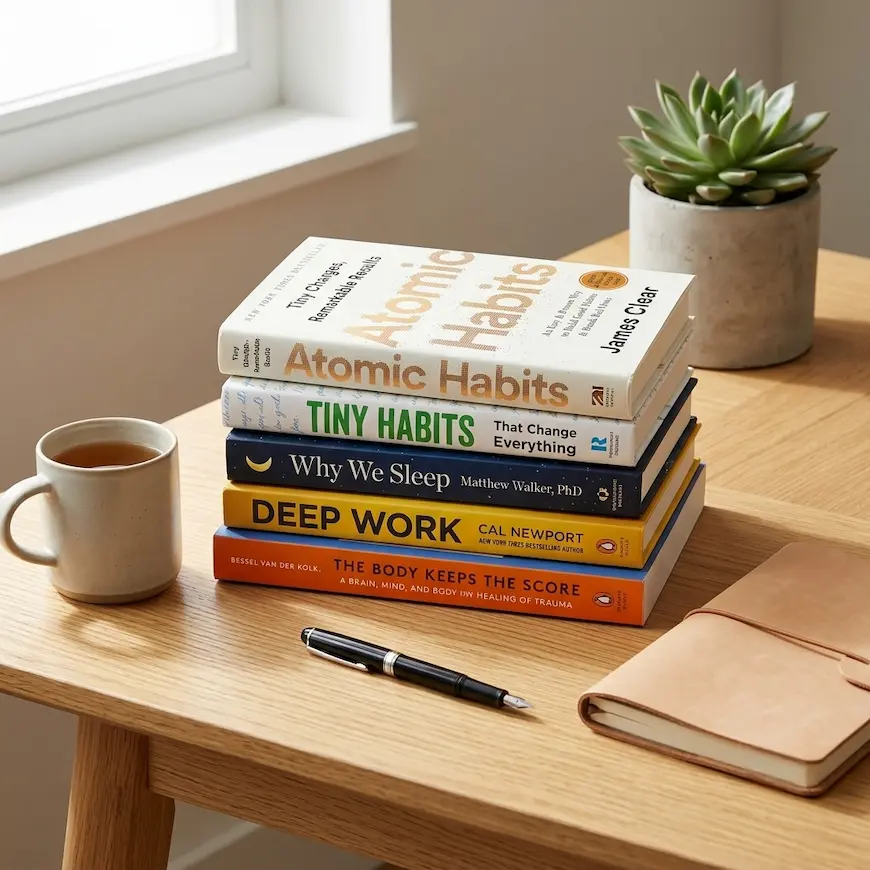
The Four Laws of Behavior Change are the book’s engine:
Make it obvious. Design your environment so the cue is hard to miss (running shoes by the door).Make it attractive. Pair the new behavior with something you already want (audiobooks only during walks).Make it easy. Cut friction until starting takes under two minutes.Make it satisfying. Give yourself an immediate reward the moment the behavior is done.
The two-minute rule is where it usually clicks for people. You do not run five miles, you put on your running shoes. That is the habit. The run tends to follow once the hard part, getting started, is out of the way.
The identity-based model is the book’s most grounded idea. Instead of chasing outcomes (“I want to lose weight”), Clear pushes identity targets (“I am someone who moves every day”). Gardner, Lally, and Wardle (2012, British Journal of General Practice ) found that consistency of self-concept and context is what drives automaticity in health settings, not bursts of motivation. Of all the best books on habits, this is the one that hands you a complete operating system.
[Get the Book]: Atomic Habits by James Clear
Full summary at Atomic Habits: How Tiny Changes Lead to Remarkable Results .
Quick Answer: Tiny Habits, by Stanford behavioral scientist BJ Fogg, argues that motivation swings around too much to be the engine of lasting change. The method is to anchor a tiny new behavior to something you already do every day, then celebrate the moment you finish. The celebration, not the repetition, is what wires the pathway.
If Atomic Habits is the most systematic of the best books on habits, Tiny Habits is the most forgiving. BJ Fogg runs the Behavior Design Lab at Stanford and has spent three decades studying what changes human behavior. His model comes down to a formula: B = MAP. Behavior happens when Motivation, Ability, and a Prompt line up at the same moment.
Most of the best books on habits try to crank up motivation, which rises and falls with your mood and your day. Fogg goes after the ability side instead. If the behavior is small enough, you can do it even when motivation is near zero.
The formula: After I [ANCHOR MOMENT], I will [TINY BEHAVIOR].
“After I pour my morning coffee, I will do two push-ups.”
“After I sit at my desk, I will open my journal and write one sentence.”
“After I brush my teeth, I will floss one tooth.”
The celebration piece is the most counterintuitive part of the book, and the most important. Fogg argues that the good feeling right after a behavior is what wires the circuit, not the raw number of reps. It fits what we know about dopamine: the signal that tags a behavior as worth repeating fires on positive emotion, not on effort or duration.
Tiny Habits and Atomic Habits solve different problems. Clear gives you the architecture, Fogg gives you the ignition. Read both.
Full review at Tiny Habits by BJ Fogg: How Small Actions Create Big Changes .
[Get the Book]: Tiny Habits by BJ Fogg
Quick Answer: The Power of Habit by Charles Duhigg shows that every habit runs as a three-part loop: cue, routine, reward. The key finding is that habits are never deleted from the brain, only overwritten. You cannot erase a habit. You can only swap in a new routine while keeping the same cue and reward.
The Power of Habit is the title that put habits on the map, and it still belongs on any shortlist of the best books on habits. Before Clear and Fogg reshaped the conversation, Duhigg wrote the book that introduced most people to the science underneath habits. Published in 2012 and drawing on MIT research into the basal ganglia, it set up the diagnostic framework that nearly every one of the best books on habits has built on since.
The idea of the keystone habit is the book’s most durable contribution. Some habits set off a chain reaction across your whole life. Exercise is the best-documented one. People who start exercising regularly, without being told to change anything else, tend to eat better, drink less, handle money more carefully, and sleep more steadily. The driver is not willpower but neurological cross-reinforcement.
The Golden Rule of Habit Change is easy to state: keep the cue, keep the reward, change only the routine. Before you try to break a behavior, work out what triggers it (stress, boredom, a certain time of day) and what reward it pays out (relief, stimulation, a bit of connection). Then drop a new routine into that same cue-and-reward slot. Skip that step and most attempts just trade one routine for another without ever asking why the original loop ran in the first place.
[Get the Book]: The Power of Habit by Charles Duhigg
Quick Answer: Deep Work by Cal Newport argues that sustained, distraction-free focus is the most valuable skill in the modern economy, and that you have to train it like any other habit. Without it, a well-planned morning routine and a tidy evening ritual do not add up to much, because the hours in between stay fragmented.
Deep Work is not a habit book in the usual sense, but it earns its place among the best books on habits anyway. You can nail your morning and evening habits and still get almost nothing done if the middle of the day gets eaten by reactive email, social media checks, and constant switching between tasks. Newport’s book fills in the gap that most of the best books on habits leave open: habits only matter if you protect the mental space to act on them.
The Deep Work protocol:
Schedule a 90 to 120 minute focus block at the same time each day, with no interruptions.
Batch shallow tasks (email, scheduling, social media) into one daily window instead of spreading them out.
Treat social media as optional if it does not directly serve your work. Newport himself keeps no accounts.
Newport is a computer science professor at Georgetown, and his point is not anti-technology. It is about the economics of attention: focused time compounds. Someone working in 90-minute uninterrupted blocks often gets more done in one session than someone scattering 20-minute fragments across a whole day.
If your habit problems really come down to “I can’t seem to follow through on anything,” this is the book that goes after the underlying cause.
[Get the Book]: Deep Work by Cal Newport
Quick Answer: In Why We Sleep, UC Berkeley neuroscientist Matthew Walker makes the case that sleep is the single biggest lever for physical health, mental health, weight, immune function, and cognitive performance. No habit you build fully makes up for chronic sleep loss, which is why Walker says fixing sleep has to come first.
If you only read one of the best books on habits for the underlying biology, make it this one. Every habit on this list depends on a working brain, and sleep is where habits get consolidated. Walker’s research shows that memory consolidation, the process that turns newly practiced behaviors into automatic ones, happens mostly during NREM slow-wave sleep and REM cycles. You rebuild your neural wiring every night.
The numbers Walker lays out are stark. He reports that adults who sleep fewer than seven hours a night show meaningfully higher cancer risk, and that six hours a night for ten nights running leaves you as impaired as a full 24 hours without sleep. The unsettling part: most people in that state rate themselves as “fine,” because the missing sleep also takes their ability to judge how impaired they are.
Of all the best books on habits and wellness here, this is the highest-leverage read if you have tried every system and still feel wiped out. The other seven assume you have a working cognitive platform to build on. Walker is the one who builds that platform.
The link between sleep quality and chronic inflammation is covered at Anti-Inflammatory Foods , and Walker’s work lines up closely with the anti-inflammatory diet research.
[Get the Book]: Why We Sleep by Matthew Walker
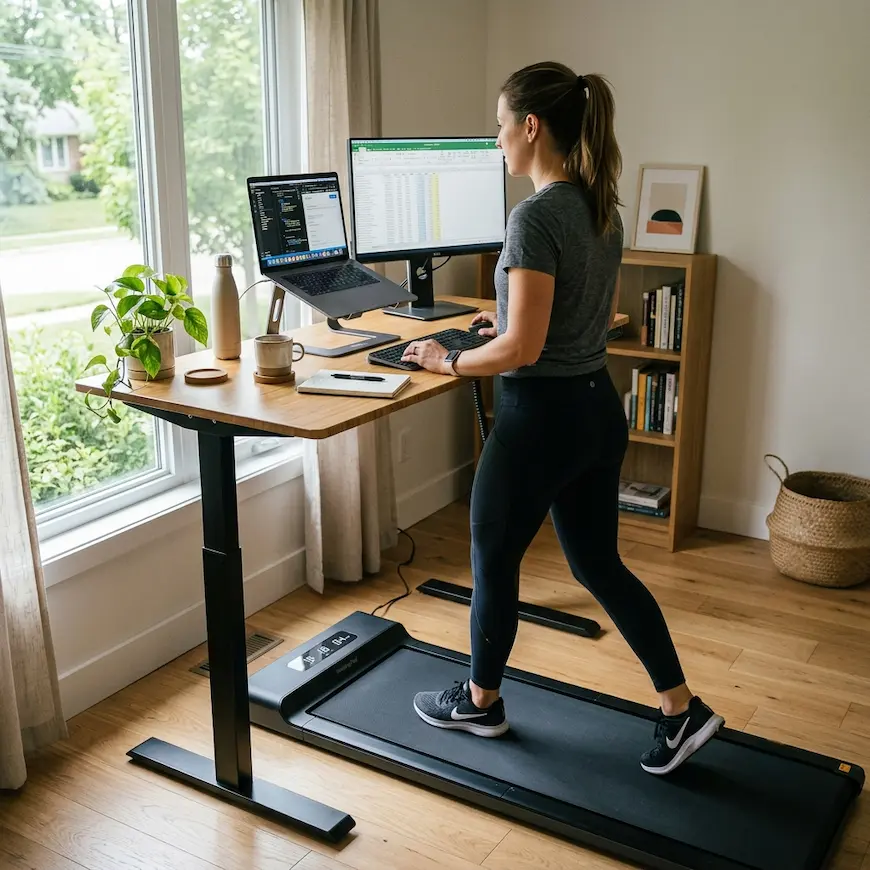
Quick Answer: Spark, by Harvard psychiatrist Dr. John Ratey, walks through clinical research showing that aerobic exercise grows new neurons, sharpens executive function, and treats anxiety and depression about as well as medication in mild to moderate cases. The point is that movement is less about your body than about building the brain that makes every other habit possible.
Spark is the most clinically grounded of the best books on habits when the subject turns to mood. John Ratey teaches psychiatry at Harvard Medical School, and his book spells out in neurological detail what happens when you exercise: BDNF (brain-derived neurotrophic factor) goes up. BDNF is the protein that lets neurons form new connections. Ratey calls it “Miracle-Gro for the brain.”
The Naperville, Illinois school study is the book’s most striking evidence. The district moved PE to the start of the day, before core subjects. Reading scores went up 17 percent. Math improved sharply. Behavior problems dropped. The academic gains followed the physical ones, because the exercise primed the brain to take in and hold new information.
Blumenthal et al. (1999, Archives of Internal Medicine ) set the clinical baseline. In a 156-person randomized controlled trial, 16 weeks of aerobic exercise matched sertraline (Zoloft) on depression outcomes in adults over 50, with no drug side effects and lower relapse rates at the 10-month follow-up.
Building a steady movement habit is one of the highest-leverage things most people can do for overall wellness, and Spark is one of the best books on habits for understanding why movement changes the brain.
The mood and energy links Ratey covers line up with our piece on Mood-Boosting Food.
[Get the Book]: Spark: The Revolutionary New Science of Exercise and the Brain by John Ratey
Quick Answer: The Body Keeps the Score by Bessel van der Kolk argues that unresolved trauma lodges in deeper, subcortical brain systems and drives automatic behaviors that no habit framework can simply override. It is the book for anyone who has worked every system on this list and still feels stuck in patterns they cannot think their way out of.
This is the title to reach for when the best books on habits have not worked for you. Van der Kolk is a psychiatrist and trauma researcher who spent decades working with veterans, abuse survivors, and patients with PTSD. His central point is that a lot of what people call “bad habits” (binge eating, compulsive phone use, substance use, emotional avoidance) are not really habits at all. They are survival responses, stored below conscious control in brain regions that executive function cannot reach directly.
Every habit formation framework assumes a reasonably regulated nervous system. For most readers, the frameworks work as advertised. For some, chronic nervous-system dysregulation (from adverse childhood experiences, ongoing stress, or unprocessed trauma) is the real reason nothing sticks. When the body’s threat-detection system runs hot at baseline, prefrontal function, which is exactly what deliberate habit change depends on, gets suppressed.
His tools (yoga, EMDR, somatic experiencing, breathwork) are not really alternatives to the books above. For some people they are prerequisites. If you have read your way through the best books on habits and still feel stuck, read this one next to Atomic Habits, especially if you have ever asked yourself, “Why do I keep doing things I’ve consciously decided not to do?”
[Get the Book]: The Body Keeps the Score by Bessel van der Kolk
Quick Answer: Most people finish only a small fraction of the books they buy. A reading habit that actually changes behavior needs a fixed daily slot of at least 20 minutes, one written experiment per chapter, and a specific “when-then” date set within 48 hours of finishing each chapter. Without that, reading about habits quietly becomes a substitute for building them.
Owning the best books on habits does nothing on its own. There is an uncomfortable irony here: reading the best books on habits without doing anything creates its own little loop. The hit of dopamine from learning a new idea scratches the brain’s itch for progress, which quietly lowers the urgency to act. You feel productive without changing a thing.
The reading protocol that turns books into behavior:
Practice
Why it works
Read at the same time daily (morning or commute)
Consistent context is the core mechanism behind automaticity (Lally 2010)
Mark up dense material by hand
Active engagement tends to encode better than passive reading
Write one experiment per chapter
Forces the jump from concept to behavior
At least 20 pages per session
Keeps enough thread to follow the argument
Calendar-block your first experiment
Implementation intentions (Gollwitzer), the “when X, I will Y” format, roughly double follow-through
All eight titles here are under 300 pages. At 20 minutes a day, you finish one every three to four weeks. Work through the best books on habits over about eight months and run one experiment from each. That gives you eight systems compounding at once. That is what lasting change usually looks like. Not a motivational sprint. A long string of small, permanent shifts.
Start with Atomic Habits by James Clear. It is clearly laid out, written for a general audience, and gives you a whole system instead of scattered tips. If finishing books is the hard part, start with Tiny Habits by BJ Fogg instead. It runs under 220 pages, is immediately actionable, and tends to show results within days of using the core method.
The ones on this list are. James Clear leans on behavioral psychology and neuroscience throughout. BJ Fogg holds a PhD from Stanford and runs an active lab. Charles Duhigg built The Power of Habit on MIT research into the basal ganglia. Matthew Walker is a UC Berkeley neuroscientist. John Ratey teaches psychiatry at Harvard Medical School. What to avoid is the kind of book built entirely on personal anecdotes with no citations: inspiring to read, but it won't tell you why anything works.
One. Reading stacks of books while doing nothing is a well known trap: the reward from learning something new can satisfy your sense of progress without any actual change in behavior. Read one chapter of one book, run one experiment, give it 30 days. Then read the next chapter. Doing it in sequence beats piling up ideas in parallel.
Yes, with one tweak. Marking up the page (writing one experiment per chapter) does not carry over to audio. Get around it by pausing after each chapter and dictating a voice note with one specific experiment to try. The more narrative titles here, like The Power of Habit, Spark, and The Body Keeps the Score, are great on audio. The more framework-heavy ones like Atomic Habits are worth re-reading on paper when you go to apply the models.
Atomic Habits handles the morning most directly, through habit stacking and the two-minute rule. For the physiology, why sleep timing and circadian rhythm set your morning energy, Why We Sleep by Matthew Walker is the one to read. Put together, they give you a morning routine grounded in both behavioral design and sleep science.
That environment shapes behavior more than motivation does. Every one of the best books on habits here lands on the same conclusion in its own words: cut friction, design your surroundings, and let repetition do the work. Motivation comes and goes with your mood and your day. A well-built environment is always there. People who build lasting habits don't count on wanting to do them. They just make not doing them a little harder than doing them.
Mimo Karam is the founder and writer at LifestyleMine. She writes about daily habits, nutrition, sleep, and emotional wellness, turning research into practical advice for people who want to live healthier without making it complicated.