✦
THE LIFESTYLEMINE NEWSLETTER
Simple wellness tips, healthy recipes, and
everyday inspiration delivered to your inbox.
Your Email Address
Fast fashion vs. durable clothing. The average American buys 68 garments a year, most worn fewer than 7 times before they’re tossed (Ellen MacArthur Foundation, 2017). A $20 fast-fashion shirt bought 6 times over 3 years costs $120. A $65 durable Oxford shirt worn weekly for 5 years costs $65, and still holds $15-20 in resale value at the end.
Single-use vs. reusables. A daily paper coffee cup runs about $1.50 with the coffee. A reusable travel mug costs $20-30 and pays for itself in 14 to 20 uses. Over a year of daily use, that’s $548 in paper cups against $25 for the reusable, a saving of $523.
Convenience food vs. batch cooking. The average restaurant meal or meal-kit runs $15-22 per person. Home-cooked meals from whole ingredients average $3-5 per person. For a couple cooking four dinners a week at home instead of ordering out, that’s roughly $4,160 a year saved.
The pattern is simple: every unnecessary purchase you skip is both carbon not emitted and money kept.
Quick Answer: The global fashion industry produces 92 million tons of textile waste a year and accounts for an estimated 10% of global carbon emissions. Sustainable fashion doesn’t mean expensive fashion. It means fashion that costs less per wear. Thrifting, capsule wardrobes, and resale platforms cut clothing costs 60-80% while removing most of your individual textile waste.
Sustainable fashion is where sustainable living on a budget gets concrete, and it starts with one number: cost per wear.
A review by Niinimaki et al. in Nature Reviews Earth & Environment (2020 ) laid out the full environmental tab for fast fashion: 79 trillion litres of water a year, large CO2 emissions across the supply chain, and over 92 million tonnes of textile waste. The authors argued that no amount of material innovation fixes this without an actual drop in how much clothing we buy.
Cost per wear changes how you shop:
Item
Purchase Price
Wears Before Disposal
Cost Per Wear
Fast fashion t-shirt
$18
7
$2.57
Mid-range cotton t-shirt
$45
80
$0.56
Premium organic cotton
$75
200+
$0.38
Thrifted button-down
$8
150
$0.05
Secondhand platforms (ThredUp, Poshmark, Facebook Marketplace, local thrift stores) put mid-to-premium garments within reach at 80-90% off retail. A $200 brand-name jacket bought for $22 at a thrift store and worn 150 times costs $0.15 a wear, about the best fashion economics you’ll find at any price.
A few practical moves for sustainable living on a budget:
Shop secondhand first for basics (t-shirts, jeans, button-downs, shoes)
Buy new only for the highest-wear items (underwear, athletic gear, specific shoes) from durable brands
Wash in cold water (about 90% of laundry energy goes to heating water) and air-dry when you can
Sell or donate clothing before it wears out, since thrifted items hold resale value
Quick Answer: The best return on eco-friendly home products comes from LED lighting (payback about 6 months, saves $225/year per DOE), smart power strips (kill phantom load, save $100-150/year), low-flow showerheads (payback 2-3 months), and reusable products like beeswax wraps and silicone bags (payback 3-5 months, cut $200-400/year in disposables).
Sustainable living on a budget means judging energy-saving swaps by payback period, not sticker price.
LED lighting. The U.S. Department of Energy estimates that swapping incandescent bulbs for LEDs saves about $225 a year in a typical home. LEDs use 75% less energy and last 15-25 times longer. A 4-pack costs $8-12 and replaces bulbs that would otherwise cost $20-40 a year to keep buying. Full-home LED payback: under 6 months.
Smart plugs and power strips. Electronics in standby mode (TVs, gaming consoles, chargers, kitchen gear) draw “phantom load,” estimated at 10-15% of total home electricity use. Smart plugs cut that automatically, saving $100-200 a year.
Low-flow showerhead. A standard showerhead uses 2.5 gallons a minute. WaterSense-certified models use 1.5-2.0 GPM with no real drop in pressure. For a 10-minute daily shower, that saves 1,825-3,650 gallons a year. Payback on a $25-30 showerhead: 2-3 months on water and water-heating bills combined.
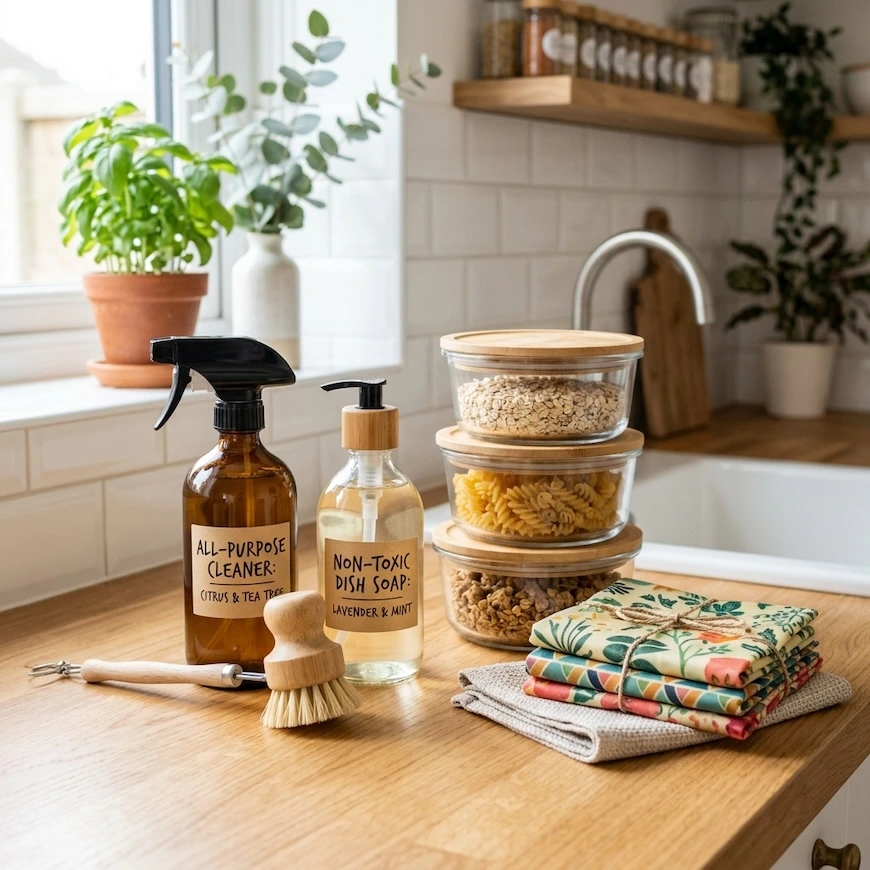
Reusable kitchen products:
Disposable
Annual Cost
Reusable Replacement
One-Time Cost
Payback
Plastic wrap
$45-60
Beeswax wraps (3-pack)
$18-22
4-6 months
Zip-lock bags (family use)
$80-120
Silicone reusable bags
$25-35
3-5 months
Paper towels
$100-150
Unpaper towels (24-pack)
$15-20
1-2 months
Plastic produce bags
$20-30
Mesh produce bags
$10-15
4-6 months
Quick Answer: A capsule wardrobe is a curated set of 30-40 versatile garments that cover about 90% of daily outfit needs. It saves money by killing impulse fashion buys (the average American spends $1,800+/year on clothing), cuts laundry, and frees up $150-300 in resale value from clothes you clear out. Built secondhand, a capsule runs $150-300 total; the same items bought retail cost $600-1,000.
The capsule wardrobe is having a real revival, and not for fashion reasons. The drivers are money and waste, which is exactly the logic of sustainable living on a budget. A standard American wardrobe holds 120-plus garments; a capsule holds 30-40. That reduction cuts roughly $600-1,000 a year in impulse fashion spending.
A functional 30-item capsule core:
5-7 tops (neutral, versatile)
3-4 bottoms (1 formal, 2 casual, 1 athletic)
2-3 dresses or suits (depending on your life)
2 outerwear pieces (1 casual, 1 formal or weatherproof)
3-4 pairs of shoes (1 dress, 1 casual sneaker, 1 athletic, 1 boot or sandal)
5-7 undergarments and workout pieces
2-3 accessories (belt, bag, watch or jewelry)
A sustainable-living-on-a-budget approach to building one:
Audit first. Pull everything unworn in 12 months and sell or donate it.
Find the gaps in your 30-item list.
Fill gaps secondhand first (ThredUp, local thrift) for basics.
Buy new only for the highest-wear items (athletic shoes, undergarments).
Apply a 48-hour rule before any fashion purchase.
Selling cleared-out clothes before you build the capsule funds the switch. ThredUp estimates the average closet cleanout returns $150-300 in resale credit. Local consignment shops and Poshmark can return 40-60% of original price for name-brand items in good shape.
Quick Answer: A zero-waste kitchen cuts food waste (worth about $1,500/year for the average family), removes single-use plastic costs ($200-400/year), and trims grocery bills through bulk buying and meal planning. The five highest-impact swaps: meal planning, buying staples in bulk, composting at home, reusable containers, and buying imperfect produce.
Food waste is one of the most expensive environmental problems in the average home. The USDA estimates that the average American family throws away 30-40% of the food it buys, around $1,500 a year in discarded groceries. A zero-waste kitchen tackles this head-on, and it’s a cornerstone of sustainable living on a budget because most of it costs nothing.
Meal planning. Spend 20 minutes a week deciding on 5-7 dinners. Write a shopping list for exactly those meals plus staples. Meal planners cut grocery spending 15-25% and food waste 40%. This one habit recovers $600-900 a year for a family of four.
Bulk staples. Rice, oats, lentils, pasta, flour, dried beans, nuts, and olive oil bought in bulk cost 30-50% less per unit than packaged equivalents. A 25-lb bag of organic rolled oats from a bulk supplier runs $35-45. The same amount in individual 1-lb boxes: $75-90.
Composting at home. Composting turns food scraps into garden amendment worth $20-50 a year in bagged compost, and it keeps methane-producing organic matter out of landfills. A countertop compost bin collects scraps for outdoor composting or municipal pickup.
Root-to-stem cooking. Vegetable scraps (carrot tops, broccoli stems, onion skins, herb stems) make free stock. Stale bread becomes croutons or breadcrumbs. Citrus peels infuse vinegar for cleaning. These habits add $15-25 a month in recovered value.
Imperfect produce. Grocery “imperfect produce” sections and subscription services (Misfits Market, Imperfect Foods) sell cosmetically rejected produce at 30-40% below retail. Taste and nutrition are the same; only looks differ.
Quick Answer: Plant-forward eating is both the most sustainable and the most affordable way to eat. A 2014 study in Nature (Tilman & Clark) found that shifting from meat-heavy to plant-based diets could cut food-related greenhouse gas emissions sharply while improving health. Swapping beef for legumes saves $3-6 a meal, which adds up to $780-1,300 a year for a household cooking three such dinners a week.
At the grocery store, sustainable living on a budget follows one rule: plants are cheaper than animals, and seasonal plants are cheaper than imported ones.
The Tilman and Clark study in Nature (2014, PMID 25383533 ) analysed dietary patterns across more than 100 countries and found that plant-rich diets (Mediterranean, pescatarian, vegetarian) cut environmental impact by 30-70% versus Western meat-heavy diets, while also lowering chronic disease risk and per-meal cost.
Cost of protein per 100g across common sources:
Protein Source
Cost per 100g protein
Environmental Impact
Beef (ground)
$3.60-5.20
Very high (land, water, methane)
Chicken breast
$1.80-2.40
Moderate
Canned tuna
$0.90-1.20
Moderate
Eggs
$0.60-0.80
Low-moderate
Greek yogurt
$1.20-1.60
Low-moderate
Tofu
$0.50-0.70
Very low
Lentils
$0.25-0.40
Very low
Chickpeas
$0.20-0.35
Very low
Sustainable living on a budget doesn’t require going fully vegetarian. Replacing 3 beef dinners a week with lentils, chickpeas, or eggs saves roughly $15-25 a week, or $780-1,300 a year, while cutting the carbon footprint of those meals by 80-90%.
A seasonal buying guide:
July to August: tomatoes, corn, zucchini, peaches, berries (peak value, lowest price)
September to October: squash, apples, root vegetables, cruciferous greens
November to March: citrus, stored root vegetables, dried legumes (buy in bulk)
April to June: asparagus, peas, leafy greens, strawberries
Buying seasonal and freezing the surplus stretches low-cost nutrition across the year.
Quick Answer: Minimalist living is the rare environmental strategy that also directly grows net worth. Research by Van Boven and Gilovich (2003) found that experiential purchases tend to make people happier over the long run than material goods, which means spending less on objects and more on experiences is both more sustainable and more satisfying.
The useful version of minimalism is financial: every object you don’t buy is money kept, storage avoided, and disposal cost dodged.
Minimalism as a money strategy, and as sustainable living on a budget:
The 30-day rule. For any non-essential purchase over $30, wait 30 days before buying. Research on impulse spending consistently finds that 70-80% of impulse buys never happen after a waiting period, because the urge fades. This habit alone saves the average consumer $200-400 a month.
One in, one out. For every new item that enters the home (clothing, kitchen tool, book, gadget), one item leaves (donate, sell, recycle). That builds natural friction against accumulation and keeps your space in order without dedicated decluttering sessions.
Experiences over objects. Van Boven and Gilovich’s research in the Journal of Personality and Social Psychology (2003, PMID 14674824 ) found that people reported higher satisfaction from experiential purchases (travel, concerts, classes, meals) than from material ones of the same cost, and that the gap widened over time as the experience became part of who they are while the object lost value.
There’s an environmental payoff that makes minimalism a pillar of sustainable living on a budget. Cutting your consumption by 30%, which the habits above make achievable, removes roughly 3-4 tons of CO2-equivalent a year from manufacturing, shipping, and disposal. That’s more than dropping a daily car commute.
Quick Answer: Transportation accounts for 29% of U.S. greenhouse gas emissions and roughly $10,000-12,000/year in average household spending. Cutting car trips 20% through biking, walking, transit, and trip-chaining saves $2,000-4,000/year while lowering personal carbon emissions, the highest-impact individual environmental action most people can realistically take.
Transportation is where sustainable living on a budget produces the biggest single annual saving. Recent AAA estimates put average car ownership cost around $12,000 a year once you add up depreciation, insurance, fuel, maintenance, and financing. Every mile you don’t drive saves roughly $0.67 in direct costs.
Practical green transportation moves for sustainable living on a budget:
Bike commuting. If you’re within 5 miles of work or regular stops, a bike can replace 2-3 car trips a week. A solid commuter bike ($300-500) pays back against car costs in under a month of replaced driving. Three bike-commute days a week (10-mile round trip) saves roughly $3,500 a year in operating costs and parking.
Trip chaining. Combining errands into one trip (grocery, pharmacy, post office) instead of separate runs cuts fuel use 30-40% with no sacrifice.
Car-sharing vs. a second car. For households that only occasionally need a second vehicle, car-share services (Zipcar, Turo) run $15-30 an hour including insurance and fuel. A second car costs roughly $6,000-8,000 a year in total ownership. Moving secondary trips to car-share reliably saves $3,000-5,000 a year.
EV economics when a car is necessary. EVs cost more upfront but run on roughly 60% lower fuel and maintenance costs, saving the average owner $1,500-2,500 a year in fuel versus a comparable gas car. One thing to note for 2026: the federal EV purchase tax credit (up to $7,500) ended for vehicles acquired after September 30, 2025 under the One Big Beautiful Bill Act, so it’s no longer part of the math for new buyers. Many states, utilities, and local programs still offer their own EV incentives worth checking.
E-bikes for urban households. An e-bike ($800-1,200 one-time) replaces most car trips under 10 miles. E-bikes cost about $0.01-0.02 a mile to run versus $0.67 for a car. Annual savings for moderate urban use: $1,500-3,500.
Quick Answer: This 30-day plan front-loads the highest-return actions: meal planning in Week 1, a wardrobe audit in Week 2, home energy swaps in Week 3, transportation shifts in Week 4. Most households that finish the sequence cut monthly spending by $200-450 and personal carbon emissions by 10-15% within 30 days, with no premium eco-products needed.
This sustainable living on a budget plan is ordered by return: highest savings and lowest difficulty first.
Week 1: Kitchen and Food (estimated savings: $80-150/month)
Day 1-2: Meal plan for the week; shop from a list only
Day 3: Use up every food item near its expiration date (a zero food waste day)
Day 4: Research bulk options for your 5 most-bought staples
Day 5: Replace one beef or lamb dinner with lentils, chickpeas, or eggs
Day 6: Set up a countertop compost bin
Day 7: Cancel any unused grocery delivery subscriptions
Week 2: Wardrobe Audit (estimated one-time recovery: $150-400)
Day 8-9: Pull everything unworn in 12 months; photograph and list it online (Poshmark, ThredUp)
Day 10: Identify the 5 items you wear 80% of the time; this is your capsule core
Day 11-12: Find your gaps; browse secondhand before considering retail
Day 13: Commit to the 30-day waiting rule for all non-essential fashion
Day 14: Repair one item instead of replacing it (loose button, hem, zipper)
Week 3: Home Energy and Products (estimated savings: $40-90/month)
Day 15: Replace your top 5 most-used bulbs with LEDs
Day 16: Plug phantom-load devices into smart plugs (TV, gaming setup, kitchen gear)
Day 17: Swap paper towels for unpaper towels in the kitchen
Day 18: Switch laundry to the cold-water setting (saves about 90% of laundry energy)
Day 19: Air-dry one load of laundry a week
Day 20: Replace plastic wrap with beeswax wraps
Day 21: Set the thermostat 2 degrees warmer in summer or cooler in winter
Week 4: Transportation and Habits (estimated savings: $80-200/month)
Day 22: Work out your actual monthly car operating cost
Day 23: Find 2-3 regular trips you could walk, bike, or take transit for
Day 24: Combine all your errands into one trip this week (trip chain)
Day 25: Check car-share pricing in your area if you own a second car
Day 26: Unsubscribe from 5 retail marketing emails
Day 27: Delete 2 shopping apps from your phone’s home screen
Day 28: Declutter one drawer or shelf with the one-in, one-out rule
Day 29: Add up your estimated monthly savings from all four weeks
Day 30: Pick the one change with the highest return and commit to it for good
For the mindset shift that makes these changes feel automatic rather than effortful, see Atomic Habits: How Tiny Changes Lead to Remarkable Results
Sustainability is about cutting environmental impact through material choices, energy use, and consumption habits. Minimalism is about reducing excess and finding "enough" as a mental and financial practice. They overlap a lot: both reject overconsumption, both favour quality over quantity, and both lead to lower spending. The difference is motive. Sustainability is driven by ecological concern; minimalism by simplicity and focus. Pursue either in the name of sustainable living on a budget and you tend to get both.
For most surfaces, DIY cleaners (white vinegar, baking soda, castile soap, a little essential oil) beat commercial eco-friendly brands on cost and match them on results. A 1-gallon jug of white vinegar ($4-5) cleans glass, surfaces, and fabrics for months. The commercial eco-friendly market charges $4-8 a bottle for diluted versions of the same ingredients you can buy in bulk for pennies. For sustainable living on a budget, making your own is the cheapest option by a wide margin.
For sustainable living on a budget, most plastic reduction comes from behaviour, not products. Bringing your own bags, containers, and water bottle removes most single-use plastic at no marginal cost after the first purchase. The disposables worth replacing first: plastic wrap (use a plate over a bowl), plastic bags (silicone or reusable zip bags), plastic water bottles (stainless steel), and plastic produce bags (mesh). Combined one-time cost: under $60; annual savings: $200-300.
Use the EWG Dirty Dozen and Clean Fifteen lists as a guide. The Dirty Dozen (strawberries, spinach, kale, peaches, pears, grapes, bell peppers, cherries, blueberries, green beans, apples, tomatoes) carry the highest pesticide residues and are worth buying organic when the budget allows. The Clean Fifteen (avocados, sweet corn, pineapple, onions, papaya, asparagus, frozen peas, honeydew, kiwi, cabbage, mushrooms, mangoes, sweet potatoes, watermelon, carrots) carry low residue risk conventionally. Buying organic for only the Dirty Dozen cuts your organic premium 60-70%.
Food scraps in landfills break down without oxygen and release methane, a greenhouse gas roughly 84 times more potent than CO2 over a 20-year window. Home composting sends scraps to aerobic decomposition instead, which produces CO2 and water rather than methane, and it makes nutrient-rich amendment for your soil. The EPA counts composting food and yard waste among the most impactful household waste-reduction actions. Finished compost also replaces bagged fertiliser ($20-50/year) and helps soil hold water, which cuts irrigation.
Three high-impact, low-friction entry points to sustainable living on a budget: (1) Meal plan to cut food waste, a 20-minute weekly habit worth $600-1,500 a year. (2) Switch all high-use bulbs to LED, a 30-minute task saving $225 a year per DOE. (3) Adopt the 30-day waiting rule for non-essential purchases over $30, which kills 70-80% of impulse buying with no real effort after the first week. None of these need new products or premium spending, and they produce the fastest measurable savings of any sustainability action.
The dollar figures here are estimates drawn from public sources (DOE, USDA, AAA, EPA) and will vary by household, region, and prices. They’re general information, not financial advice.
Mimo Karam is the founder and writer at LifestyleMine. She writes about daily habits, nutrition, sleep, and emotional wellness, turning research into practical advice for people who want to live healthier without making it complicated.