✦
THE LIFESTYLEMINE NEWSLETTER
Simple wellness tips, healthy recipes, and
everyday inspiration delivered to your inbox.
Your Email Address
Quick Answer: Hedonic adaptation is the process by which things that once gave you pleasure go invisible through repetition. The good news is that it reverses. Noticing novelty inside familiar things, the kind of active attention Harvard psychologist Ellen Langer built her career studying, is what brings ordinary moments back into focus.
There is a specific reason you stopped noticing your own life.
It is called hedonic adaptation, and it is one of the most well-documented findings in positive psychology. When something pleasant is new, it gets your full attention: the first morning in a new apartment, the first cup of really good coffee, the first week of a new job. Then repetition kicks in, the brain files the thing as known, and your attention drifts to whatever is new or threatening instead.
Your daily life did not get less beautiful. Your attention just stopped landing there.
Ellen Langer, a Harvard psychologist who spent her career on the difference between mindless and mindful processing, has shown how much changes when you treat familiar things as variable rather than fixed. The coffee might taste a little different today than yesterday. The light through your window shifts by the minute. Your commute passes different things depending on what you look at. This is not imagination. It is accurate perception of novelty that is always there and usually ignored.
The reason this matters is that the content of your life is already in front of you. The problem is almost never a shortage of things worth noticing. It is the automatic quality of your attention, the way it skips past the present toward the next task or the background hum of your phone.
Romanticizing your life is, underneath everything, the practice of interrupting that autopilot and choosing to actually be where you are. That interruption is the core of how to romanticize your life.
Quick Answer: The morning is the best time to practice this, because nothing has gone wrong yet. The practice: before you pick up your phone, give one minute of full attention to something already in the room. The light, the quiet, the warmth of the bed, the smell of coffee. One minute of real attention before the day starts sets a different register for everything that follows.
Romanticizing your morning is not about waking at 5am or running a two-hour routine. It is about the quality of attention in the first few minutes you are awake, before the day takes over.
The phone is the obstacle. Most people grab it within minutes of waking, sometimes within seconds, and that single act pulls attention straight into the external, reactive, social mode that is the opposite of savoring. You are not in your own morning anymore. You are in other people’s mornings, other people’s opinions, other people’s content.
What I started doing instead: the first thing I reach for is the coffee, not the phone. This sounds small. The gap it opens is not. Between waking and picking up my phone, there is now a stretch of ten to thirty minutes where I am only in the room I am actually in. I notice the specific quality of morning light in different seasons. I notice that the coffee smells different depending on the beans. I notice when I am cold and when I am not, which sounds absurdly basic but is exactly the kind of thing you stop registering when you are scrolling before your eyes are fully open.
You do not have to change your morning to do this. This is how to romanticize your life at the one hour when it is easiest, first thing, before the noise. You have to change where your attention goes inside the morning you already have. One approach that works: before the phone, name three things you can see, hear, or smell right now. Not as a gratitude exercise. Just as an attention exercise. Where are you, actually? That question is most of how to romanticize your life.
Building a morning structure that leaves room for this gives the attention somewhere to land. The morning routine guide covers the habit architecture that makes it sustainable instead of something you do once and forget.
Quick Answer: Ordinary tasks are where most of life actually happens, and they get the least attention. The shift is giving a single task the quality of attention you would give something you chose. Cooking with music that fits the mood. Cleaning as a reset, not a chore. The commute as the one part of the day when you owe nothing to anyone.
This is the section that separates people who like the idea from people who actually do it. It is where how to romanticize your life stops being a vibe and becomes a practice. The morning is romantic by nature: early, quiet, full of possibility. But the commute? The dishes? The grocery store?
Those are where the practice gets tested, and where it pays off most.
Cooking. The shift that works is picking music or a podcast you genuinely look forward to and saving it only for cooking. Listen to your favorite podcast only while making dinner, and you start looking forward to making dinner. The task becomes the delivery system for the thing you wanted. It is a basic piece of behavioral design, and it is one of the most concrete pieces of how to romanticize your life.
Commuting. The commute is one of the most universally dreaded parts of the workday, which makes it a genuinely interesting opportunity. You are in transit. Nobody expects you to produce anything. Your desk and your household cannot both reach you. If you walk any part of it, take your headphones out for one stop and find five things you have never noticed on this route. If you take a train, look out the window instead of down at your phone. The commute is already happening, and learning how to romanticize your life means using time like this instead of waiting it out. What you do with your attention while it happens is the one variable you control.
Cleaning. Reframe it as building the environment you want to live in, not eliminating a problem. The same 20 minutes of tidying feels completely different depending on whether you call it fixing a mess or making a space. Put on music you love. Move fast.
Quick Answer: Slow living and romanticizing your life are the same practice under different names. Both come down to single-tasking: giving one thing your full attention instead of splitting it across several. You cannot savor a meal you eat while scrolling. You cannot enjoy a walk you spend on a call. The practice is simpler than it sounds and harder than it looks.
Slow living as an aesthetic is everywhere online, and like most things that go viral, the look has come almost completely unstuck from the practice.
The actual practice is single-tasking. If you want the most reliable answer to how to romanticize your life, it is this: do one thing at a time with full attention, not because multitasking is impossible, but because when you split your attention you experience none of the things you are doing fully. You get through them. You do not experience them.
Cognitive psychology is consistent on this: the brain does not really multitask, it switches between tasks quickly, and every switch carries a small cost. So doing five things at once does not buy you five experiences. It buys you five partial ones that land as noise rather than meaning.
The practice in two moves:
Eat one meal a day without a screen. That is enough. Not every meal, not a grand overhaul. One meal where you taste the food and notice the texture and temperature without anything competing for your attention.
Take one walk a week with no audio. No podcast, no call, no music. Notice what actually exists on the route you take. In Langer’s work, people asked to look for new things in a familiar setting came away more engaged and in better spirits. The instruction does not even have to be that explicit. Just walking without filling the silence is enough.
Walking without audio is one of the simplest ways to practice how to romanticize your life.
Quick Answer: A routine is something you do automatically to move through time. A ritual is the same action done with deliberate attention. The action is identical. What makes it a ritual is the quality of presence you bring. You already have the actions. The upgrade is free.
This is the shift that makes how to romanticize your life practical rather than abstract.
You already have a morning routine. You already have a way you make coffee, a sequence you move through to get out the door, an evening process that winds you down before sleep. None of that needs to change. What can change is the attention inside those actions.
A routine is: make coffee, drink coffee, go. A ritual is: make coffee with the attention of someone glad this is the first thing they do all day. Same coffee. Different experience.
The distinction comes from anthropology, where ritual is defined less by what is done than by the frame of intention around it. Anthropologists like Victor Turner, who studied ritual for decades, describe it as a way of setting ordinary acts apart, lifting them out of the everyday by the attention and meaning given to them.
A daily ritual does not have to be elaborate to count. The minimum version: pick one thing you do every day and do it once, this week, with your full attention. No phone, no background noise, just the thing and the sensory details of that moment. That single ritual is a working model of how to romanticize your life.
Quick Answer: Your environment is not a backdrop. It actively shapes your attention, your mood, and the quality of experience you have in it. The changes that matter most are light, scent, and texture. Those three register differently than visual tidiness and hit how a room actually feels more directly.
There is a version of this section that turns into a home-decor shopping list, and I want to avoid that completely.
Romanticizing your space is not about buying things. How to romanticize your life at home is the same move as everywhere else, attention rather than acquisition: notice what your space is currently telling your nervous system and make small adjustments toward what you actually want to feel there.
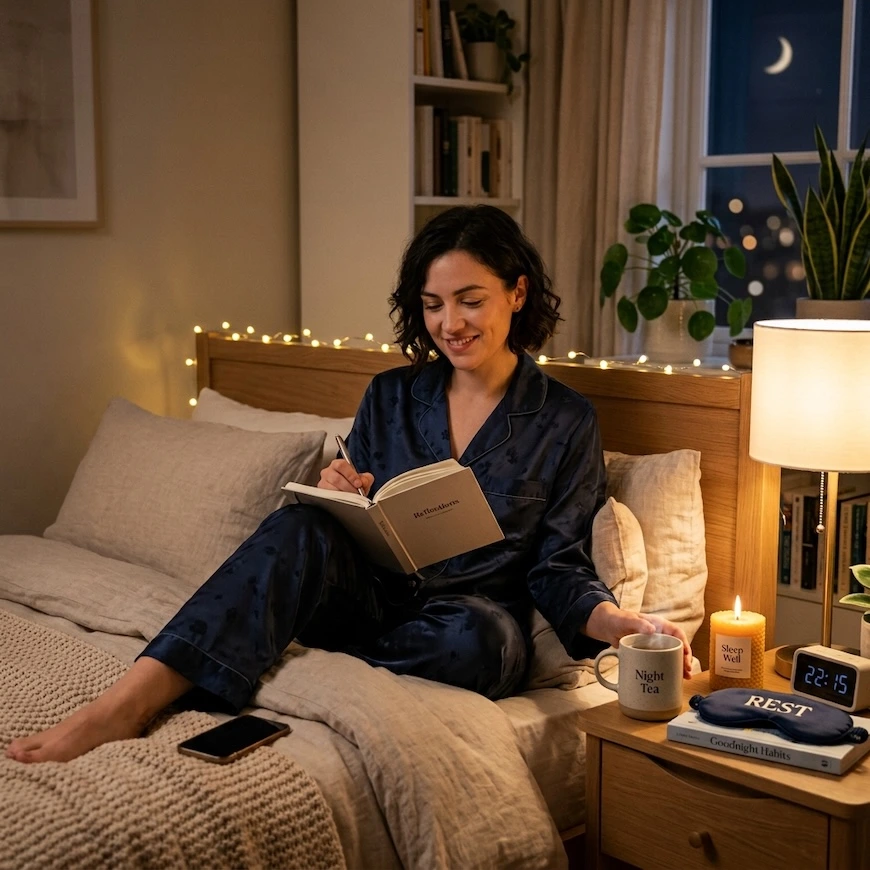
Light is the highest-leverage variable. Overhead lighting at full brightness at 9pm is a signal that the day is not over. Lamps at a low angle make a warmth overhead lighting cannot. The change: kill the main light in the evening and use only lamps or candles. It costs nothing if you already have lamps, and the shift in atmosphere is immediate.
Scent is the sense most tied to memory and emotion, and the most neglected in most homes. One candle burning while you cook changes the register of that hour. This is not about luxury. A single candle you light consistently before a specific activity becomes an anchor for it.
Texture needs the least explanation and gets the least credit. Whatever you reach for first in the morning, your phone, your journal, a soft robe, a warm blanket, sets a physical register for the first minutes of the day. Choosing what sits within reach tells your attention something about what this time is for, which is how to romanticize your life in miniature.
Quick Answer: Intentional living means making deliberate choices about your time, attention, and energy instead of defaulting to whatever takes the least resistance. The first step is noticing how much of a typical day is chosen versus defaulted. Most people are surprised by how much is default. This practice makes the chosen parts visible.
Intentional living is the broader category this all sits inside, and it is wider than any single practice.
What makes a life feel intentional is not a schedule or a productivity system. It is the experience of recognition: these choices feel like mine. This is how I actually want to spend this hour. This is a meal I chose. This is a walk I took because I wanted to, not because I had to.
Most of us live a mix of chosen and defaulted experience, and the ratio shifts without us noticing. The default path is always available and always easier. The default evening is the couch and the streaming service. The default Saturday is errands. The default response to stress is the scroll.
A lot of how to romanticize your life is just noticing when you are on the default path and asking whether you chose it. Not judging the default when you did choose it. Not performing intentionality for an audience. Just asking: is this what I want to be doing right now?
The question creates a small interruption in the automation, and the interruption is enough to change the experience of whatever comes next, whether that is the same default activity done with awareness or a different choice made from real preference.
An intentional life does not require making different choices every time, and neither does how to romanticize your life. It requires knowing you made a choice. The shift from someone who defaults to someone who chooses is slower and more durable than any habit change, and it changes more about daily life than any single trick.
Quick Answer: This 30-day practice runs on one anchor question, asked once a day: what moment today did I actually notice? Not the most memorable or dramatic one. The quietest one. The one you would have walked past if you had not been looking. Writing the answer in two or three sentences a day builds the noticing habit faster than anything else.
Learning how to romanticize your life is a skill, which means it gets better with repetition and worse without it. The framework below is small enough to actually do.
Week 1: noticing only. Ask one question every evening: what was one moment today I moved through without fully experiencing it? Write two or three sentences. No other changes. This builds the attention muscle in a low-stakes, after-the-fact way before you try to use it in real time.
Week 2: morning anchor. Add one phone-free morning practice to your existing setup. It can be as short as ten minutes of coffee without a screen, or as long as your morning allows. The rule is singular: no phone until the anchor activity is done.
Week 3: ritual installation. Pick one daily action and turn it into a ritual. It has to already exist in your day. The conversion needs only added attention and one sensory upgrade: music, a candle, a specific mug, a particular route. Do it the same way, with the same intention, for seven days straight.
Week 4: space and social. Apply the noticing practice to your environment once and to one conversation. Notice three things about a familiar room as if you are seeing it new. In one conversation, give the other person your full attention, no phone on the table, no rehearsing your next line in your head.
By day 30 this is not a transformation. It is a calibration, and it is most of how to romanticize your life: not a new self, a recalibrated attention. You are adjusting where your attention lands by default, and the moments that make a day feel good are more visible than they were before.
Mindfulness is usually a formal practice with structure: a meditation session, a breathing exercise, a body scan. Romanticizing your life is an informal attention practice applied to the content of your day without asking you to sit still or follow a protocol. Both direct attention to the present, and both have documented effects on wellbeing. This practice focuses specifically on positive experiences and sensory pleasure, while mindfulness is non-preferential and includes difficult experiences equally. If you want a low-friction version of how to romanticize your life, this is often easier to start than formal meditation. They are related but distinct, and they work well together.
No. The core practice is a change in attention, not in purchasing. You already have a morning, a commute, tasks, a home, and meals. Knowing how to romanticize your life takes only deliberate attention, not a cart full of candles. The items in this article, candles, a journal, a pour-over, are optional anchors some people find helpful. None are necessary.
Most people notice a change in the quality of specific moments within the first week if they keep up the morning anchor. Most of how to romanticize your life shows up in small moments first; the broader shift, where the default texture of a typical day feels different, usually takes three to four weeks of steady practice. Like any attention skill, it is cumulative and depends on how often you practice the noticing, not how hard you go on any single day.
It will feel forced at first, because you are deliberately steering attention toward something your brain usually handles automatically. The first time you try to notice the quality of your morning light, you may feel self-conscious. Feeling awkward is a normal first stage of learning how to romanticize your life, and it passes. The noticing becomes natural the way any new attention pattern does, through repetition until it stops being an effort. The goal is not to perform romance at your own life. It is to practice until the noticing happens on its own.
Yes, and the research suggests this might be when how to romanticize your life matters most, not least. Savoring small positive moments does not require that life overall is going well. The moments exist on their own: a warm shower, a song you love, a good meal. The case for practicing during difficult stretches is that it builds a reservoir of positive experience the harder parts draw down. You are not in denial about the stressful thing. You are also noticing the coffee.
Related but different. Gratitude practice usually means listing things you are grateful for, often in a general or after-the-fact way. Romanticizing your life is a real-time sensory practice: you notice the experience as it happens, not list it later. Gratitude is cognitive acknowledgment of good things. This is the perceptual experience of them. Both can be part of how to romanticize your life, and they reinforce each other, but they work differently and produce somewhat different effects.
Mimo Karam is the founder and writer at LifestyleMine. She writes about daily habits, nutrition, sleep, and emotional wellness, turning research into practical advice for people who want to live healthier without making it complicated.