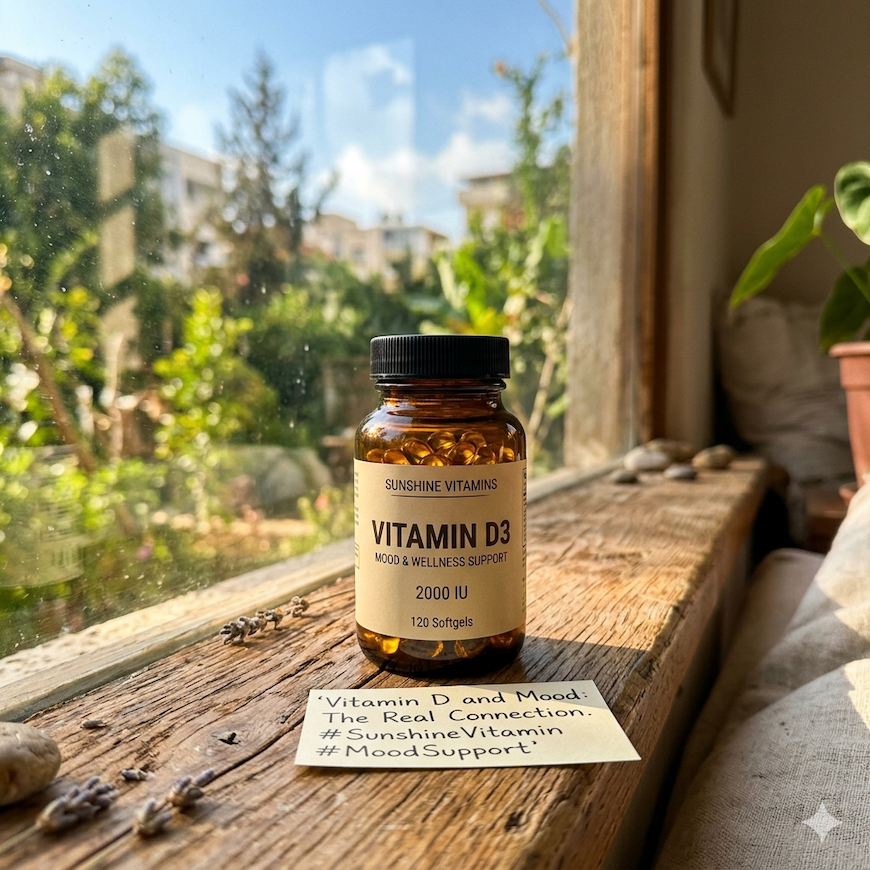
I tested my vitamin D for the first time in 2022. The result came back as 17, and the doctor wrote *severely deficient* in a tone that suggested I’d been ignoring something obvious.
I hadn’t, exactly. I’d been blaming a lot of things on a lot of other things. The flat, heavy mood that had become my permanent November-through-March default. The 3pm brain fog that no amount of coffee fixed. The strange fact that I cried watching a commercial for orange juice the previous week. None of those felt like “vitamin deficiency.” They felt like “I’m just not doing well right now and I should probably go to therapy.”
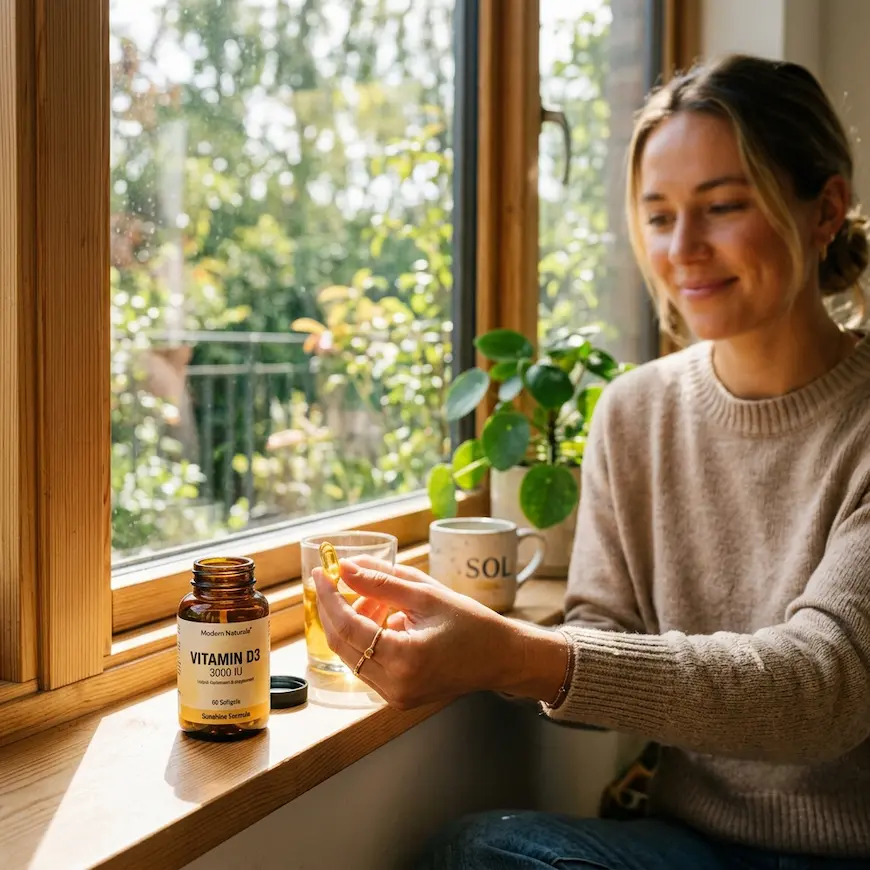
I went to therapy anyway. I also started 4,000 IU of vitamin D daily.
Six weeks later, my mood had quietly shifted in a way I hadn’t expected. Not transformed. Not cured. Just lifted, the way a room feels different when a window finally gets opened. The therapy was helping with the thinking. The vitamin D seemed to be doing something more biological, something I could only describe as “my baseline isn’t underwater anymore.”
This article is about the actual connection between vitamin D and mood, what the research really shows, who’s most likely to be deficient without knowing it, and what to do about it. I want to be honest about both directions: the people for whom vitamin D is genuinely transformative, and the people for whom it’s not going to fix what’s actually wrong.
What Vitamin D Actually Is (Briefly)
Vitamin D isn’t really a vitamin in the traditional sense. It’s a prohormone — a substance your body converts into a hormone that affects almost every system you have. Your skin makes it when sunlight hits it. Your liver and kidneys activate it. Your brain, immune system, and bones all use it.
The “sunshine vitamin” nickname is technically accurate. Without enough sun exposure (or supplementation), levels drop, and they drop further than most people realize. According to the NIH Office of Dietary Supplements, about 25% of adults in the US have vitamin D levels low enough to be considered insufficient. Globally, the number is higher.
Most of those people don’t know. They feel a little off, a little tired, a little flat, and they blame it on stress, age, or being a parent of small children. Some of that is fair. Some of it is vitamin D.
How Vitamin D Affects Mood (The Real Mechanism)
The connection between vitamin D and mood isn’t folklore. It’s biological, and the pathway is genuinely interesting once you see it.
There are vitamin D receptors throughout the brain — including the areas that regulate mood and emotion. [Vitamin D] influences the synthesis of serotonin (the neurotransmitter most associated with mood stability), modulates inflammatory markers in the brain (chronic neuroinflammation is linked to depression), and supports the activity of brain-derived neurotrophic factor (BDNF), which is roughly the fertilizer your brain uses to make and maintain healthy neurons.
When vitamin D is low, all three of those systems quietly underperform. The serotonin pathway has less raw material. Inflammation creeps up. BDNF activity drops. The cumulative effect is what people describe as “flat” — not deep grief, not panic, just a steady gray.
The Harvard Medical School article on vitamin D and mood disorders walks through this in more clinical detail if you want the deeper version. The short version: the connection between vitamin D and mood is real, measurable, and worth taking seriously.
What it isn’t: a guaranteed fix for clinical depression. We’ll get to that distinction in a minute.
Related: How to stop overthinking — what to do when low mood comes with mental looping →
Signs Your Vitamin D Might Be Low (And Affecting Your Mood)
The symptoms of low vitamin D are unspecific, which is exactly why so many people miss them for years. They get blamed on stress, getting older, being a parent, having a difficult job. Some of them are those things. Some of them are quietly vitamin D.
Signs worth recognizing:
Mood-related:
– Persistent low mood, especially through fall and winter
– Flat, “underwater” feeling that doesn’t lift with sleep or weekends
– Mild anxiety that doesn’t have an obvious cause
– More frequent irritability or shorter fuse than usual
– Crying more easily, including at things that wouldn’t normally make you cry
Energy and cognitive:
– Persistent tiredness that doesn’t respond to good sleep
– Brain fog, especially in the afternoon
– Slow recovery from physical effort
– Lower motivation than your baseline
Physical (often-missed):
– Bone or back pain (vitamin D’s main biological role is bone health)
– Muscle weakness or aching
– More frequent colds or sickness
– Hair shedding more than usual
If you have 4–5 of these and they’ve been around for months, the connection between vitamin D and mood is worth investigating. The test is cheap. The supplement is cheap. The reward, if you’re deficient, is significant.
Related: Why you’re always tired — vitamin D is one of the seven lifestyle causes →
Who’s Most at Risk for Low Vitamin D
Some people are far more likely to be vitamin D deficient than others. If you’re in one of these groups, your odds of low levels are very high, and the vitamin D and mood connection is more likely to be playing out in your daily life.
Latitude and lifestyle:
– Anyone living above roughly 37°N latitude (so the entire northern US, all of Canada, all of northern Europe). Above that line, the sun isn’t strong enough to produce meaningful vitamin D from October through March, regardless of how much time you spend outdoors.
– Anyone who works indoors most days (which is most office workers).
– Anyone who wears sunscreen religiously (necessary for skin cancer prevention; comes at a cost for vitamin D).
Skin and age:
– People with darker skin produce less vitamin D per unit of sun exposure. The melanin that protects against UV damage also slows vitamin D synthesis.
– Adults over 50 — skin produces less vitamin D with age, and absorption can decline too.
Body and health:
– People with higher BMI — vitamin D gets stored in fat tissue, so more body fat means less circulating vitamin D available for use.
– People with digestive conditions (IBD, celiac, Crohn’s) that affect fat absorption.
– People on certain medications, including some seizure medications, glucocorticoids, and weight-loss drugs.
If two or more of these apply to you, please don’t guess. Get tested. The connection between low vitamin D and mood in these groups is well-documented and worth taking seriously.
How to Actually Test Your Vitamin D
This is the step most articles skip and is the single most useful thing you can do.
Ask your doctor for a 25-hydroxy vitamin D test (also called 25(OH)D). This is the standard, accurate marker for vitamin D status. It’s covered by most insurance, and even out of pocket it usually costs $30–60.
Here’s how to read the result:
Here’s the data in a clean table:
| Result (ng/mL) | Status |
|---|---|
| Below 20 | Deficient |
| 21–29 | Insufficient |
| 30–50 | Sufficient |
| 50–80 | Optimal (per most integrative practitioners) |
| Above 100 | Too high — risk of toxicity |
Most general practitioners consider anything above 30 ng/mL “fine.” Most functional medicine doctors aim for 50–80 ng/mL, especially when vitamin D and mood are the concern. The research on mood-specific benefits tends to support the higher target — people with levels in the 50s often feel notably better than those in the 30s.
When you get your number, write it down. Test again 3–4 months after starting supplementation. The number is the only honest feedback you have. Symptoms can lie. Bloodwork doesn’t.
How to Raise Your Vitamin D (Three Real Ways)
There are three ways to actually raise vitamin D levels. All three have a place; supplementation is the most reliable.
Sun exposure
Direct sun on bare skin (face, arms, legs) for 10–20 minutes a day during the warmer months can produce significant vitamin D. The catch: this only works above the latitude where the sun is strong enough, which means it only works from roughly April through September in most of the northern hemisphere. The other six months, sun exposure produces essentially zero vitamin D, no matter how clear the sky looks.
If you live somewhere sunny year-round, this is a real option. If you live somewhere with real winters, supplementation is necessary regardless of how much you go outside.
Food
Food is the weakest of the three. Even the best vitamin D food sources (fatty fish, egg yolks, fortified dairy) only provide modest amounts. A serving of salmon delivers around 400–500 IU. Most adults need 1,500–4,000 IU daily to actually move levels.
That said, food matters as a steady baseline contributor. Fatty fish 2–3 times a week, fortified milk or plant milk in your coffee, eggs in your breakfast — these compound over time. They don’t replace supplements if you’re deficient, but they help.
Supplementation (Usually the Answer)
For most people with documented low levels and significant mood impact, vitamin D supplementation is the practical solution. Three things to know:
Form: Take vitamin D3 (cholecalciferol), not D2 (ergocalciferol). D3 is more bioavailable and raises blood levels more effectively.
Dose: Depends on your starting level. The NIH professional fact sheet on vitamin D provides standard guidelines, but most adults benefit from 1,000–4,000 IU daily. People who start severely deficient often need 4,000–5,000 IU for the first few months, then drop down to a maintenance dose of 1,000–2,000 IU. Always confirm dose with your doctor — high doses are well-tolerated but require monitoring.
Pair with K2: Many integrative practitioners recommend taking vitamin D3 with vitamin K2, because K2 helps direct calcium (which D3 helps absorb) to the bones rather than to soft tissue. The research is still evolving on this, but the combination is generally safe and inexpensive.
Take with food: Vitamin D is fat-soluble, so it absorbs much better when taken with a meal that contains some fat. Skipping food and just taking the pill can cut absorption by half.
Related: Best supplements for energy that actually work — the bigger supplement framework →
How Long Before You Feel a Difference?
For most people with low vitamin D who start consistent supplementation, the mood improvement timeline goes something like this:
– Weeks 1–2: Usually nothing noticeable. Levels are still building.
– Weeks 3–4: Some people start to feel a subtle lift. Energy slightly improves. Sleep can feel deeper.
– Weeks 5–8: The clearer mood improvement window. The “underwater” feeling lifts. Motivation gradually returns.
– Months 3–6: Full benefit, if levels have reached the optimal range (50–80 ng/mL).
The slowness is real and worth preparing for. People often quit at week 3 because they don’t feel anything yet and assume it’s not working. The connection between vitamin D and mood isn’t instant. It’s biological, and biology takes its time.
If you’ve been supplementing consistently for 3 months and nothing has changed, retest your levels. Either your dose isn’t high enough for your body, ornvitamin D isn’t the right intervention for what you’re experiencing.
When Vitamin D Isn’t the Answer
I want to be honest about this part because I think the wellness conversation around vitamin D and moodsometimes oversells it.
Vitamin D supplementation genuinely helps people who are deficient. The mood improvement when you go from 17 ng/mL to 50 ng/mL is real, often dramatic, and worth pursuing. But vitamin D supplementation doesn’t help people whose levels are already sufficient (above 30 ng/mL). Loading up on D when you’re not deficient doesn’t give you “more mood.” It just raises your levels into the optimal-but-not-better range.
The bigger honesty: vitamin D is not a treatment for clinical depression. If your low mood has persisted for months, if it’s affecting your work and relationships, if you’re having thoughts of self-harm or you can’t see a future you want — those situations need professional care. Therapy, sometimes medication, possibly psychiatric support. Vitamin D might be part of the picture, but it isn’t the picture.
I’d say it this way: vitamin D and mood is a real connection that matters for the people for whom it matters. It’s the floor. Once the floor is in place, the rest of the work — sleep, exercise, therapy, connection, meaningful activity — can actually take hold. Without the floor, you’re trying to build on quicksand. But the floor alone isn’t the building.
If your gut is telling you what you’re feeling is bigger than a vitamin gap, listen to your gut. Please see a qualified mental health professional. LifestyleMine is a wellness platform, not a clinical resource.
A Note on Seasonal Mood Patterns
For many people, the connection between vitamin D and mood shows up most clearly as seasonal patterns — feeling reliably worse from October through March, and reliably better from April through September.
This is Seasonal Affective Disorder territory (SAD), and it overlaps significantly with winter vitamin D deficiency. Sunlight gets weaker, days get shorter, your skin makes less vitamin D, your serotonin pathway runs leaner.
The protocol that works for most people with this pattern:
– Start supplementing in late September, before the dip
– 2,000–4,000 IU daily through October to April
– Drop to 1,000–2,000 IU through May to September (or stop if you’re getting enough sun)
– Add a daylight lamp for 10–15 minutes in the morning, October to March
– Get outside even in the cold — the light still helps your circadian rhythm even when vitamin D synthesis is impossible
For some people, this protocol alone is enough to keep their winter mood within a workable range. For others, it isn’t, and SAD is a real clinical condition that may require professional support. Both are legitimate.
Frequently Asked Questions
How much vitamin D should I take for mood?
Depends on your blood level. Most adults benefit from 1,000–2,000 IU daily for maintenance and 4,000–5,000 IU daily if starting deficient. Test first if possible, retest after 3 months. The right dose is the one that brings you into the 50–80 ng/mL range without going higher.
How long until vitamin D helps my mood?
Most people start noticing subtle changes in 3–4 weeks, with clearer improvement by 6–8 weeks. Full effect typically lands at 3–6 months once levels reach the optimal range. Don't quit at week 3 — the timeline is biological, not behavioral.
Can I take vitamin D every day?
Yes. Daily vitamin D is the standard and best-absorbed protocol. Weekly mega-doses (like 50,000 IU once a week) exist but produce more inconsistent results. Daily is better for steady vitamin D and mood support.
Is it possible to take too much vitamin D?
Yes, but it takes effort. Toxicity generally requires sustained doses above 10,000 IU daily for many months. Standard supplementation (1,000–4,000 IU) is well within safety margins. If you ever feel nauseous, fatigued, or excessively thirsty on high-dose vitamin D, stop and test your levels — these can be early signs of toxicity.
Can vitamin D replace antidepressants?
No, and please don't try this on your own. Vitamin D may complement antidepressant treatment in people who are deficient, but it isn't a substitute. If you're currently on antidepressants, don't change your medication based on a wellness article — talk to your prescriber about adding vitamin D alongside what you're already doing.
What’s the best vitamin D supplement?
Look for vitamin D3 (cholecalciferol), ideally combined with K2 (MK-7 form), in an oil-based softgel for better absorption. Reputable brands include Thorne, Pure Encapsulations, NOW Foods, and Sports Research. Avoid massive proprietary blends — you want clear dosing.
The Takeaway
The honest version of vitamin D and mood, after testing low and watching what supplementation actually did over months: this is a real connection that matters when it matters. The “when it matters” is the important part.
If you’re deficient — and the odds of being deficient are higher than most people realize, especially in the northern half of the world from October through April — correcting it can quietly shift your mood baseline in a way that feels like a window opening, not like a switch flipping. It’s not euphoria. It’s not transformation. It’s just the floor coming back, so the rest of the work can take.
If you’re not deficient, supplementing aggressively isn’t going to “improve” your mood beyond your baseline. The body doesn’t reward extra vitamin D with extra wellbeing. It just stores what it doesn’t need.
So the protocol is simple. Test your levels once a year (autumn is the right window). If you’re low, supplement with vitamin D3 at the dose your doctor recommends. Retest. Adjust. Combine it with the food sources, get outside when you can, get a daylight lamp for the dark months if seasonal mood is your pattern.
And if the heaviness in your chest is bigger than what a supplement can hold, please see someone. The connection between vitamin D and mood is real and worth taking seriously. The connection between actual mental health care and actually getting better is more real and more important.
That’s the case for vitamin D and mood, honestly told.
All content on LifestyleMine is for informational and educational purposes only. It is not a substitute for advice from a qualified healthcare or mental health professional. If you’re experiencing persistent low mood, thoughts of self-harm, or symptoms of depression, please reach out to a doctor, therapist, or in the US, the 988 Suicide and Crisis Lifeline.

Mimo Karam is the founder and writer at LifestyleMine. She writes about daily habits, nutrition, sleep, and emotional wellness, turning research into practical advice for people who want to live healthier without making it complicated.