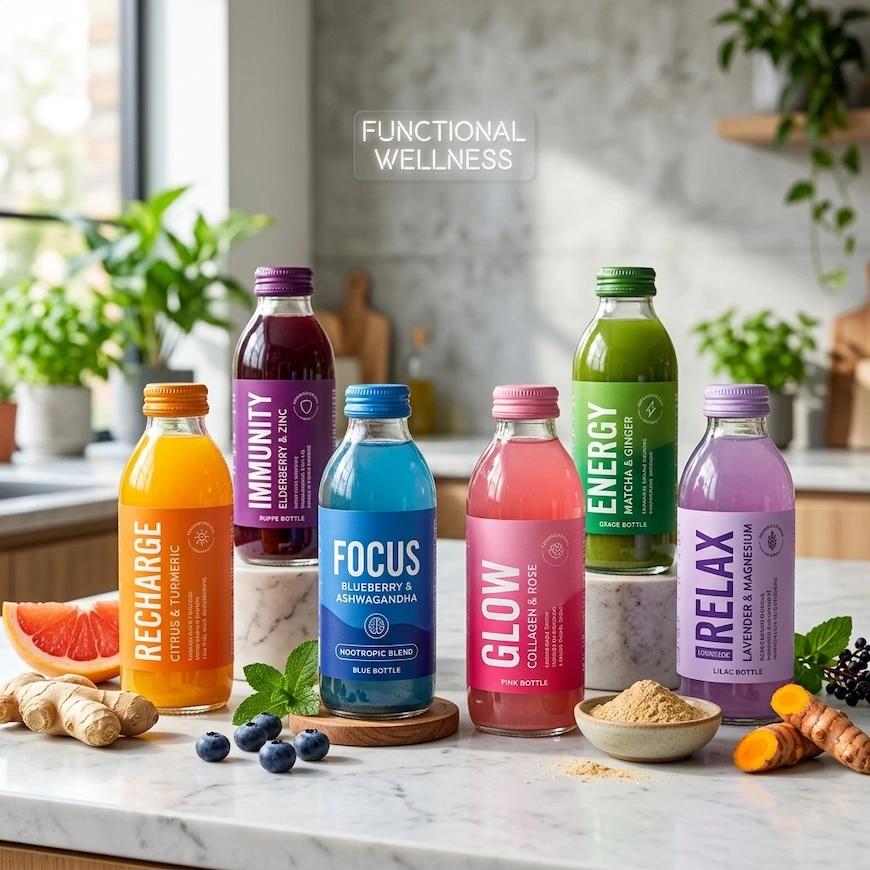
Quick Answer: Some of the best functional drinks are worth the money and most are not. Mushroom coffee built on lion’s mane, and ashwagandha-based adaptogen drinks, have real if modest human trial evidence. Prebiotic sodas and most detox blends are flavored sugar water wearing a wellness label. The answer depends on which drink and which ingredient, not on the category.
The functional drinks aisle has become one of the fastest growing sections in the grocery store. Mushroom coffee, adaptogen blends, collagen lattes, prebiotic sodas, electrolyte powders. Every can promises something: calm, focus, gut health, better energy without the crash.
Some of it is real. A lot of it is a $6 can of flavored water with a compound sprinkled in at a dose too small to do anything. That difference matters when these drinks cost two to four times what a coffee or a soda costs.
What follows is a ranked, ingredient-by-ingredient breakdown of the most popular categories, what the research actually says, and which of the best functional drinks earn the extra money.
What Makes a Drink “Functional” (And How to Know If It Actually Works)
Quick Answer: A drink is functional when it contains a bioactive ingredient at a dose close to what the human research on that ingredient used. Below that dose it is a flavored version of a health trend. Labels rarely disclose the dose, which is the whole problem with judging the best functional drinks from the shelf.
Before ranking the best functional drinks, it helps to define the word. “Functional” is a marketing term before it is a scientific one. It technically means a beverage formulated to deliver a physiological benefit beyond hydration or caffeine, through an added ingredient like an adaptogen, a mushroom extract, a probiotic strain, or an amino acid.
The trouble is that the word tells you nothing about dose. A prebiotic soda might contain 2 grams of chicory root fiber, which does close to nothing for your gut, sitting on the same shelf as an ashwagandha drink with 300mg of a studied extract and real trial data behind it.
Three questions cut through most of the marketing:
- Is the active ingredient dosed near the amount used in human trials? Some companies disclose this in fine print. When they do not, that silence tells you something.
- Is the ingredient stable in liquid? Some adaptogens and probiotics lose potency in ready-to-drink formats long before you open the can.
- Is the claim specific and modest (supports a stress response, may improve focus) or sweeping (detoxifies your body, cures bloating)? Specific claims tend to track real research. Sweeping ones tend not to.
Functional beverages are not a scam as a category. They are a category where the best functional drinks and the marketing-only ones share a shelf, and the label does not tell you which is which.
Matcha vs. Coffee: The Comparison That Launched a Thousand Morning Debates
Quick Answer: Matcha delivers a slower, steadier caffeine release than coffee thanks to L-theanine, an amino acid that smooths the jittery spike. Coffee carries roughly two to three times the caffeine of a standard matcha serving. Neither is objectively better. Matcha suits people who crash on coffee; coffee suits people who want a faster, stronger hit.
This is the comparison people argue about most when ranking the best functional drinks, so start with the numbers. Coffee runs 95 to 165mg of caffeine per 8oz cup depending on the brew. A standard 2g serving of matcha lands closer to 35 to 70mg, alongside L-theanine, which changes how that caffeine feels.
The mechanism has been tested directly. In a placebo-controlled crossover trial, 27 healthy volunteers received 50mg of caffeine with and without 100mg of L-theanine. Caffeine alone improved alertness and attention-switching accuracy. The combination improved both the speed and the accuracy of attention switching, and reduced how easily participants were derailed by distracting information during a memory task (Owen et al., 2008). So the “matcha focus” people describe is not invented. It is just smaller and steadier than the marketing suggests.
In practice:
- Choose matcha if coffee gives you anxious energy or a hard afternoon crash.
- Choose coffee if you want a stronger effect and caffeine does not bother you.
- Ceremonial grade matcha tastes noticeably less bitter than culinary grade, and it earns the price difference only if you drink it plain. Buried in a sweet latte, the quality is wasted.
Neither belongs above the other on a list of the best functional drinks. This is a caffeine preference, not a health decision. One practical caveat if you are pregnant or managing a heart condition: both count toward your daily caffeine ceiling. Most clinicians put that around 200mg during pregnancy, so check with yours before building a stack around either one.
Mushroom Coffee: What It Is, What It Does, and Which Brands Are Worth It
Answer Block: Mushroom coffee blends ground coffee with mushroom extracts, usually lion’s mane and chaga. Lion’s mane has human trial evidence for cognitive support in older adults with mild cognitive impairment. Chaga’s human evidence is much thinner. The coffee still supplies the caffeine; the mushroom is the added variable, and its effect is real but modest.
Mushroom coffee has moved from niche wellness product to grocery aisle staple, and it consistently ranks near the top of any list of the best functional drinks. The pitch is coffee without the jitters, plus cognition. The reality is more qualified.
Lion’s mane (Hericium erinaceus) has the strongest evidence of any mushroom in these blends. In a double-blind placebo-controlled trial, 30 Japanese adults aged 50 to 80 with diagnosed mild cognitive impairment took 3 grams of powdered lion’s mane daily for 16 weeks. Cognitive scores improved in the treatment group and not in the placebo group, and the advantage faded after supplementation stopped (Mori et al., 2009). That is a real finding, but note the population and the size: 30 older adults with existing impairment, not healthy thirty-somethings chasing a sharper morning. The jump from that trial to “instant focus in your coffee” is a long one.
Chaga is the reason some mushroom blends do not make the best functional drinks cut. It shows strong antioxidant activity in lab work and has far less human data on cognition or energy. Most chaga marketing is extrapolated from cell culture and animal studies.
The thing that actually matters when buying: check whether the product uses fruiting body extract, the mushroom itself, or mycelium grown on grain, which is cheaper, weaker, and sometimes mostly starch by weight. That detail lives in the ingredient list, never on the front label.
Collagen Coffee: The Morning Ritual That Serves Two Purposes
Quick Answer: Collagen coffee is regular coffee with a scoop of unflavored collagen peptides stirred in. It does not change the coffee. It is a way to attach a daily collagen dose, usually 10 to 20g, to a habit you already have. Any benefit comes from the collagen, not from combining it with coffee.
This one belongs to habit stacking more than to the best functional drinks conversation. Collagen peptides are flavorless and dissolve fully in hot liquid, so a scoop in your morning cup is the easiest way to hit a consistent dose without building a new ritual.
There is no synergy between coffee and collagen worth mentioning. The entire point is consistency. People who buy a tub and use it sporadically get less out of it than people who attach it to something they already do daily, and coffee is the most common daily habit there is. Evidence for collagen peptides on skin elasticity and joint comfort is promising but still modest, mostly short trials on manufacturer-supplied product, so treat it as a reasonable bet rather than a settled one.
One real consideration: coffee’s tannins can slightly interfere with mineral absorption. The effect is small and not specific to collagen. If it bothers you, a smoothie or oatmeal works exactly as well as a vehicle.
Adaptogen Drinks: Ashwagandha, Rhodiola, and the Best Formats for Each
Quick Answer: Adaptogen drinks contain herbs like ashwagandha, rhodiola, or reishi, studied for supporting the body’s stress response rather than eliminating stress. Ashwagandha has the strongest human evidence of the common adaptogens, with measurable drops in self-reported stress and cortisol. Rhodiola’s evidence is mixed. Adaptogen is a real pharmacological category, but evidence strength varies enormously by herb.
Adaptogens anchor the top of almost every best functional drinks ranking, including this one. They are herbs proposed to help the body handle physical and mental stress without stimulating or sedating it. Marketing has diluted the term, but the research on specific herbs, ashwagandha above all, is solid for a supplement category.
In a randomized double-blind placebo-controlled trial, adults under chronic stress took either a high-concentration full-spectrum ashwagandha root extract, 300mg twice daily, or a placebo for 60 days. The ashwagandha group showed significantly larger reductions across every stress assessment scale used, along with substantially lower serum cortisol (Chandrasekhar, Kapoor & Anishetty, 2012). This is among the better designed adaptogen trials, and it is the study most ashwagandha marketing is standing on, usually without saying so.
Rhodiola rosea has supportive research on fatigue and mental performance under stress, but the trials are smaller and less consistent, which is why it rarely tops a best functional drinks list on its own. Reishi, common in adaptogen blends, has more evidence for immune modulation than for stress.
One safety point that most articles in this category leave out. The NIH LiverTox database rates ashwagandha a likely cause of clinically apparent liver injury, with cases first reported in 2017 and rising since. The injury is rare and usually resolves within one to four months of stopping, but rare severe cases have occurred, and LiverTox advises against use in anyone with cirrhosis or advanced chronic liver disease. If you have a liver condition, take medication metabolized by the liver, or are pregnant or nursing, this is a conversation to have with a doctor before starting.
Format matters more here than in most categories. These drinks work as a consistent daily habit, not as an as-needed rescue on a bad day, because the studied benefits build across weeks rather than minutes.
Prebiotic Sodas: Do Poppi and Olipop Actually Do Anything?
Quick Answer: Prebiotic sodas like Poppi and Olipop carry small amounts of fiber, roughly 2 to 9 grams depending on the product, from chicory root or cassava, sold as gut health support. At those doses they work as a low-sugar soda alternative rather than a gut intervention. They beat regular soda comfortably. They are not the gut health product the branding implies.
Prebiotic soda is the category people most often assume belongs among the best functional drinks. It exploded because it solved a real problem. People wanted something that felt like soda without the sugar, and on that count it delivers: usually 5 to 9 grams of sugar against roughly 39 in a cola.
The prebiotic framing is where marketing gets ahead of the science. Prebiotic fiber does feed beneficial gut bacteria, but the amount in a can, often 2 to 4 grams of actual prebiotic fiber once you read past the front-label language, sits well below the 5 to 10+ grams daily that gut research typically uses.
Drink Poppi or Olipop because it is a much better soda. Not because it is remodeling your microbiome. If gut health is the actual goal, fiber from food and an evidence-based probiotic do far more, and it is worth comparing this category against the drinks that do have gut health evidence behind them before you commit a monthly budget to soda.
Electrolyte Drinks: When They Help and When You’re Paying for Sugar Water
Quick Answer: Electrolyte drinks earn their place during heavy sweating, exercise past 60 to 90 minutes, illness with vomiting or diarrhea, and hot-weather activity. On a normal, lightly active day they are mostly unnecessary, and traditional sports drinks add real sugar without the electrolyte concentration to justify it.
Electrolytes are the most situational of the best functional drinks. Sodium, potassium, and magnesium matter when you are losing them faster than food replaces them. That is a specific set of situations: long workouts, heat, illness, heavy alcohol recovery.
Outside those, most people get enough from a normal diet, and an electrolyte drink is flavored water with minerals you did not need that day. The wellness version of this argument, that everyone is chronically dehydrated and should sip electrolytes constantly, is not well supported. Thirst and urine color remain the most reliable everyday signals for healthy adults.
Newer brands like LMNT differ from traditional sports drinks mainly by cutting sugar and raising sodium, which suits genuine sweat loss and not a desk day. If you are adding electrolytes because you are moving more, the movement is doing the work; even a modest daily walking habit shifts how you feel more than the drink does.
The Morning Drink Stack: How to Combine Functional Drinks Without Overdoing It
Answer Block: The common mistake is stacking too many actives into one morning: coffee, an ashwagandha drink, a collagen scoop, an electrolyte packet. For most healthy adults this is not dangerous, but it makes it impossible to tell what is working, and it gets expensive fast. Pick one or two and give them a few weeks.
If you are assembling something from this list, sequencing beats volume. This is also where the best functional drinks tend to fail people, not because any one product is bad but because five overlapping ones cancel out your ability to evaluate any of them.
- Caffeine and adaptogen pair well when separated: coffee or matcha in the morning, ashwagandha in the evening. Its effects are cumulative rather than acute, so the timing costs you nothing.
- Collagen goes into anything hot or cold and needs no slot of its own. Stack it into coffee, a smoothie, or oatmeal.
- Electrolytes belong around exercise or heat, not a sedentary morning.
- Prebiotic soda is an afternoon swap for regular soda, not a morning drink.
A reasonable daily version, built only from the best functional drinks above: coffee or matcha with collagen stirred in, an ashwagandha drink in the evening, electrolytes only on sweat days. Two evidence-backed additions to a habit you already have, rather than five trends competing for the same hour.
No drink outperforms the boring inputs. If your energy is flat, what you eat and how your morning is structured move the needle harder than anything in a can. The drinks are a margin, and margins only matter once the basics are handled.
The Ranked List: Best Functional Drinks in Every Category
Answer Block: Ranked by evidence strength against cost, ashwagandha-based adaptogen drinks and lion’s mane mushroom coffee using fruiting body extract lead. Collagen coffee ranks high on consistency and cost per serving. Prebiotic sodas and electrolyte drinks rank as better-than-what-they-replace rather than essential. Reishi-only and chaga-only blends rank lowest on evidence per dollar.
Here is the full best functional drinks ranking across everything covered:
- Best evidence-to-cost ratio: Ashwagandha-based adaptogen drinks (Moon Juice SuperYou). Strongest human trial data on this list, with the liver caveat above.
- Best upgrade to an existing caffeine habit: Lion’s mane mushroom coffee with fruiting body extract (Four Sigmatic). Real cognitive research, studied in a different population than most buyers.
- Best low-effort daily habit: Collagen coffee (Vital Proteins stirred into coffee you already drink). Cheapest per serving and the easiest to sustain.
- Best soda replacement, not a gut product: Prebiotic sodas (Poppi, Olipop). Much better than cola, oversold as an intervention.
- Best for actual sweat loss, skip otherwise: Electrolyte drinks (LMNT). Situational.
- Best caffeine-free alternative: MUD\WTR starter kit, for people cutting coffee who still want a warm morning ritual.
A note on how to use a ranking like this. The people who get the most out of these drinks are usually the ones treating the morning cup as something they enjoy rather than something they optimize, which is closer to romanticizing the ritual than to biohacking it. And if you are here because you are rethinking what you drink more broadly, the sober curious framing applies neatly: swapping one habitual drink for a better one is a smaller, more durable change than overhauling everything at once.
Frequently Asked Questions
Is matcha healthier than coffee?
Neither is objectively healthier for most people. Matcha's L-theanine produces a steadier, less jittery experience at a lower total caffeine dose. Coffee hits harder and faster. Pick based on how caffeine treats you.
How much ashwagandha is actually effective?
The most cited trial used 300mg of a high-concentration root extract twice daily for 60 days. Check whether a product comes close to that. Many drinks include a fraction of it.
Does collagen coffee taste different from regular coffee?
No. Unflavored peptides dissolve completely and change nothing about taste, texture, or appearance.
Are electrolyte drinks necessary if I’m not an athlete?
On a normal day for a sedentary or lightly active person, no. They matter during heavy sweating, illness, heat, or sessions past roughly an hour.
What’s the cheapest of the best functional drinks to start with?
Unflavored collagen peptides in coffee you already drink. Lowest cost, easiest to sustain, and it adds one ingredient to an existing habit instead of creating a new one.

Mimo Karam is the founder and writer at LifestyleMine. She writes about daily habits, nutrition, sleep, and emotional wellness, turning research into practical advice for people who want to live healthier without making it complicated.