Quick Answer: Most home gym ideas in the $300 to $500 range pay for themselves within 4 to 6 months compared with a studio or boutique membership at $60 to $200+ per month. Cost aside, training at home removes the two barriers people cite most often when they stop exercising: the commute and the schedule.
The math behind most home gym ideas has shifted enough in recent years that it is worth running the numbers instead of assuming the home setup is the budget compromise and the gym membership is the real thing.
A mid-range membership runs roughly $40 to $80 a month. Boutique studios, so cycling, Pilates, specialized strength gyms, often run $150 to $250+ monthly for unlimited access, or $25 to $40 for a single drop-in class. At $150 a month you are spending $1,800 a year. The home gym ideas covered in the budget tiers below cost a fraction of that, once, with nothing owed afterward.
The consistency argument is separate from the cost argument, and it holds up better than you might expect. A year-long trial that randomly assigned 49 women in a behavioral weight loss program to either supervised group exercise or home-based exercise found the home group stuck with the program more reliably and lost more weight over the follow-up period (Perri et al., 1997). One trial in one population is not proof that home training wins for everyone, and plenty of people are more consistent when they have to show up somewhere and be seen. But if your actual obstacle has been logistics rather than motivation, the case for training at home holds on both cost and consistency.
The $50 Starter Gym: What You Can Actually Do With Just This
Quick Answer: The most effective budget home gym ideas at the $50 level are a set of resistance bands, a jump rope, and a decent exercise mat. That combination covers strength, cardio conditioning, and mobility work without a single dumbbell.
The usual objection to cheap home gym ideas is that real training needs weights from day one. That is not true, and the research on bands is more favorable than most people assume.
Resistance bands with handles give you scalable resistance for rows, presses, squats, and lateral work in one cheap, drawer-sized product. A meta-analysis pooling 18 studies and 35 separate activation measures found that elastic resistance produced muscle activation comparable to isoinertial resistance across prime movers, antagonists, assistant movers, and stabilizers (Aboodarda, Page & Behm, 2016). Bands are a real training tool, not a beginner’s placeholder.
A jump rope, gives you hard cardiovascular work in a tiny footprint for very little money. Boxers have not kept using them out of nostalgia.
An exercise mat covers floor work, stretching, and mobility, and it matters more than it sounds if you train on hardwood or tile with any regularity.
This tier is a complete starting point rather than something to suffer through until you can afford better. A lot of people stay here for months, or permanently, especially once bodyweight work goes into the mix.
The $150 Gym: The Equipment That Unlocks a Full Workout Range
Quick Answer: Adding a pull-up bar and a foldable bench to the $50 foundation opens up pulling movements and a much wider range of pressing and core work, which is the specific gap bands alone leave behind.
The $150 tier fixes the one real gap in entry level home gym ideas: pulling strength, plus the stability a bench gives you for everything else.
A doorframe pull-up bar adds pull-ups, chin-ups, and hanging core work. Bands can approximate a vertical pull, but not replace it, and most standard doorframes take a bar with no drilling.
A foldable weight bench expands what you can do before you add any external weight at all, since changing the angle of your torso changes the leverage on most pressing, core, and single leg exercises. The folding part is what makes it work for small home gym ideas, because it stores instead of permanently claiming floor space.
At roughly $150 combined, you now have strength, cardio, mobility, and both push and pull patterns with proper support.
The $300 Gym: The Setup Most People End Up With
Quick Answer: The $300 tier adds adjustable dumbbells, which is where most home gym ideas eventually converge, since one adjustable pair replaces an entire rack of fixed weights.
Adjustable dumbbells buy you more new training capability per dollar than anything else here, and the $300 tier exists mainly to fit them.
A set like the Bowflex SelectTech runs from 5 to 52.5 pounds per hand in small increments, replacing about 15 pairs of fixed dumbbells and the rack you would need to store them. This is the point where a home setup stops supplementing bodyweight work and starts supporting progressive strength training that actually goes somewhere over months and years.
That distinction matters more than the equipment list suggests. Progression in resistance training depends on systematically manipulating load, volume, and rest over time rather than repeating the same session indefinitely (Kraemer & Ratamess, 2004). Small load increments are what make that possible at home, and adjustable dumbbells are the cheapest way to get them.
This also tends to be where people stop, based on how most home gyms actually evolve. The $50 and $150 tiers handle cardio, mobility, and bodyweight adjacent training. Adjustable dumbbells add scalable resistance on top, which covers most of what a well rounded strength and conditioning routine needs.
The Complete Home Gym Equipment List (Ranked by Value)
Quick Answer: Ranked by capability added per dollar, the buying order for most home gym ideas runs: resistance bands, exercise mat, jump rope, pull-up bar, adjustable dumbbells, foldable bench, foam roller.
Pulling the tiers above into one ranked list:
| Rank | Equipment | Approx. Cost | Why This Rank |
|---|---|---|---|
| 1 | Resistance bands | $25–35 | Broadest exercise range per dollar |
| 2 | Exercise mat | $40–60 | Makes all floor work usable |
| 3 | Jump rope | $15–25 | Cheapest effective cardio |
| 4 | Pull-up bar | $30–40 | Unlocks pulling entirely |
| 5 | Adjustable dumbbells | ~$300 | Biggest single-item jump |
| 6 | Foldable bench | $80–120 | Expands pressing and core range |
| 7 | Foam roller | $20–30 | Recovery and mobility |
This is not a mandatory purchase order. It is the order that adds the most new capability at each step, which is what you want if you are working through these home gym ideas gradually. Someone with $75 should buy items one through three rather than skipping ahead to something more expensive.
The Best Home Gym Equipment for Small Spaces
Quick Answer: For small home gym ideas, prioritize anything that folds, stacks, or does double duty: a foldable bench, adjustable dumbbells instead of a rack, bands that live in a drawer, and a mat that rolls up.
Tight square footage reorders the list. For apartment home gym ideas, permanent footprint starts to matter more than price.
Adjustable dumbbells earn a second mention here. One set replaces a full rack, which makes it the single biggest space saving decision available for strength work specifically.
Foldable and collapsible gear generally, so benches, band anchor systems, mats that roll rather than sit unrolled, is worth paying a small premium for. Being able to reclaim the floor when you are done matters disproportionately in a small apartment.
Vertical storage handles the rest. A wall hook or over-door organizer keeps bands, ropes, and mats reachable without claiming floor space, which is a bigger deal in a studio than in a spare room.
One realistic space check: everything in this guide through the $300 tier fits in about six by six feet, roughly a large area rug. That covers most apartment bedrooms, living room corners, and converted closets. If you also want steady daily movement without adding another machine footprint, a folding under-desk walking pad slides under furniture and stacks on top of the setup here rather than competing with it.
Apartment Gym Setup: How to Work Out Without Bothering Your Neighbors
Quick Answer: For apartment home gym ideas, noise matters as much as space. A thick mat dampens dumbbell and floor contact noise, bands and bodyweight work are near silent, and training during normal daytime hours solves most of the rest.
Noise is the constraint most home gym ideas skip entirely, and it deserves real attention if you share walls or a ceiling.
A thick mat, noticeably thicker than the general purpose yoga mat from the $50 tier, placed under dumbbells and any floor impact work, cuts a lot of what transmits to the unit below.
Low impact substitutions do most of the remaining work: lower dumbbells under control instead of dropping them, use band exercises instead of plyometric jumping, lean on bodyweight strength work. All of it is essentially silent regardless of how the building was framed.
Timing is the simplest fix and the one people skip. Keeping equipment work inside normal daytime and early evening hours prevents most neighbor friction no matter how much noise dampening gear you buy.
Jump rope needs a caveat here. It made the $50 tier on merit, but it is one of the louder cardio options if you are above ground level or in an older building. Band conditioning circuits or a bodyweight cardio circuit are quieter substitutes if it becomes an issue.
The One Piece of Equipment to Buy First (Before Everything Else)
Quick Answer: If you are buying one thing rather than a whole tier, buy resistance bands with handles. They cost the least, store the smallest, and cover more movement patterns than anything else in this guide.
If the tiered approach still feels like too much planning, here is the direct answer buried in all the home gym ideas above.
A band set with interchangeable resistance levels and handles covers rows, presses, squats, hinge patterns, and core rotation. That is most of the major movement patterns, in one product, for $25 to $35, in something that fits in a drawer. Nothing else in this guide covers that much ground for that little.
Bands alone are not a permanent complete solution. The tiers above exist because most people eventually want vertical pulling and progressively heavier loads. But as an answer to “can I actually train at home,” bands settle the question for the least money you will ever spend on this.
How to Organize a Home Gym So You Actually Use It
Quick Answer: The equipment you use most should take the least effort to reach, stored visibly rather than buried in a closet. A small dedicated corner beats clearing the living room floor before every session, and that friction is what decides whether the setup gets used.
Equipment you cannot reach easily does not get used, however well you chose it. Layout is the part of most home gym ideas that gets treated as an afterthought and then quietly decides everything.
Designate a fixed spot, even just a corner, instead of packing everything away and rebuilding the setup each time. Digging a bench out of a closet is nothing on any given day. Across a month it is the reason you skipped four sessions.
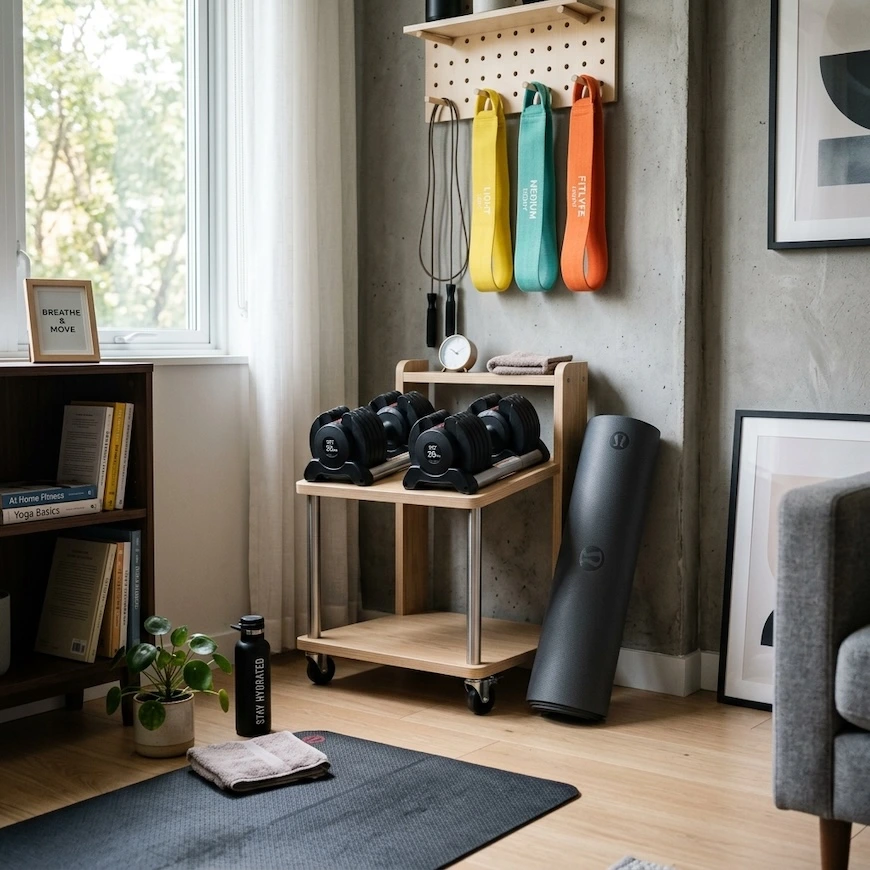
Keep the things you use most visible and within reach. Bands on a wall hook, the mat rolled and leaned in the corner rather than folded into a drawer, dumbbells on the floor instead of behind three boxes. Visibility works as a reminder and shortens the gap between deciding to train and starting.
Put the occasional stuff, foam roller and jump rope, in secondary storage. Not everything needs prime real estate.
Then reassess after a month. Which equipment gets used and which sits untouched becomes obvious fast, and adjusting the layout and your future purchases around real usage rather than the original plan is how most good home gym ideas end up personalized to the person using them.
Frequently Asked Questions
How do I build a home gym in a small apartment?
Favor foldable and multi-purpose gear, so a foldable bench, adjustable dumbbells rather than a fixed rack, bands that store in a drawer. Give it one small fixed spot instead of a whole room, and plan for noise, particularly a thick mat under any dumbbell work.
Which home gym ideas give the best value for the money?
Resistance bands on pure value, since they cover the most exercises for the least cost and space. Adjustable dumbbells on capability per purchase, since one set replaces a whole rack.
Can I build a full home gym for under $200?
Yes. The $50 tier plus a pull-up bar gets you a comprehensive bodyweight and band setup covering push, pull, core, and cardio for under $200, before adjustable dumbbells enter the picture at all.
How loud is home gym equipment, and will it bother my neighbors?
Bands and bodyweight work are near silent. Dumbbells and floor impact movements are the real concern, and a thick mat plus lowering weights under control handles most of it. Jump rope is the loudest common option and worth rethinking above ground level or in an older building.
Do I need a bench, or can I skip it?
You can skip it early. It does widen your pressing, core, and single leg options quite a bit once added, and a foldable version keeps the space benefit. Add it after the $50 tier and the pull-up bar rather than at the start.
Mimo Karam is the founder and writer at LifestyleMine. She writes about daily habits, nutrition, sleep, and emotional wellness, turning research into practical advice for people who want to live healthier without making it complicated.