✦
THE LIFESTYLEMINE NEWSLETTER
Simple wellness tips, healthy recipes, and
everyday inspiration delivered to your inbox.
Your Email Address
VOCs, or volatile organic compounds, evaporate readily at room temperature. That property is exactly what makes a cleaning spray work as fast as it does, and exactly why it affects the air in your kitchen. Researchers who tested 213 consumer products across 50 product types found endocrine disrupting and asthma associated compounds throughout cosmetics, cleaners, sunscreens, and vinyl items, and reported that product labels frequently gave buyers no way to identify or avoid them (Dodson et al., 2012 ).
PFAS, the so-called forever chemicals, show up in some non-stick cookware coatings and in stain or water resistant treatments on textiles. They are valued for durability, which is the same property that keeps them from breaking down in the environment or in the body.
Preservatives and fragrance compounds in personal care and cleaning products round out the list. Most of these hide under a single word on the label: “fragrance” or “parfum,” a catch-all category that can legally cover dozens of undisclosed individual compounds.
Those four categories are enough background to follow every swap below without needing a chemistry degree.
Quick Answer: The kitchen is the highest priority room for non toxic home swaps because it involves direct food contact every day. The three swaps with the biggest payoff are non-stick cookware (replacing PFAS coated pans), food storage (glass instead of plastic), and dish soap plus surface cleaners.
The kitchen is the one room where a non toxic home effort pays off fastest, because household chemistry meets what you actually put in your body, and if you care enough about ingredients to read a nutrition label , the pan you cook in deserves the same attention.
Swap 1: Non-stick cookware. Older and cheaper non-stick coatings can shed PFAS compounds, especially once they are scratched or overheated. A ceramic coated set, like T-Fal Signature Nonstick Pots and Pans
Swap 2: Plastic food storage. Heating and scratching plastic containers, particularly in the microwave or dishwasher, raises the odds of chemicals migrating into whatever is inside. Glass containers are the obvious fix, and they tend to outlast plastic by years.
Swap 3: Plastic wrap. Reusable beeswax wraps, cost little, require no habit change, and remove a very high frequency point of plastic-on-food contact.
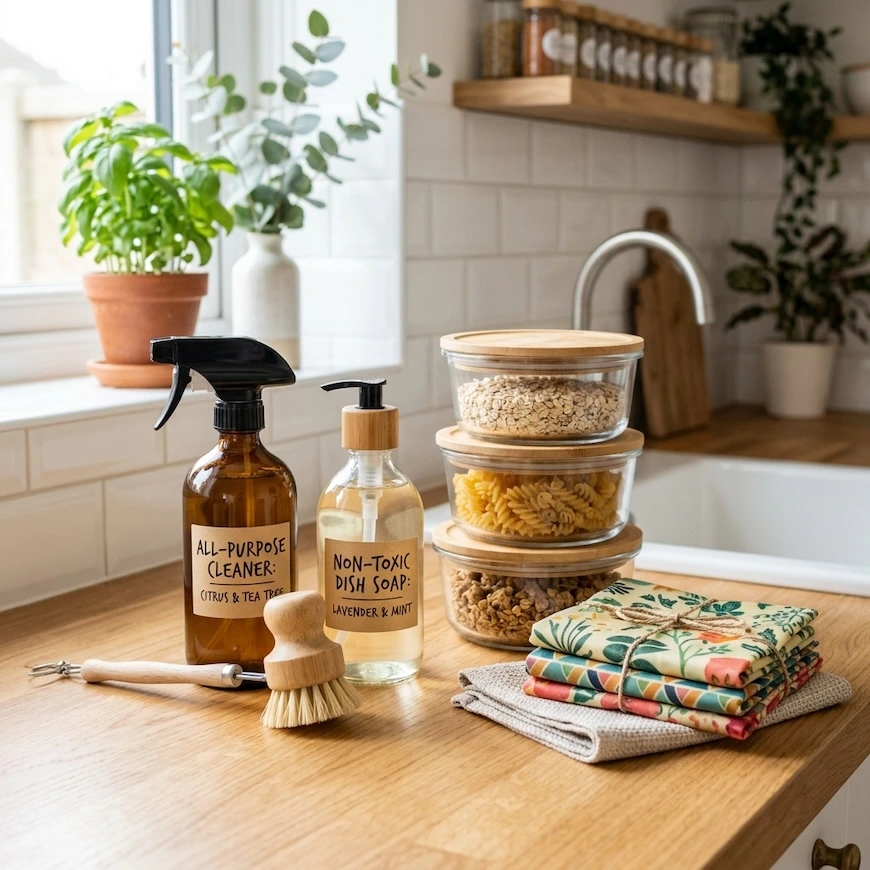
Swap 4: Dish soap. Conventional formulas often carry the synthetic fragrance and preservative compounds described above. A plant based option cleans about as well in a normal kitchen.
Swap 5: All purpose cleaning spray. This is one of the highest VOC emitting categories in the average home, thanks to how often it gets used in a fairly enclosed space. Nazaroff and Weschler’s review of cleaning agents and air fresheners describes how terpenes in these products react with indoor ozone to form secondary pollutants, including formaldehyde (Nazaroff & Weschler, 2004 ). A concentrate kit, lets you control dilution and skip the packaging churn of buying pre-mixed bottles forever.
Quick Answer: Bathroom products deserve priority in a non toxic home because many go directly on skin and stay there for hours, which increases absorption compared with anything you rinse off. Focus on daily use, leave-on products first.
The bathroom comes second in a non toxic home plan, mostly because of contact time.
Leave-on products, so lotion, deodorant, daily skincare, warrant more scrutiny than shampoo or body wash that goes down the drain in ninety seconds. That does not mean gutting the whole cabinet at once. It means picking the one or two things you apply every single morning and leave on all day.
A practical filter: scan the ingredient list of your daily leave-on products for “fragrance” or “parfum.” That is where the undisclosed compounds cluster. Swap those specific items and leave the rest for later.
Quick Answer: Bedroom air deserves attention in any non toxic home plan because of sustained, unconscious exposure during sleep, usually 7 to 9 hours in one enclosed room. The main swaps are bedding materials, mattress off-gassing, and laundry products used on sheets.
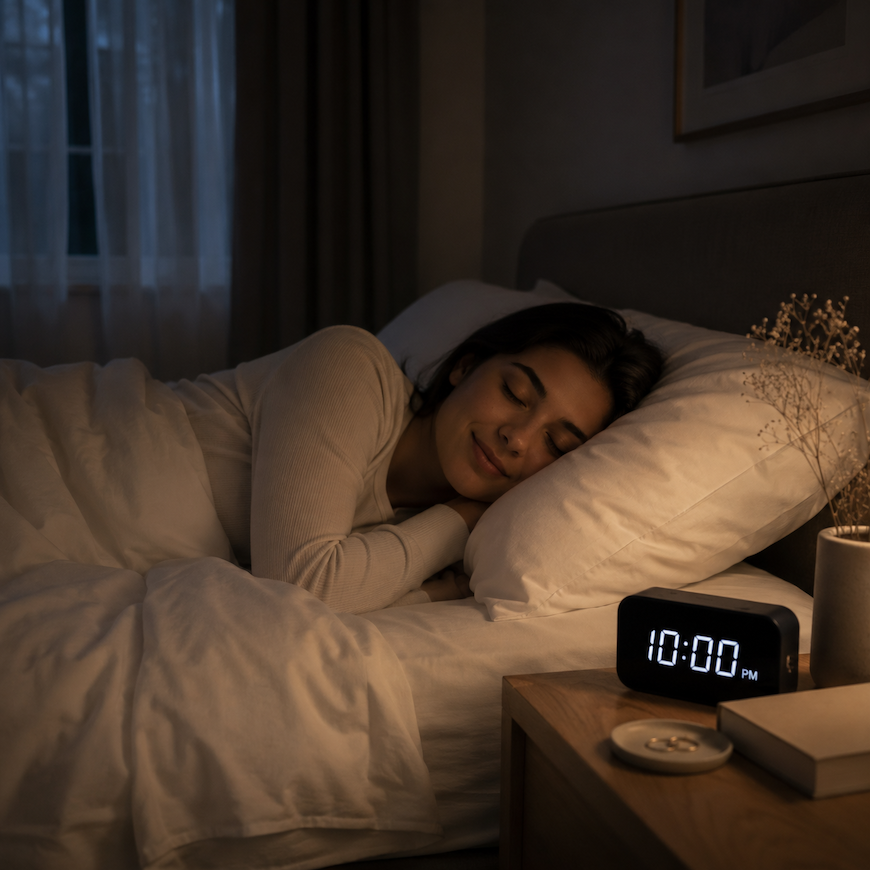
Most non toxic home content skips the bedroom, which has always struck me as backwards. It is the room where you breathe the same air for the longest continuous stretch, every night, without noticing any of it.
Synthetic fiber bedding can involve chemical treatments during manufacturing. Cotton or linen sheets are a sensible priority given that they touch your skin for a third of the day.
New mattress off-gassing is real but time limited. Memory foam in particular releases VOCs for a while after unboxing. Airing a new mattress out in a well ventilated room for several days before you sleep on it cuts most of that exposure window.
Laundry products used on bedding tie straight back to the fragrance and VOC categories above. Sheets sit against your skin and inside your breathing space all night, which makes them a higher priority than towels or the guest room linens you wash twice a year.
Quick Answer: Laundry detergent and general cleaning products are the easiest low tox home swaps to make, because you are not changing a habit, only a bottle. Fragrance free or plant based detergent and a concentrate cleaning system are the two best values here.
This is the section to do first if you are only going to do one, because nothing else in a non toxic home routine asks so little of you. You are not changing a habit, just which bottle you buy.
Laundry detergent is the cleanest example. A fragrance free or plant based option, swaps in with no change to your routine at all, and detergent touches every fabric you own on repeat.
Stain removers and specialty cleaners tend to be the most heavily fragranced, most VOC dense products in the cabinet. A plant based stain remover, does the same job.
General surface cleaning carries over from the kitchen section. One concentrate system covering kitchen and bathroom beats buying a separate specialty spray for every surface in the house.
Quick Answer: Scented candles and air fresheners are among the highest VOC emitting products people use indoors, since releasing fragrance compounds into the air is the entire point of them. Beeswax or soy candles scented with essential oils, used in moderation with ventilation, are a reasonable alternative.
Fragrance gets less airtime in non toxic home content than cleaning products do, and probably deserves more, because dispersing compounds into the air you breathe is not a side effect here. It is the product function.
Conventional scented candles are usually paraffin wax, a petroleum byproduct, burned with synthetic fragrance oils. Plug-in and spray air fresheners work on the same principle, just continuously.
A beeswax or soy candle with essential oil fragrance, burns cleaner than paraffin with synthetic scent. Cleaner is not the same as zero, though, since any candle produces combustion byproducts. Moderate use and an open window still matter whatever you are burning.
For scent without combustion, a simmer pot of citrus peels and cinnamon does the job, and so does opening the windows for ten minutes.
Quick Answer: Several popular non toxic home recommendations have thin or contested evidence relative to their cost and hassle, including replacing all plastic immediately, avoiding every synthetic material, and treating trace level chemical detections as personally alarming. Prioritization beats completeness.
Most non toxic home guides leave this part out, which is a shame, because knowing what to skip is what keeps the whole project affordable.
Replacing every piece of plastic you own, immediately. A storage bin you open twice a year and a plastic coat hanger represent almost no cumulative exposure. Spending real money on those before you have dealt with the containers you microwave four times a week is a bad trade.
Avoiding all synthetics as a blanket rule. Some synthetic treatments exist to reduce other risks, flame retardancy being the obvious one, and stripping them out without understanding the tradeoff is not automatically safer.
Treating any trace level lab detection as personally alarming. Modern testing can find compounds at concentrations far below any established level of concern, and “chemical X detected in product Y” is a different claim from “chemical X is harming you at this dose.” Conflating those two drives most of the anxiety in this content category.
Buying a brand new version of everything you already own, on the same day. This costs a fortune and throws out perfectly good products in the process. Replacing things as they run out or wear out is the same approach that makes any gradual lifestyle change stick, whether that is cutting back on alcohol or overhauling a cleaning cabinet.
Quick Answer: If you are starting a non toxic home transition from scratch, begin with one non-stick pan, your daily use plastic containers, all purpose cleaning spray, laundry detergent, and one daily leave-on personal care product. Those five cover the highest frequency exposure points across the most rooms.
If fifteen swaps feels like too many, here is the short version, ranked by exposure frequency and ease:
The non-stick pan you reach for most. Direct food contact, daily, one purchase.Plastic containers you use for leftovers. Repeated heat cycles, highest frequency plastic contact.All purpose cleaning spray. High VOC category, same shelf swap.Laundry detergent. Touches every fabric you own, zero routine change.One daily leave-on product , lotion or deodorant. Longest skin contact time of anything you use.
Those five cover the kitchen, laundry, and bathroom without an expensive weekend of throwing things away. That is a functional non toxic home baseline. Everything else can wait until the bottle runs out.
The ones with the highest frequency and longest contact time: your most used non-stick pan, the plastic containers you microwave, all purpose cleaning spray, laundry detergent, and one daily leave-on personal care product. Those five account for a disproportionate share of your total exposure.
Older and lower quality non-stick coatings can release PFAS compounds when scratched, overheated, or damaged. That does not make every non-stick pan a crisis, but given how often cookware touches hot food, it is a cheap swap with a clear rationale, and ceramic coated pans now cook comparably for home use.
Low tox describes an approach aimed at reducing overall chemical load rather than claiming any product is completely free of synthetic compounds. It is the more accurate framing, and it is the one this guide uses.
It depends entirely on pace. Replacing products as they run out, starting with the starter list above, spreads the cost across months instead of demanding a lump sum, and several swaps (detergent, cleaning spray) cost roughly what the conventional versions do.
Beeswax and soy candles with essential oils generally burn cleaner than paraffin with synthetic fragrance oils, but any burning candle produces combustion byproducts. Better means lower, not zero, and ventilation matters either way.
Not automatically. Lab equipment can now detect compounds at concentrations far below any level of concern, and "detected" is not the same claim as "dangerous at this level." Focus on the well established, high frequency exposures covered above rather than chasing every headline.
Mimo Karam is the founder and writer at LifestyleMine. She writes about daily habits, nutrition, sleep, and emotional wellness, turning research into practical advice for people who want to live healthier without making it complicated.