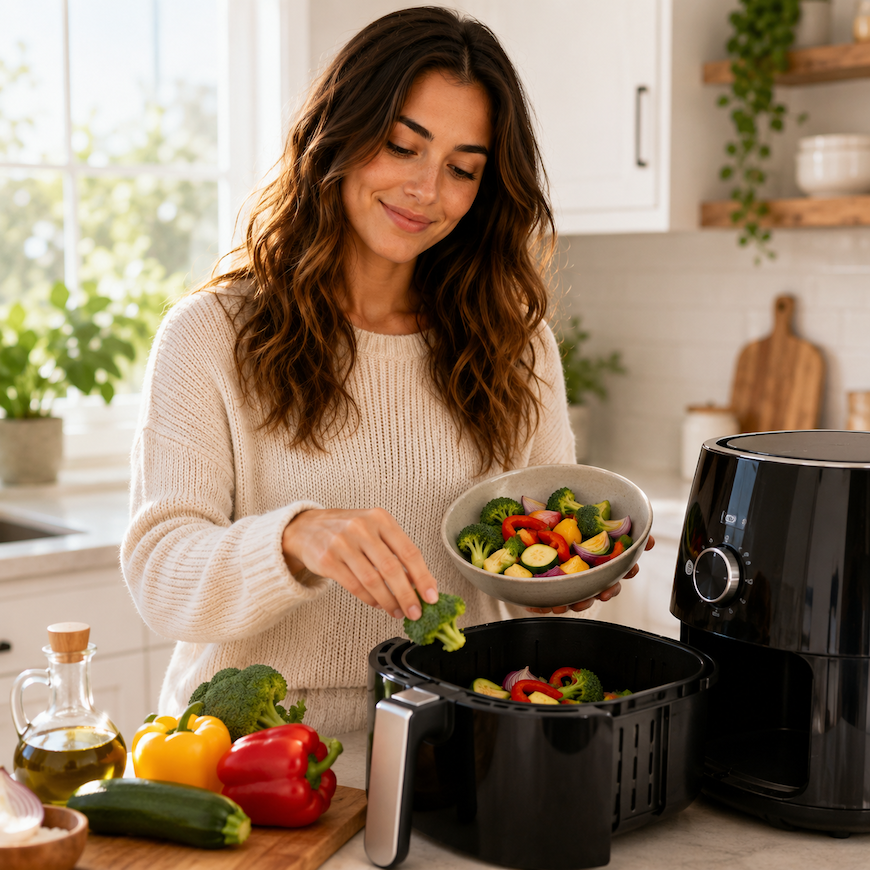
I bought an air fryer on Black Friday 2022.
For the first six months, I used it almost every night. Chicken thighs. Sweet potato fries. Roasted broccoli. Salmon fillets. I felt like I was eating better, cooking faster, and skipping the mess of oil everywhere. It was easy to convince myself this was healthier. It felt healthier.
Then I looked into the research.
Whether the air fryer healthy label actually holds up turns out to be more nuanced than either the marketing or the skeptics suggest. Some of what I assumed was true. Some of it wasn’t. And there’s one chemical nobody mentions in the air fryer healthy conversation that probably should be the first thing people learn about.
Here’s what I found.
What an Air Fryer Actually Does to Your Food
The question of whether an air fryer is healthy starts with the mechanism.
An air fryer is a compact convection oven: a heating element next to a fan that whips hot air around the food. The moving air pulls surface moisture off fast and drives the Maillard reaction, the same browning that gives roasted chicken its crust or toast its char. It’s a reaction between amino acids and reducing sugars under heat, throwing off hundreds of flavor compounds at once.
What an air fryer is not: a fryer. Nothing gets submerged in oil. The crisp comes entirely from hot air stripping moisture off the surface. You use a little oil, usually a light spray or a teaspoon tossed through the food, but the cooking itself is dry heat, not fat.
That’s why an air fryer healthy choice for cooking works mechanically: less oil going in means less fat in the result. A deep fryer submerges the food in oil, which it absorbs the whole time it cooks. An air fryer uses 70 to 80% less oil than deep frying, and the food absorbs almost none of it.
Try this best seller Ninja DZ201 DualZone 2-Basket Air Fryer on amazon.
The Acrylamide Problem (The One Nobody Talks About)
Here’s the part that surprised me.
Acrylamide is a compound that forms when starchy foods cook above 120°C (248°F). It forms as part of the Maillard reaction, so the browner and crispier your food gets, the more acrylamide forms. This applies to roasting, baking, toasting, and frying equally.
The WHO classifies acrylamide as probably carcinogenic to humans (Group 2A) based on evidence from animal studies. The human evidence is still being worked out, but the classification sits in the same tier as red meat and shift work.
Air fryers are, on this count, clearly better than deep fryers. A study in the Journal of Food Science found that air frying cut acrylamide content in french fries by up to 90% compared with deep frying at equivalent temperatures. That’s a big reduction.
But the air fryer healthy claim breaks down if you push the temperature too high or cook until the food is very dark. Acrylamide formation accelerates sharply above 175°C (347°F). At 200°C (392°F) with a long cook time, even an air fryer can produce acrylamide levels comparable to lighter deep frying.
The practical takeaway: cook at 175°C or below when you can, pull food before it goes deep brown, and don’t burn it. A lightly golden finish produces far less acrylamide than a dark, very crispy one.
The Fat and Calorie Numbers
This is where an air fryer healthy setup earns the label.
A 100g serving of deep-fried french fries runs about 312 calories and 15g of fat. The same serving, air-fried from fresh potato, lands around 150 to 170 calories and 4 to 6g of fat. That’s roughly half the calories and 60 to 70% less fat from the cooking method alone.
For everyday meals, that adds up. If you eat fried or roasted food four or five times a week and switch from deep frying, the drop in fat and calories over months is substantial. This is one of the most documented air fryer healthy benefits, and it’s real.
The mechanism is simple. Oil is calorie-dense at 9 calories per gram, and deep-fried food soaks up a lot of it during submersion. Air frying adds almost no oil-derived calories, because the food is never submerged.
That ties directly into cardiovascular health. Cutting overall fat intake, particularly from the repeatedly heated oils used in commercial deep frying, reduces your exposure to oxidized lipids, which are more inflammatory than fresh oils. If you’re working on your heart, lowering your fried-food oil load is one of the healthy heart habits with the clearest evidence behind it.
What Air Frying Does to Nutrients
This is where the air fryer healthy picture gets more mixed.
Heat degrades nutrients. Every cooking method does. The questions that matter are how much heat, for how long, and whether the food touches water, which leaches out water-soluble vitamins.
Versus deep frying: Air frying wins. Deep frying at 180°C (356°F) destroys more heat-sensitive nutrients, because the oil temperature is sustained and the food fully immersed. It also sometimes uses reused oil, which carries higher concentrations of oxidized lipids and aldehydes.
Versus boiling: Air frying wins for water-soluble vitamins. Vitamin C and the B vitamins (B1, B2, B6, folate) dissolve in water. Boil vegetables and those vitamins leach into the water you pour down the drain. Air frying keeps the food dry, so it holds onto far more of them. This is one of the less-discussed air fryer healthy advantages: dry heat actually preserves B vitamins better than the most common vegetable cooking method in most kitchens.
Understanding what your body actually needs from food makes this matter. B vitamins and vitamin C are among the most commonly under-consumed nutrients, and protecting them through your cooking method is worth attention.
Versus steaming: Steaming wins. It keeps temperatures lower (100°C at sea level) with no direct high-heat contact. Vitamin C starts degrading above 70°C (158°F), so any high-heat method, air frying included, reduces it. Steaming keeps total heat exposure low and nutrient retention high for most vegetables. An air fryer healthy choice for cooking beats frying or boiling, but it isn’t the top method for preserving nutrients.
Versus oven baking: Comparable. A conventional oven at 200°C produces similar nutrient loss to an air fryer at the same temperature. The difference is speed: air fryers cook 20 to 30% faster than a conventional oven for most foods, which means less total time under heat. That speed edge gives the air fryer a marginal advantage for nutrient retention at the same temperature.
The Non-Stick Coating Question
Most air fryer baskets are coated with PTFE (polytetrafluoroethylene), the same material as Teflon. This is a legitimate air fryer healthy concern and deserves a straight answer.
PTFE is stable and considered safe at normal cooking temperatures. The problem starts at 260°C (500°F) and above, where it begins to break down and can release fumes. In rare cases those fumes cause flu-like symptoms in humans, and they’re acutely toxic to pet birds.
Air fryers typically top out at 200 to 230°C (392 to 446°F), below the breakdown threshold for undamaged PTFE. For most uses, the coating isn’t a meaningful concern.
Two caveats. First, scratching the coating speeds up breakdown, so use silicone or wooden utensils rather than metal, and never scrub with abrasive pads. Second, aerosol cooking sprays (the ones with soy lecithin as a propellant) can degrade non-stick coatings faster than oil applied directly. If you use spray, switch to a refillable mister with straight oil.
If PTFE bothers you, ceramic-coated air fryer baskets are widely available now and skip it entirely. Stainless steel baskets exist too, though food sticks more without oil.
What an Air Fryer Cannot Fix
This is the part most air fryer healthy reviews miss entirely.
The cooking method can reduce fat. It can’t improve the food.
Air-frying a processed chicken nugget gives you a slightly less fatty processed chicken nugget. The nugget still has the fillers, sodium, and industrial seed oils baked into its recipe, none of which the air fryer touches. Air-frying frozen chips still gives you ultra-processed starch with additives. The air fryer cuts the oil added during cooking. It doesn’t change what the food was to begin with.
The air fryer healthy reputation comes from comparing it with deep frying the same food. That comparison is valid and useful. But “better than deep frying” and “healthy” aren’t the same thing.
Where air fryers really shine is whole foods: salmon fillets, chicken breast, sweet potato, broccoli, Brussels sprouts, tofu, zucchini, mushrooms. Cook those in an air fryer and you get a genuinely healthy result, fast, with minimal cleanup. Most are also among the best anti-inflammatory foods available, and air frying preserves their nutritional value better than boiling or deep frying.
If you’re cooking whole-food ingredients, the air fryer healthy label is well-earned. If you’re cooking packaged, processed food, you’re reducing the harm, not creating health.
Air Fryer vs. Other Cooking Methods
Here’s roughly where the air fryer sits against the full range of options:
Deep frying: Air fryer wins clearly. 70 to 80% less oil, up to 90% less acrylamide, no reused-oil oxidation issues, and similar texture for many foods.
Boiling: Air fryer wins for water-soluble vitamin retention. Boiling is better for keeping acrylamide low in starchy vegetables (no browning happens) but worse for overall nutrient preservation.
Conventional oven: Essentially a tie. The air fryer is faster (20 to 30%), which gives it a marginal nutrient edge. Energy use is also lower than a full-size oven for small to medium portions.
Steaming: Steaming wins for nutrient retention. No browning, no acrylamide, lowest heat exposure, no oil needed. But it doesn’t produce the texture that makes food satisfying to eat every day for most people.
Grilling/BBQ: It depends. Grilling over an open flame produces polycyclic aromatic hydrocarbons (PAHs) when fat drips onto the heat source. Air fryers don’t have that mechanism, so they don’t generate PAHs the same way. For someone eating a lot of grilled red meat, moving some meals to the air fryer is a meaningful cut in PAH exposure. The fumes that come off burning oil or fat are worth ventilating with any appliance, and if your cooking area has poor airflow, that’s relevant to five habits your lungs actually need.
The overall health ranking: steaming, then air frying and oven baking, then boiling, then grilling, then deep frying. Air frying sits in the upper middle, a good place to be for a method that also makes food people enjoy eating.
The Indirect Benefit That Matters Most
Here’s something the research doesn’t measure directly, but that I think matters more than the acrylamide numbers.
People who cook at home eat better than people who don’t. That isn’t controversial. Home-cooked meals are lower in sodium, saturated fat, and total calories than restaurant or takeout equivalents. The barrier to cooking at home, for most people, is time, effort, and the volume of cleanup.
Air fryers cut all three. Most meals cook in 12 to 18 minutes. There’s no oil splatter. The basket takes 90 seconds to clean. If an air fryer gets someone cooking chicken and vegetables at home five nights a week instead of ordering delivery, the health impact of that one behavior change dwarfs any acrylamide consideration.
This is the air fryer healthy argument I find most convincing. Not that air frying is the nutritionally superior method, but that for people who struggle to cook real food consistently, an air fryer removes enough friction that they actually do it.
For anyone building better food habits, the fundamentals of what your body actually needs from food don’t change based on the appliance. But if an appliance makes you more likely to eat whole foods regularly, it’s earning its counter space.
For plant-heavy diets, air fryers handle tofu, tempeh, chickpeas, and vegetables very well, hitting textures that would otherwise need deep frying or a lot of oil. The vegetarian diet benefits of eating more plant protein are meaningful, and the air fryer makes cooking that way much easier day to day.
Frequently Asked Questions
Does an air fryer produce acrylamide?
Yes, but much less than deep frying. The FDA notes that acrylamide forms in many starchy foods cooked above 120°C (248°F), regardless of method. Air frying at moderate temperatures (160 to 175°C), with food pulled before it gets very dark, produces minimal acrylamide. Burned or very dark food in an air fryer still produces it at levels worth avoiding.
Is the non-stick coating on air fryer baskets safe?
PTFE coatings are stable and safe at air fryer temperatures, which typically max at 200 to 230°C, well below the 260°C breakdown threshold. The risk rises with scratching, so use silicone or wooden utensils and skip abrasive scrubbing. Aerosol sprays with soy lecithin also degrade coatings faster than direct oil. To avoid PTFE entirely, ceramic-coated or stainless steel baskets are available. Treating the coating well so it stays intact matters too.
Can an air fryer help with weight loss?
Indirectly, yes. Cutting the oil used in cooking reduces oil-derived calories by 70 to 80% compared with deep frying. For people who eat fried food often, that's a real, cumulative reduction. But the air fryer doesn't make food inherently lower in calories. It reduces the oil-derived calories added during cooking. The food itself still matters as much as the method.
What foods should I avoid cooking in an air fryer?
Wet batters (pancake batter, beer batter) don't work, because the liquid drips before it sets. Leafy greens cook unevenly and blow around in the airflow. Whole roasts are a mixed bag: a whole chicken works, but a large beef roast cooks more evenly in a conventional oven. Very delicate fish like sole can dry out fast. For everything else, including chicken, salmon, sweet potato, broccoli, Brussels sprouts, tofu, chickpeas, and eggs, a good air fryer healthy result is straightforward on basic settings.
Is an air fryer worth buying for health reasons alone?
Not exclusively. The air fryer healthy benefits are real but not dramatic enough on their own to justify a purchase if you already cook at home regularly with conventional methods. The genuine value is the combination of health and convenience. If an air fryer gets you cooking at home more often, eating fewer takeaway meals, and enjoying whole foods more easily, then the health case is strong. As a Journal of Food Science study on acrylamide reduction in air frying confirms, it's also meaningfully safer than deep frying on the specific metric of acrylamide formation.
The information in this article is for educational purposes only and does not constitute medical or nutritional advice. Individual dietary needs vary. If you have specific health conditions or concerns about cooking methods and nutrition, consult a registered dietitian or your physician.

Mimo Karam is the founder and writer at LifestyleMine. She writes about daily habits, nutrition, sleep, and emotional wellness, turning research into practical advice for people who want to live healthier without making it complicated.