✦
THE LIFESTYLEMINE NEWSLETTER
Simple wellness tips, healthy recipes, and
everyday inspiration delivered to your inbox.
Your Email Address
This is the oral care habit that gave me my own gum recession, and it turns up in just about every dentist’s patient base.
The logic most people run on: harder bristles clean better, more scrubbing, feels cleaner afterward. The truth runs the other way. Hard and medium-bristle brushes abrade enamel and chew up the gingival margin, the gum tissue where it meets the tooth. Over years that abrasion walks the gum line back, exposing the softer dentin underneath, which is less decay-resistant, more temperature-sensitive, and impossible to grow back once it’s gone.
The American Dental Association (ADA) recommends soft-bristle brushes for everyday brushing, full stop. Not medium. Soft. The bacteria in dental plaque sit in a soft biofilm, so you don’t need stiff bristles to lift them off. You need the right technique.
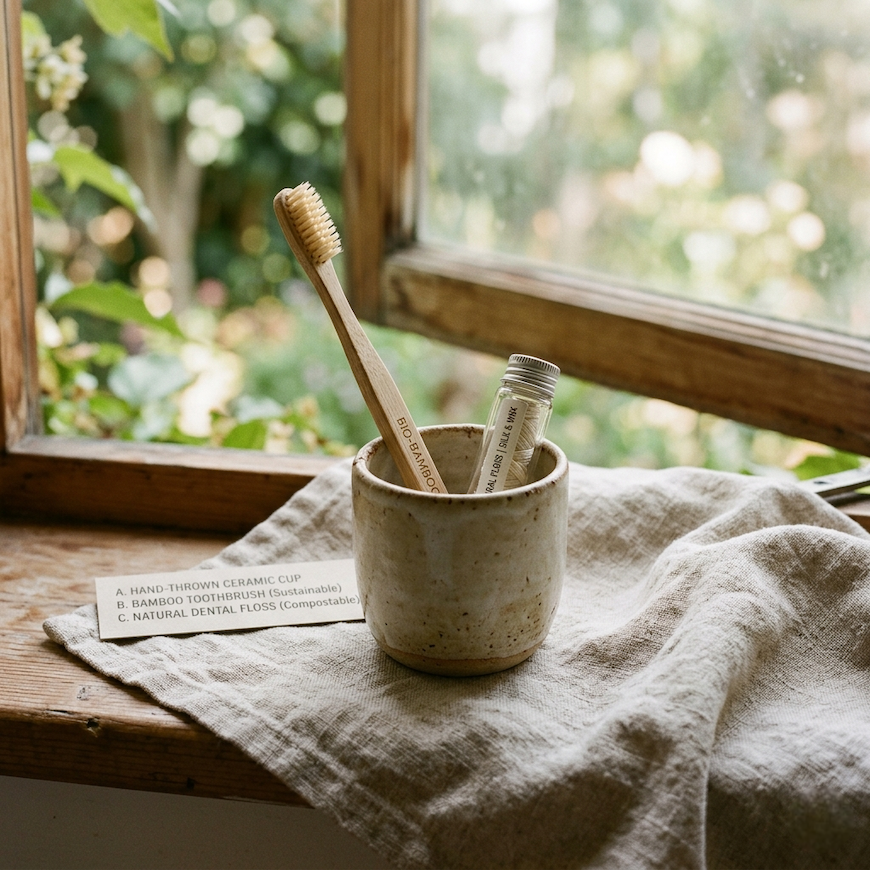
The easy swap: Swap your current brush for a soft-bristle model; an ADA seal on the packaging confirms it meets the safety and efficacy standards. If the budget stretches, an electric toothbrush with a pressure sensor is the most reliable way to stop yourself brushing too hard, since it cuts the oscillation the moment you push past the recommended pressure.
Even with a soft brush, how you move it matters. This oral hygiene habit is less about the tool and more about the motion.
Brushing your teeth is not scouring a pan. The force it takes to remove plaque biofilm is tiny, because the bacteria haven’t hardened into calculus yet, which takes anywhere from 24 to 72 hours. Morning and evening, all you’re lifting off is soft biofilm. Light circular motions with the Bass technique, where you angle the bristles 45 degrees to the gum line and use small circular strokes, beat aggressive back-and-forth scrubbing on both counts, for plaque removal and for sparing the tissue.
The damage from aggressive brushing piles up over years. If you’ve been scrubbing hard since your teens, your gum line is probably showing it already, even if nobody’s pointed it out to you.
The easy swap: Hold your toothbrush like a pen, not like a scrubbing brush. That one change forces a lighter touch. Brush in small circles and let the bristles do the work instead of driving them into your gums.
This dental care habit is simple, boring, and almost universally done wrong.
Two minutes is the minimum recommended brushing time, yet most adults clock 45 to 70 seconds. The arithmetic is unforgiving. Your mouth has four quadrants, upper left, upper right, lower left, lower right, and each one wants about 30 seconds of real attention. At 60 seconds total, two quadrants get a fair go and two get a rushed swipe.
Plaque starts rebuilding the moment you stop brushing, and by 12 to 24 hours it’s a lot harder to break up. The two-minute brush is tuned to that regrowth cycle, giving you a window of protection that lasts until the next round.
The easy swap: Set the timer on your phone, or get an electric brush with a built-in two-minute timer, which most mid-range models have. If timers annoy you, pick a song you like. Most run 3 to 4 minutes, so quitting at the halfway mark still buys you 90 seconds, which beats 45.
This is one of the most counterintuitive oral care habits to change, and one of the highest-impact.
Fluoride toothpaste leaves a protective film on your enamel, and that film needs time to bind; it doesn’t lock in during your two minutes of brushing. Rinse hard the second you finish and you sluice most of it away before it’s done anything useful.
The post-brush rinse is a habit almost everyone has, usually handed down by parents who were taught the exact same thing. But the fluoride-retention evidence is clear: skipping the rinse, or doing nothing more than a small spit with no water, leaves a lot more fluoride on your enamel than a full mouthful of water does.
It’s also why dentists suggest fluoride mouthwash at a different point in the day, mid-morning, say, or right before bed once you’ve already brushed earlier. That’s not a redundant second dose. It’s supplemental fluoride at a moment when you aren’t busy rinsing it off.
The easy swap: After brushing, spit out the excess toothpaste but leave the water tap alone. Let that thin toothpaste film stay on your teeth. It feels odd for a few days. Inside a week it feels normal, and your enamel is measurably better protected for it.
Now the reverse problem, and one of the most misunderstood oral care habits, because the advice sounds like it’s arguing with itself.
Acidic food and drink, citrus, coffee, soda, anything vinegar-based, even some fruit, soften your enamel for a while. For 30 to 60 minutes after that acid hits, the enamel surface sits in a slightly demineralized, softened state. Brush in that window and you’re not just cleaning, you’re scrubbing softened enamel clean off the tooth. That’s abrasion, not hygiene.
Saliva re-hardens enamel on its own after an acid exposure, but it needs time, usually 30 to 45 minutes for a full recovery. Holding off until then keeps the brush from doing mechanical damage while the enamel is at its most vulnerable.
This is the mechanism behind the enamel risk people warn about with lemon water and other acidic morning drinks. The harm comes from brushing too soon afterward. It’s also why a lot of dentists now say that for anyone who eats acidic things in the morning, brushing before breakfast beats brushing after.
The easy swap: If your morning involves acidic food or drink, give it 30 to 45 minutes before you brush. Or flip the order, brush before breakfast and just rinse with water afterward. Either way your enamel gets its fluoride coat before the acid arrives, and you’re never scrubbing it while it’s soft.
Related: Is lemon water good for you? The benefits, and the enamel risk most people miss →
This is the oral hygiene habit gap behind the most preventable dental work adults end up paying for.
A toothbrush, even a great one in skilled hands, can’t reach the contact points between your teeth, and those interdental spaces make up roughly 35% of each tooth’s surface. The bacteria that drive cavities and gum disease are every bit as busy there as on the faces a brush can reach. Skip flossing and you leave a third of every tooth permanently unbrushed.
The evidence on flossing and gum disease prevention is solid. The NIH National Institute of Dental and Craniofacial Research notes that gum disease, which starts as gingivitis in the very pockets flossing disrupts, affects nearly half of adults over 30. Left alone, it’s one of the leading causes of tooth loss, and it’s tied to systemic inflammation.
An honest heads-up: if you haven’t flossed regularly and then you start, your gums will bleed for the first week or two. Don’t read that as a reason to quit. It’s the built-up inflammation in those pockets getting disturbed, and it settles down fast once flossing becomes routine.
The easy swap: Floss once a day, at night, right before your last brush. The order matters. Floss first to loosen the debris and bacteria wedged between your teeth, then brush to sweep it all out. Floss picks are fine if string feels fiddly, and water flossers like a Waterpik work well for anyone with bridgework or braces.
Related: Anti-inflammatory foods: how chronic inflammation starts in places like the gums →
Mouthwash timing is one of the most commonly muddled oral care habits.
Most people reach for mouthwash right after brushing, as the last move in the routine. It feels logical: rinse, spit, done. The catch is that both antibacterial and fluoride mouthwashes interfere with the fluoride film your toothpaste just laid down. You spend two minutes coating your enamel in fluoride, then rinse it straight off with a different liquid.
A better sequence keeps mouthwash away from your brushing time altogether, so use it mid-morning, mid-afternoon, or right before bed on an occasion when you’re not also brushing. Used that way it acts as extra fluoride instead of cancelling out your toothpaste.
If your mouthwash is a cosmetic, non-fluoride one you swish purely for fresh breath, using it after brushing matters less. But with any fluoride mouthwash, keeping it separate from brushing is worth doing.
The easy swap: Shift your mouthwash to a different slot than your toothbrush. Easiest version: use it mid-morning, after your coffee and before your first meal. You get fresher breath and a bonus fluoride dose at a time when it isn’t competing with your toothpaste.
Bad breath is one of those oral care habits signals people tend to either normalize or paper over instead of looking into. It deserves a closer look.
Occasional bad breath, after coffee, after a garlicky lunch, on an empty stomach, is normal and not a dental issue. Persistent bad breath that comes back no matter what you do is a symptom. Usually the source is gum disease, where the bacteria pumping out volatile sulfur compounds are the same ones inflaming your gums. It can also be dry mouth, since saliva is antibacterial and its absence lets bacteria run wild, or cavities harboring active bacteria, tonsil stones, or now and then a systemic issue involving the gut or liver.
There’s a quick self-check for it. Lick the back of your wrist, let it dry for about 10 seconds, then smell it. That’s a rough stand-in for what your breath smells like to everyone else. If it’s reliably unpleasant despite good oral hygiene habits, raise it with a dentist.
Mouthwash, mints, and tongue scrapers all chase the odor without touching the source, so they cover the problem rather than fixing it. And persistent bad breath happens to be one of the easier things for a dentist to diagnose, if you actually bring it up.
The easy swap: When breath stays unpleasant, add a tongue scraper to your morning routine, since the surface of the tongue is one of the biggest bacterial colonies in the mouth, drink more water across the day, and if it lingers, flag it at your next dental visit as a specific concern rather than an afterthought.
This is the oral care habit that carries the biggest financial and health price tag.
A check-up every six months earns its keep two ways. There’s the professional cleaning that scrapes off calculus, the hardened tartar no home brush will ever shift, and there’s early detection of problems that cost far less to treat at the start than once they’ve progressed. A small cavity caught at a six-month visit is a 20-minute filling. Ignore it for 18 months and you may be looking at a root canal. A gum pocket caught early reverses with a scaling; caught years late, it can mean surgery.
The CDC’s oral health data puts the cost of dental disease to individuals and health systems in the hundreds of billions a year, and most of that money goes toward issues that started out preventable or easy to treat before anyone caught them.
If you skip the dentist because the chair makes you anxious, that’s common and entirely understandable, and practices today have far more options for nervous patients than they did even ten years ago. Say so when you book. Plenty of offices now offer accommodations for anxious patients that genuinely change how the visit feels.
The easy swap: Book the next six-month appointment before you walk out of the current one, every single time. If every six months is too much to commit to, twice a year is the evidence-based floor. Treat it as the one oral care habit that backstops everything else you might be getting wrong.
This part matters more than most wellness content lets on.
Gum disease, in particular, isn’t only a mouth problem. Chronic gum inflammation tracks with higher systemic inflammation, which ties into cardiovascular disease, metabolic trouble, and immune function. Bacteria from infected gum pockets can slip straight into the bloodstream. Several large population studies have linked gum disease to elevated cardiovascular risk, though researchers are still sorting out how much is cause and how much is correlation.
The takeaway isn’t that your gums are giving you heart disease. It’s that oral care habits sit inside a bigger picture of inflammatory health, and the mouth isn’t walled off from the rest of the body. What you do, or skip, between your teeth and gums has knock-on effects that dental research is still working to pin down.
Related: Morning habits that change how you feel: building the routine that protects your health from the first hour →
Let me be clear about scope. These nine oral care habit changes are for prevention and general improvement in otherwise healthy adults.
If you’ve got tooth pain, marked sensitivity, visible gum recession, loose teeth, chronic bad breath that ignores every hygiene fix, white patches in your mouth, or any odd change in the tissue, that’s a dentist’s job to evaluate. Promptly. Not in six months. Now.
Oral cancer, severe gum disease, abscesses, and impacted teeth won’t resolve with better dental care habits. They need professional treatment, and getting evaluated early makes a real difference to how things turn out.
LifestyleMine writes about wellness habits for everyday maintenance and prevention. If something is actively wrong in your mouth, please go see a dentist.
Related: Signs of magnesium deficiency: a mineral that affects jaw muscle tension, sleep, and systemic inflammation →
If you can only pick one, switch to a soft-bristle brush today and stop rinsing with water after you brush. Both cost nothing and protect your teeth directly. If you can manage two, add nightly flossing. Together, those three oral care habit changes cover most of the preventable dental damage out there.
Twice a day, morning and evening, two minutes each. Brush once a day and you leave a 12-hour stretch of unchecked bacterial activity in between. Brushing after every single meal isn't necessary, and it can backfire if you do it right after acidic food, so morning and night already cover the windows that count.
Just the opposite. Electric toothbrushes with oscillating-rotating heads beat manual brushing for plaque removal pretty consistently in clinical studies. They aren't mandatory, and solid technique with a manual soft-bristle brush does the job. But if you tend to brush too hard or too fast, an electric brush with a pressure sensor and a built-in timer takes those variables off the table.
Floss first, brush for two minutes, then spit without rinsing. Save mouthwash for a separate time rather than straight after brushing. That order means you brush away whatever the floss loosened and keep the fluoride film intact afterward.
Bleeding signals existing gum inflammation, not flossing doing harm. The pockets that have gone uncleaned are carrying built-up bacterial irritation. Once you floss consistently, the bleeding clears within 7 to 14 days as the inflammation eases. If it's still there after two weeks of daily flossing, mention it to your dentist, since it can point to established gum disease.
They can, two ways. First, untreated gum disease feeds systemic inflammation, which measurably disrupts sleep. Second, nighttime grinding, or bruxism, which wears enamel down and can ache in the jaw, often rides along with poor sleep in the first place. A lot of people who grind do it during light or broken sleep. If you wake up with a tight jaw or sensitive teeth, tell your dentist.
Gum inflammation from skipped flossing clears in 1 to 2 weeks of daily flossing. The fluoride protection you get from not rinsing after brushing kicks in with every single brush. Gum recession from heavy-handed brushing stops advancing the moment your technique changes, though what's already receded won't regrow without a procedure. On the whole, oral care habit improvements are among the fastest to show measurable results.
Nine oral care habits, and most people have at least five of them wrong.
The dentist who pointed at my gum recession at 31 wasn’t handing me bad news, she was handing me information I could still act on. I changed brushes that week. Dropped the post-brush rinse. Got consistent about flossing. Started brushing before acidic food instead of after. The recession I’d already caused didn’t come back, but it stopped advancing, and my next two check-ups looked nothing like the previous decade of visits.
Teeth and gums are almost entirely a maintenance story. The cost of upkeep is small, the right brush, two honest minutes, a meter of floss every night. The cost of neglecting your oral hygiene habits is wildly out of proportion to the cost of keeping up with them.
The habits take under five minutes a day. The dentist bill for skipping them does not.
All content on LifestyleMine is for informational and educational purposes only. It is not a substitute for advice from a qualified dental or healthcare professional. If you are experiencing tooth pain, gum recession, bleeding that doesn’t resolve, or any unusual changes in your mouth, please consult a dentist promptly.
Mimo Karam is the founder and writer at LifestyleMine. She writes about daily habits, nutrition, sleep, and emotional wellness, turning research into practical advice for people who want to live healthier without making it complicated.