ADVERTISEMENT

What Cannot Be Cooked in an Air Fryer (And What Works Best)

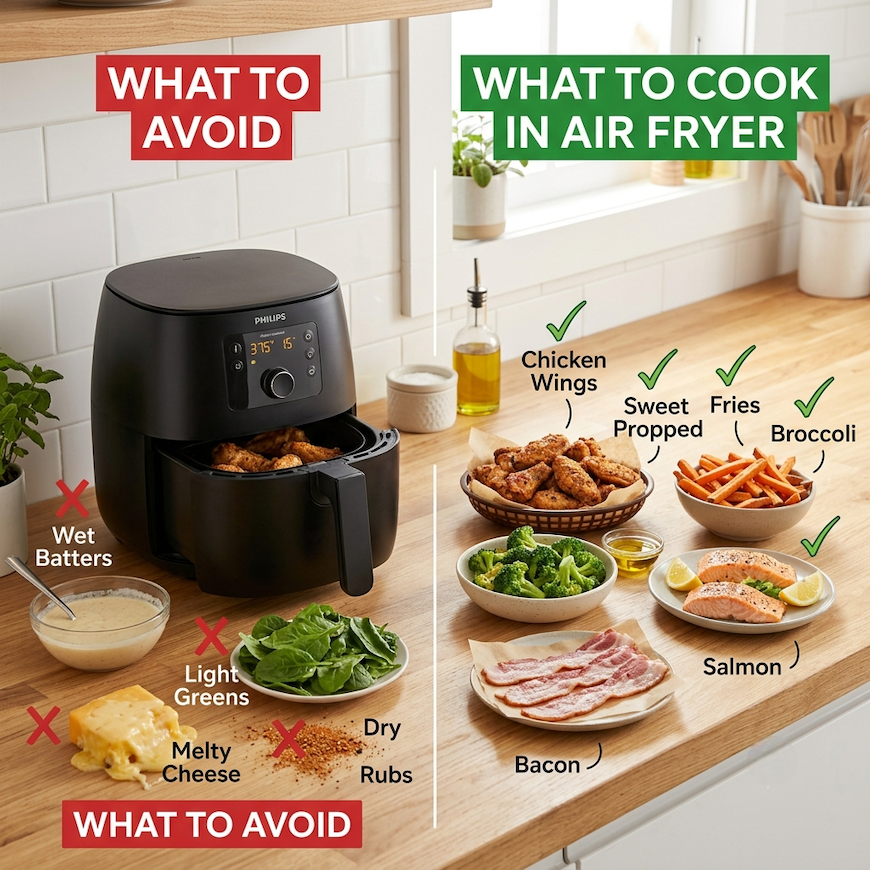
Various foods on a kitchen counter next to an air fryer showing what to cook and what to avoid - what cannot be cooked in an air fryer

What Cannot Be Cooked in an Air Fryer?

Quick Answer: What cannot be cooked in an air fryer reliably: wet batters (they drip before they set), uncoated cheese (it melts straight through the basket vents), leafy greens (the fan blows them around and chars them), popcorn (kernels need steady contact heat), large roasts over 4 pounds (the outside burns before the middle is done), heavily sauced foods (the liquid drips and smokes), and fresh bread dough (it needs moist heat to rise). Almost everything else cooks well once you adjust the temperature.

ADVERTISEMENT


The honest answer to what cannot be cooked in an air fryer comes back to one fact about the machine: an air fryer is a small convection oven that blows very hot, dry air, usually 200–400°F, around the food at high speed. Anything that has to be submerged in oil, needs steady contact heat across a flat surface, throws off a lot of steam, or is too light to stay put will struggle no matter how you set the dials.

Here is the full list of what cannot be cooked in an air fryer, and why each one fails:

Food Why It Fails
Wet-battered foods (tempura, beer batter) Batter runs off before it sets, leaving raw patches underneath and a mess in the basket
Uncoated cheese Melts in 60–90 seconds, drops through the basket vents, burns on the element
Fresh leafy greens (spinach, kale, arugula) The fan lifts and tosses them, so the edges char before the centre cooks
Popcorn Kernels need steady contact heat at 356–392°F; moving air heats them unevenly
Large bone-in roasts (4+ lbs) The outside overcooks before the middle reaches a safe internal temperature
Heavily sauced foods (BBQ ribs, saucy wings) Liquid drips into the drawer below, smokes, and bakes into stubborn residue
Whole large fish The delicate skin sticks and tears, and the narrow basket makes flipping it cleanly hard
Fresh bread dough Needs moist heat to rise; dry air sets a hard crust before the inside finishes

Why wet batters fail: the science behind air frying

Quick Answer: Wet batters fail because they need the instant surface contact of 375°F oil to set within seconds. Drop battered food into hot oil and a crust forms almost immediately. In an air fryer, the batter runs down the sides before any crust can form, so you end up with coating that is raw in some spots and dry in others.

To understand what cannot be cooked in an air fryer, it helps to know what the machine actually does. The name is misleading. Air frying is really convection baking with a steep heat gradient and almost no moisture.

A dry surface is what browns. The browning that makes fried food taste good, the Maillard reaction, kicks in when sugars and amino acids react above about 280°F (138°C). For that to happen, the surface of the food has to be fairly dry. Deep frying dries it instantly by surrounding wet food in oil. An air fryer gets there a different way, by blowing very hot, dry air over the surface. Foods that can survive that fast surface drying (chicken skin, potato slices, frozen breaded items) do well. Foods that cannot hold their shape until the surface dries fall apart.

There is also the acrylamide question. Above 248°F (120°C), starchy foods produce acrylamide, a chemical that forms when the amino acid asparagine reacts with reducing sugars under dry heat. Tareke and colleagues (2002) were the first to identify acrylamide across a wide range of cooked starchy foods, including fried potatoes and cereals (Tareke et al., 2002). An air fryer running at its top setting (400°F/204°C) can form acrylamide in starchy foods much as deep frying does.

The advantage of air frying here is not that it removes acrylamide but that it cuts fat absorption. In fact, Sansano and colleagues (2015) found that air frying reduced acrylamide in fried potatoes by roughly 90% compared with deep-oil frying, even without any pretreatment (Sansano et al., 2015). Cooking starchy foods at 330–350°F rather than maxing out the temperature, and stopping before they turn deep brown, lowers acrylamide in any method.

In plain terms:

  • Pre-breaded frozen foods work because the breading was made for dry heat
  • Homemade wet batter (flour, egg, liquid) does not
  • Panko crumbs with an egg wash work; liquid tempura batter does not

Cheese, eggs, and delicate ingredients

Quick Answer: Uncoated cheese melts and falls through the basket vents before it can brown. Eggs do fine when you cook them in a silicone cup or ramekin, but they stick and burn straight in the basket. The trick with delicate ingredients is simple: use a parchment liner or a silicone accessory and the air fryer handles them.

ADVERTISEMENT


Not everything on the what cannot be cooked in an air fryer list is a total write-off. Plenty of delicate ingredients work with the right tool.

Cheese is a case-by-case thing:

  • Hard cheese bonded to a protein surface (halloumi, parmesan-crusted chicken) does very well
  • Soft cheese on its own (brie, cheddar, mozzarella) melts in 60–90 seconds before it can brown
  • Frozen breaded mozzarella sticks work straight from frozen, because the breading sets before the cheese melts

Eggs depend on containment:

  • Scrambled or fried straight in the basket does not work, since there is no non-stick surface and nothing to hold the egg
  • Hard-boiled eggs work surprisingly well at 250°F for 16 minutes, placed right in the basket
  • Eggs in silicone cups or ramekins are great for baked eggs, mini frittatas, and egg muffins

Fish is similar:

  • Salmon fillets and cod portions do very well with a light oil spray and a parchment liner
  • Whole fish with skin tends to stick and tear without a dedicated grill rack

Leafy greens, popcorn, and other surprising failures

Quick Answer: Leafy greens get blown against the heating element and char at the edges before the middle cooks. Popcorn fails because kernels need steady contact heat at 356–392°F, which moving air cannot hold. Both sit near the top of any list of what cannot be cooked in an air fryer, and both are reliably disappointing.

Some of what cannot be cooked in an air fryer can be surprising, because the food looks like a good candidate.

Take leafy greens (spinach, kale, arugula). The fan that makes air frying work, usually 1,500–2,000 RPM, lifts and throws lightweight leaves around. Instead of cooking evenly, they slam against the element, char in seconds, and leave the rest of the basket raw. The exception is kale chips: tear the kale into bigger, heavier pieces, cook at 300°F in a single layer, and it crisps nicely. Size and weight are what decide it.

Popcorn is a different problem. Corn kernels have to hit 356–392°F (180–200°C) while sealed inside their hull, so steam pressure builds until they burst. In an air fryer, hot air surrounds each kernel but cannot keep up the even pressure contact a popper provides. You get maybe 20–40% of kernels popping, the popped ones burning before the rest catch up, and a kitchen that smells like scorched hulls.

Fresh pasta also struggles. Dried pasta works at very low heat with the odd shake (for pasta chips). Fresh pasta carries too much surface moisture, so it steams from the inside and turns gummy instead of crisping.

Whole large tomatoes and stone fruit round out what cannot be cooked in an air fryer, for the same reason. The water content throws off so much steam that the fruit collapses or bursts before the surface can brown.

The best foods to cook in an air fryer

Quick Answer: The foods that shine in an air fryer are bone-in chicken thighs, salmon fillets, frozen vegetables, hard-boiled eggs, canned chickpeas, frozen appetizers (dumplings, spring rolls, mozzarella sticks), and leftover pizza. They all play to the machine’s one real strength: fast, even, dry-heat browning with barely any oil.

ADVERTISEMENT


If you know what cannot be cooked in an air fryer, the flip side is worth having too. These are the steady performers.

Bone-in chicken thighs. The air fryer renders the fat beautifully in 22–25 minutes at 380°F and gives you crispier skin than an oven, without the splatter of a stovetop pan. The bone slows the cooking just enough to keep the inside juicy.

Salmon fillets, 1 to 1.5 inches thick. At 400°F for 8–10 minutes with a light oil spray, salmon gets a slightly crisp outside and stays moist within. Shaving 4 or 5 minutes off the oven time matters on a weeknight.

Frozen vegetables (broccoli, Brussels sprouts, cauliflower). This is where the air fryer does something an oven struggles with: it caramelises frozen vegetables without defrosting them first. At 400°F for 12–15 minutes with a light spray, frozen broccoli gets charred edges that a lot of people prefer to the steamed version.

Chickpeas, canned, drained, dried, and tossed in oil. At 380°F for 20–25 minutes they turn into a crisp snack on a fraction of the oil pan-frying would need. One of the appliance’s most efficient tricks.

Reheating pizza, fried chicken, and fries. The air fryer is about the only common appliance that brings leftover pizza and fried food back close to the original texture. A microwave adds moisture; an air fryer takes it away. Three or four minutes at 350°F revives pizza with a crisp base instead of a soggy one.

Small-batch baking (muffins, cupcakes, cookies). Air fryers preheat faster than ovens and hold temperature well in a small space. For a single batch in silicone cups or a small parchment-lined pan, the results often beat a half-empty oven.

Air fryer temperature guide

Quick Answer: Most foods do best between 350°F and 400°F. Use the low end (325–350°F) for delicate proteins and baked goods, the middle (375°F) for vegetables and reheating, and the top (400°F) for frozen foods, skin-on chicken, and anything you want very crisp. As a rule, drop oven recipes by 25°F and cut the time by about 20%.

Once you have ruled out what cannot be cooked in an air fryer, the rest is a matter of dialing in temperature. The standard conversion is straightforward: set the air fryer 25°F below what an oven recipe calls for, and trim the cooking time by 20–25%. The fan makes the heat behave as if the oven were 25°F hotter.

Food Temperature Time Notes
Bone-in chicken thighs 380°F / 193°C 22–25 min Flip at 12 min; internal temp 165°F
Boneless chicken breasts 370°F / 188°C 16–18 min Pound to even thickness first
Salmon fillet (1 inch thick) 400°F / 204°C 8–10 min Light oil spray; no flip needed
Shrimp 400°F / 204°C 6–8 min Single layer; flip at 4 min
Pork chops (boneless) 380°F / 193°C 14–16 min Internal temp 145°F
Steak (1 inch thick) 400°F / 204°C 10–14 min Flip at 6 min; rest 5 min after
Brussels sprouts (fresh, halved) 380°F / 193°C 12–15 min Light oil; shake at 8 min
Broccoli florets 400°F / 204°C 10–12 min Shake basket at 6 min
Frozen French fries 400°F / 204°C 15–18 min Single layer; shake at 10 min
Frozen chicken nuggets 400°F / 204°C 10–12 min No extra oil needed
Hard-boiled eggs 250°F / 121°C 16 min Place directly in basket, no water
Reheating pizza 350°F / 177°C 3–4 min Direct in basket
Muffins / cupcakes 325°F / 163°C 12–14 min Silicone cups; rotate at 8 min
Chickpeas (canned, dried) 380°F / 193°C 20–25 min Toss in oil first; shake at 12 min

Is air frying actually healthy? What the research shows

Quick Answer: Air frying is healthier than deep frying because it uses 70–80% less oil, which cuts calories and saturated fat. It does not erase acrylamide in starchy foods, but it produces less than deep frying. It is not healthier than steaming or poaching. It is an improvement on frying specifically, not on every cooking method.

ADVERTISEMENT


Knowing what cannot be cooked in an air fryer is one thing; knowing whether the cooking is good for you is another. Here is the health comparison between an air fryer and a deep fryer, with the studies attached where they exist.

The fat reduction is real. Because an air fryer needs only a teaspoon or two of oil instead of a full bath, a serving of home-made air-fried fries carries roughly 150 fewer calories than the deep-fried version. That is the appliance’s strongest health argument.

Acrylamide drops compared with deep frying, but it does not disappear. Tareke and colleagues (2002) identified acrylamide across a range of heated starchy foods, including fried potatoes (Tareke et al., 2002). Later work backed up the cooking-method difference: Sansano and colleagues (2015) measured a roughly 90% reduction in acrylamide for air-fried potatoes versus deep-oil frying at the same 180°C (356°F) (Sansano et al., 2015). The practical takeaway is the same either way: cook starchy foods at 330–350°F instead of the maximum, and stop before they go deep brown.

What air frying does not fix:

Acrolein. Heat cooking oil past its smoke point and it gives off acrolein, an irritant tied to respiratory effects. An air fryer at 400°F with a low-smoke-point oil, butter (300°F) or unrefined coconut oil (350°F), will generate it. Use high-smoke-point oils instead: avocado (520°F), refined coconut (450°F), or light olive (375–405°F).

Nutrient retention. Air frying is no kinder to heat-sensitive vitamins (C, B1, folate) than oven baking. Boiling and steaming hold on to more water-soluble vitamins than any dry-heat method.

So the bottom line: if you deep-fry often, switching to an air fryer is a real upgrade. If you already bake or grill, the health gap is small. What the air fryer actually buys you is speed, convenience, and crisp vegetables without much added fat.

For how cooking method changes the nutritional value of specific anti-inflammatory foods, see our anti-inflammatory foods guide. A lot of the foods on that list (broccoli, Brussels sprouts, salmon, chickpeas) happen to be among the air fryer’s best performers.

Read also: Is an Air Fryer Healthy? What the Research Actually Shows

The best air fryers to buy in 2026

Quick Answer: For most households the Ninja AF101 (4-quart, around $99) is the pick for 1 to 3 people. For families of 4 or more, the Ninja AF161 Max XL (5.5-quart) or the Philips Premium XXL (7-quart) make more sense. Basket size is the spec that matters most: if you cannot cook in a single layer, you lose the crispness the whole appliance is built around.

ADVERTISEMENT


Once you know what cannot be cooked in an air fryer and what cooks best, the next question is which machine to buy. Here is the 2026 buying guide, including a couple of Ninja models worth a look.

Model Capacity Best For
Ninja AF101 4 qt 1–3 people; first air fryer; everyday use
Ninja AF161 Max XL 5.5 qt Families of 4; larger cuts; 450°F Max setting
Philips Premium XXL 7 qt Large families; batch cooking; Fat Removal basket
Cosori Pro Gen 2 5.8 qt Tech users; preheat reminder; app connectivity
Instant Vortex Plus 6 qt Multi-function (bake, roast, dehydrate, broil)

Ninja AF101 Air Fryer: The AF101 is the best-selling air fryer on Amazon for plain reasons: it fits a 3-lb chicken, heats up in under 3 minutes, the basket is dishwasher-safe, and the single-dial interface with four functions (air fry, roast, reheat, dehydrate) is easy to figure out. At 4 quarts it handles 2 to 3 servings a cook. For a first air fryer covering everyday use, this is the default.

Ninja AF161 Max XL Air Fryer: The extra 1.5 quarts over the AF101 matters more than it sounds. You can fit a full rack of chicken thighs or a pound of Brussels sprouts in one layer without batching. The Max setting (450°F) adds room for high-heat searing. The best pick for a household of 4.

Philips Premium Airfryer XXL: Philips put out the first consumer Airfryer back in 2010. The XXL’s ridged Fat Removal basket lifts food off its own drippings, so it comes out lower in fat than a flat-basket design. At 7 quarts it takes a 4 to 5 lb whole chicken. It is the priciest option here, and the only one with that basket geometry.

Air Fryer Parchment Paper Liners: Pre-cut parchment liners are the single most useful accessory. They stop sticking, make cleanup easy, and let you cook delicate fish, eggs, and baked goods without wrecking them. One rule: never preheat with an empty liner in the basket, because the fan will lift it against the element, and that is a fire hazard.

Air Fryer Accessories Kit: A multi-piece kit with a baking pan, grill rack, pizza pan, and skewers opens up a lot more cooking. The grill rack lifts meat for better airflow on all sides; the baking pan makes egg cups and muffins practical. Check your basket diameter before you order, since most kits list compatible models on the product page.

Air fryer tips for good results every time

Quick Answer: The four tips that matter most: cook in a single layer (stacking means steaming, not frying); preheat for 3 minutes before the food goes in; dry the surface of the food first, because moisture kills crispness; and shake or flip at the halfway mark for even browning.

A few habits make most of the difference once you have sorted out what cannot be cooked in an air fryer.

Single layer is non-negotiable. Air frying works by moving hot air over every surface at once. Crowd the basket and the bottom layer steams in the moisture coming off the food above instead of crisping. For a big batch, cook in two rounds. The total time is often the same or less, because each uncrowded round cooks faster.

Always preheat. Most air fryers hit temperature in 2 to 4 minutes. Add food to a cold one and it cooks unevenly and misses the burst of surface heat that triggers browning. Preheat at the target temperature for 3 minutes first. New users skip this step; experienced ones never do.

Dry everything before it goes in. Pat proteins dry. Drain and thoroughly dry canned chickpeas. Toss vegetables in oil after they are dry, not before. Surface moisture turns to steam, and steam competes with browning. One to two teaspoons of oil per pound of food is plenty for most things.

Shake or flip at the midpoint. The bottom of the basket gets direct upward airflow; the top gets it second-hand. Shaking the small stuff (fries, chickpeas, vegetables) or flipping the big stuff (proteins, fish) halfway through evens out the browning.

Reheat at a lower temperature. At 400°F, leftovers dry out in 2 to 3 minutes. At 350°F, pizza, pasta, fries, and cooked chicken come back in 3 to 5 minutes with the texture close to new. A tablespoon or two of water in the drawer below the basket also keeps fat drippings from smoking.

Use a meat thermometer. Airflow varies between brands and models, and recipe times are estimates. A thermometer takes out the guesswork: chicken 165°F, pork 145°F, beef medium 135–140°F. This matters more here than in an oven, because the cooking can outrun the visual cues.

For more on which foods give the best nutritional return with minimal processing, see our anti-inflammatory eating guide. Many of the highest-impact foods on that list are also among the air fryer’s best performers.

ADVERTISEMENT


Frequently asked questions

Yes. Muffins, cupcakes, brownies, cookies, and small cakes all do well in silicone cups or a small parchment-lined pan that fits the basket. Drop the temperature 25°F from the oven recipe and start checking 5 minutes early. The air fryer bakes faster thanks to the concentrated fan heat in a small space.

Clean it after every use. Take out the basket and pan and wash them in warm soapy water, or the dishwasher if the maker allows it. Wipe the interior with a damp cloth once it cools. For stuck-on residue, soak the basket in warm soapy water for 20 minutes before scrubbing. Clean the heating coil with a soft brush when it is fully cool, since grease on the coil is the main cause of smoking.

For 1 to 2 people: 2 to 3 quarts. For 2 to 3 people: 4 to 5 quarts (the Ninja AF101 at 4 quarts is the best seller in this range). For 4 or more: 5.5 to 7 quarts. The one real constraint is single-layer cooking, so buy bigger than you think you need. Overfilling is the most common mistake, and it gives the kind of mediocre results that make people think the appliance does not work.

Yes, and it is one of the best uses for it. Frozen fries, nuggets, fish sticks, dumplings, spring rolls, and mozzarella sticks all cook from frozen at 400°F in 10 to 15 minutes, no thawing. Add 2 to 3 minutes for food straight out of a very cold freezer. Always keep frozen foods in a single layer.

For a household that reheats in the microwave and cooks weeknight dinners in the oven: yes. The short list of what cannot be cooked in an air fryer is far outweighed by what it does well. Two use cases carry the cost on their own. Reheating leftovers, where it is the only appliance that brings back crispness, and cooking frozen foods faster and crisper than an oven. If you cook mostly from scratch and already own a convection oven, the edge is smaller. For a small household it also stands in for the oven on single-batch baking and sides, which uses less energy than heating a full-size oven.

Scroll to Top