✦
THE LIFESTYLEMINE NEWSLETTER
Simple wellness tips, healthy recipes, and
everyday inspiration delivered to your inbox.
Your Email Address
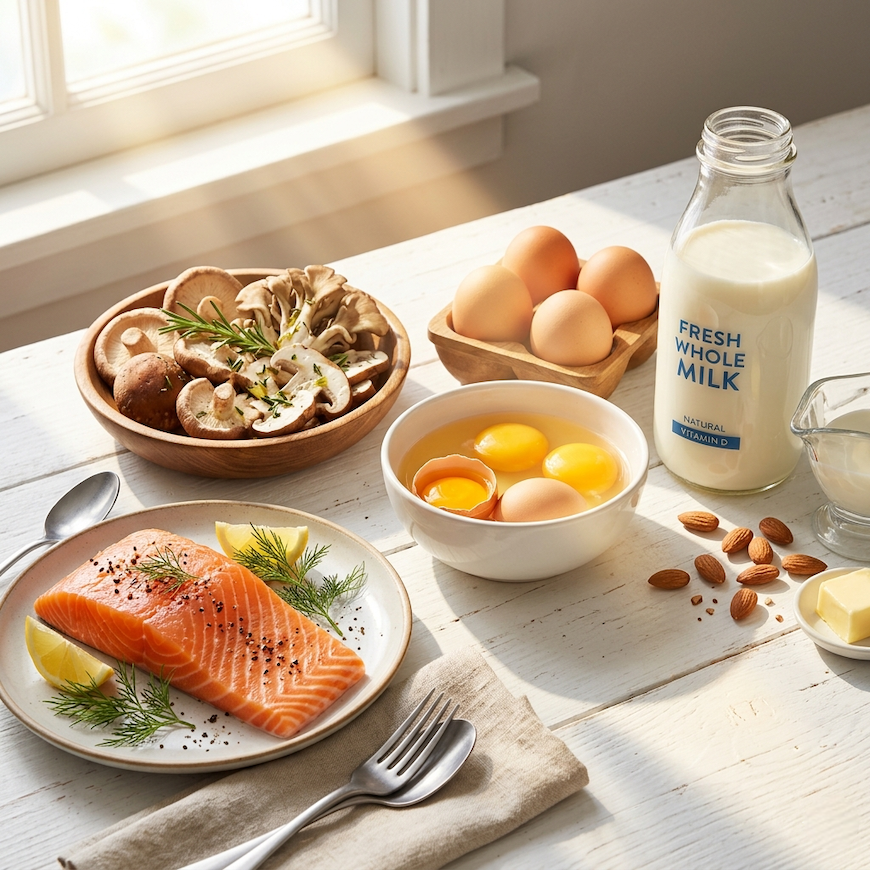
Quick Answer: Best natural sources by IU per serving, from USDA FoodData Central data: wild salmon (3oz/85g) = 441-988 IU; rainbow trout (3oz) = 645 IU; swordfish (3oz) = 550 IU; mackerel (3oz) = 360 IU; canned tuna in water (3oz) = 154 IU; sardines (one 3.75oz can) = 178 IU; herring (3oz) = 216 IU; cod liver oil (1 tsp) = 448 IU; beef liver (3oz) = 42 IU. Fatty fish are the only natural sources with clinically meaningful concentrations.
Here’s a fuller reference table of foods high in vitamin D from natural sources:
Food
Serving
Vitamin D (IU)
% Daily Value (800 IU)
Wild salmon (sockeye)
3oz/85g
441-988 IU
55-123%
Farmed Atlantic salmon
3oz/85g
245-529 IU
31-66%
Rainbow trout
3oz/85g
645 IU
81%
Swordfish
3oz/85g
550 IU
69%
Mackerel
3oz/85g
360 IU
45%
Herring
3oz/85g
216 IU
27%
Canned tuna (water-packed)
3oz/85g
154 IU
19%
Sardines (canned in oil)
3.75oz/106g
178 IU
22%
Cod liver oil
1 tsp (4.5ml)
448 IU
56%
Beef liver
3oz/85g
42 IU
5%
Egg yolk (1 large, standard)
1 yolk
37-44 IU
~5%
Pasture-raised egg
1 whole egg
160-200 IU
20-25%
UV-exposed mushrooms
3oz/85g
400-1,000+ IU
50-125%+
Standard white mushrooms
3oz/85g
4-8 IU
<1%
⚠️ Correction note: An earlier version of this article said “a serving of two eggs provides 82% of the daily value for vitamin D.” That’s wrong. Two large standard grocery store eggs provide roughly 88 IU, about 11% of the 800 IU daily value. Pasture-raised eggs from hens with outdoor access run higher (160-200 IU each), but still nowhere near 82% DV for a two-egg serving. If you’ve seen that figure elsewhere, it probably reflects exceptional pasture-raised eggs or an error in the original source.
Wild vs farmed salmon vitamin D: Among foods high in vitamin D, wild salmon sits right at the top. Wild salmon eat krill, shrimp, and other marine organisms that concentrate vitamin D up the food chain. Farmed salmon eat pellet feed with controlled vitamin content, usually delivering 45-55% less than wild-caught. Both are excellent, but wild sockeye or Alaskan salmon sit at the higher end. The omega-3 benefits article covers the parallel EPA/DHA gap, worth a look if you’re picking fish as a combined vitamin D and omega-3 source.
Cod liver oil: One of the most concentrated food sources, and the original treatment for rickets: 1 teaspoon gives you 448 IU vitamin D plus 890 IU vitamin A. The vitamin A is worth watching. A and D are both fat-soluble and compete for some metabolic pathways, so a teaspoon is fine but a daily tablespoon can push you into vitamin A excess.
Quick Answer: Most commercially grown mushrooms are raised indoors in the dark and contain almost no vitamin D (4-8 IU per 3oz). Expose them to UV light, though, either commercially (some brands now sell UV-treated mushrooms) or at home, and they synthesize vitamin D2 (ergocalciferol) through the same UV-to-ergosterol pathway human skin uses for D3. Thirty to sixty minutes of direct midday sun with the gills facing up can produce 400-1,000+ IU per 3oz serving, enough to meaningfully add to your daily intake.
Mushrooms are the rare plant entry on any list of foods high in vitamin D, and the best option if you want vitamin D without direct sun. They hold ergosterol in their cell walls, a compound that converts to vitamin D2 under UVB, the same way 7-dehydrocholesterol in human skin converts to vitamin D3 under those wavelengths.
How to UV-expose store-bought mushrooms:
Place mushrooms gill-side up on a tray or plate
Set them in direct sunlight (not through glass, which blocks UVB) between 10am and 3pm
Leave them for 30-60 minutes
The vitamin D they make is stable for several days in the fridge
A UVB lamp (the reptile kind) works if sunlight isn’t an option
The vitamin D survives cooking, though not completely: light cooking keeps more than long, high-heat methods. Portobellos left gills-up in midday sun for 60 minutes have tested at over 400 IU per 3oz serving.
The D2 caveat: Mushroom vitamin D is D2 (ergocalciferol), not D3 (cholecalciferol). That matters for absorption, which the next section gets into.
Quick Answer: Fortified foods are the second tier. They don’t deliver big doses per serving, but they add up over a day. Fortified cow’s milk: 115-130 IU per 8oz cup (standard US practice, though not legally required). Fortified OJ: about 137 IU per 8oz. Fortified plant milks: 100-144 IU per cup (varies by brand, so check the label; not all plant milks are fortified). Fortified breakfast cereals: 40-100 IU per serving. Together, that’s 300-500 IU/day for someone who eats fortified foods regularly.
Fortified Food
Serving
Vitamin D (IU)
Notes
Cow’s milk (fortified)
8oz/240ml
115-130 IU
US practice; not legally required
Fortified orange juice
8oz/240ml
137 IU
Check label, not all OJ is fortified
Soy milk (fortified)
8oz/240ml
100-120 IU
Varies by brand
Almond milk (fortified)
8oz/240ml
100-144 IU
Varies by brand
Oat milk (fortified)
8oz/240ml
100-130 IU
Varies by brand
Fortified yogurt
6oz/170g
80-100 IU
Varies by brand
Breakfast cereal (fortified)
1 cup
40-100 IU
Varies widely; check label
Fortified margarine
1 tbsp
60 IU
Less commonly consumed
Label reading note: “Contains vitamin D” on a plant milk label doesn’t tell you how much. Some brands give you 15% DV (120 IU), others 25% DV (200 IU). The actual number is in the nutrition facts panel under “Vitamin D.”
The supplements for healthy aging article covers the vitamin D3+K2 angle in detail, the K2 piece that steers calcium from vitamin D into bone rather than arterial walls. Fortified foods usually use D3, which absorbs better than D2, and for a lot of people they’re the most reliable everyday foods high in vitamin D.
Quick Answer: D3 (cholecalciferol) is the form human skin makes under UVB and the form in animal foods (salmon, eggs, fortified cow’s milk). D2 (ergocalciferol) is the form in mushrooms and most plant-based fortified foods. A 2012 AJCN meta-analysis by Tripkovic et al. comparing D2 and D3 supplementation found D3 raised serum 25-OHD 87% more effectively than D2 at the same IU dose. The same logic applies to food: 400 IU from UV mushrooms (D2) raises blood levels less than 400 IU from salmon (D3).
Not all foods high in vitamin D deliver the same form of it. This matters most for vegans and vegetarians, who lean on plant-based D2. A vegan eating UV mushrooms and fortified plant milks is getting mostly D2, and if their 25-OHD stays low despite the effort, switching to a lichen-based vitamin D3 supplement usually corrects things faster than the same dose of D2.
Why does D2 perform worse? The liver converts both D2 and D3 to 25-OHD, the storage form your blood test measures. D3 binds vitamin D-binding protein (DBP) more tightly and converts more efficiently. D2 also clears from the blood faster, so consistent daily intake matters more than the same total dose taken less often.
For people getting their vitamin D from food rather than pills, the gap matters most in borderline cases. If you eat salmon two or three times a week (D3) and your 25-OHD sits at 28 ng/mL, leaning on UV mushrooms as your main source would move the needle slower than fatty fish or a D3 supplement.
Quick Answer: The US RDA is 600 IU/day for adults 18-70 and 800 IU/day for adults 70+. The Endocrine Society recommends 1,500-2,000 IU/day for adults at risk of deficiency, a notably higher target based on clinical outcome data. To hit 1,500 IU/day from food alone, you’d need wild salmon five or six days a week plus fortified milk daily, which isn’t realistic for most people. The evidence-based approach combines targeted food sources, measured sun exposure, and supplementation guided by 25-OHD testing.
The landmark 2007 NEJM review by Holick , cited over 4,000 times, set the deficiency framework: serum 25-OHD below 20 ng/mL is deficient, 21-29 ng/mL is insufficient, and 30 ng/mL is the minimum for bone health benefits. Most vitamin D researchers put the optimal range for non-skeletal benefits (immune function, cancer risk reduction, cardiovascular protection) at 40-60 ng/mL.
What dietary combination gets you closest to 1,500 IU/day:
Food Combination
Daily IU Contribution
Wild salmon (3oz, 3x/week avg)
~200 IU/day
Fortified milk (2 cups/day)
~240-260 IU/day
Fortified plant milk (2 cups/day, alt)
~200-288 IU/day
UV-exposed mushrooms (3oz, 3x/week avg)
~170 IU/day
2 pasture-raised eggs daily
~320-400 IU/day
Fortified cereal (1 cup/day)
~60-100 IU/day
Cod liver oil (1 tsp daily)
448 IU/day
Aggressive dietary approach total ~700-1,000 IU/day
Even when you stack the best foods high in vitamin D, an aggressive food-first approach (fatty fish, fortified dairy, UV mushrooms, pasture-raised eggs) usually tops out around 700-1,000 IU/day, below the 1,500 IU/day recommended for correcting deficiency. The signs of magnesium deficiency article covers a related point: magnesium is needed to convert vitamin D into its active form, so a shortfall can stall it even when your serum level looks fine.
Quick Answer: Anyone with confirmed deficiency (25-OHD below 20 ng/mL) needs supplementation; food alone can’t reach optimal levels in a reasonable timeframe. The test is the serum 25-hydroxyvitamin D (25-OHD) blood test, available through a GP or direct-to-consumer labs. Target 40-60 ng/mL for most adults. Use D3 (cholecalciferol), which raises levels better than D2 at equal doses. It’s fat-soluble, so take it with your largest meal, and pair it with K2-MK7 to direct the extra calcium absorption toward bone rather than arteries.
When foods high in vitamin D can’t close the gap on their own, a blood test tells you how far supplementation has to go. Who’s most likely to fall short on vitamin D from food alone:
People living above 37° latitude through winter (October to April across much of the northern US)
People with darker skin tones (melanin lowers UV synthesis efficiency)
People who work indoors with little midday sun
Adults over 65 (skin synthesis efficiency drops about 75% with age)
People eating vegan or vegetarian diets (no fatty fish, limited egg yolks)
People with fat malabsorption conditions (Crohn’s disease, celiac, short bowel syndrome, cystic fibrosis)
People with obesity (vitamin D is fat-soluble and gets sequestered in fat tissue, lowering bioavailability)
People on medications that affect vitamin D metabolism (glucocorticoids, anticonvulsants, rifampin)
The protocol is simple: test first (a 25-OHD blood test runs $30-60 without insurance and is often covered as preventive care), then calibrate food and supplementation against your actual number instead of guessing. The protein calculator article uses the same “test, then target” logic, and it applies just as well to vitamin D.
Because most people eat far less fatty fish than guidance suggests, spend little time in midday sun with enough skin exposed, and fill up on foods that look healthy (salads, vegetables, grains) but carry essentially no vitamin D. The narrow set of foods high in vitamin D, set against how little of them most people actually eat, is the core of the deficiency problem. Geography piles on too: someone in Boston from October through March makes essentially zero vitamin D from sun.
Modestly. Baking, steaming, or pan-frying at moderate temperatures keeps roughly 70-90% of the original content. Boiling (fish in soup or stew) can lose more if you don't drink the liquid, and deep frying can cut content by 30-50%. Bottom line: baked or pan-cooked salmon keeps most of its vitamin D, and the loss isn't big enough to change its value as a source.
From food alone, essentially no. There's no documented case of toxicity from naturally occurring vitamin D in food. Cod liver oil in very large amounts could in theory approach concerning levels, but normal teaspoon servings are safe. Toxicity is a supplement issue at very high doses (typically above 10,000 IU/day), not a dietary one. The Institute of Medicine sets the tolerable upper intake level at 4,000 IU/day for adults, though most research shows adverse effects don't reliably show up below 10,000 IU/day.
Slowly. Serum 25-OHD shifts over weeks to months, not days. For someone deficient at 15 ng/mL eating fatty fish three times a week plus daily fortified milk (roughly 400-600 IU/day extra), reaching the sufficient 30 ng/mL takes about 3-6 months. Add a 2,000 IU D3 supplement and that drops to 6-10 weeks. Summer sun is fastest: 20 minutes of midday full-body exposure in light skin can produce 10,000-20,000 IU in one session.
On vitamin D, they're close. Most fortified plant milks (almond, soy, oat) provide 100-144 IU per 8oz, comparable to cow's milk at 115-130 IU. Both usually use D3, though some plant brands use D2, so check the label. For calcium and vitamin D together, cow's milk has natural calcium (300mg per cup) while plant milks rely on added calcium that varies by brand. For vitamin D, serving size and fortification level matter more than which milk you pick.
No. Standard grocery store eggs provide about 37-44 IU per yolk (roughly 5% DV each). Three eggs a day gets you only 110-130 IU, about 14-16% of the 800 IU DV. Pasture-raised eggs with steady outdoor UV access can hit 160-200 IU each, so three of those deliver roughly 480-600 IU (60-75% DV). A real contribution, but eggs alone won't meet daily needs, and most store eggs aren't truly pasture-raised.
This article offers general nutritional information about food sources of vitamin D. The only reliable way to check vitamin D status is a serum 25-hydroxyvitamin D blood test, since dietary estimates and sun exposure habits are poor predictors of actual blood levels. People with fat malabsorption disorders, kidney disease, or who take medications that affect vitamin D metabolism should talk to a healthcare provider before making big changes to vitamin D intake. Supplement dosing for deficiency correction should be guided by baseline 25-OHD testing and medical supervision.
Mimo Karam is the founder and writer at LifestyleMine. She writes about daily habits, nutrition, sleep, and emotional wellness, turning research into practical advice for people who want to live healthier without making it complicated.