✦
THE LIFESTYLEMINE NEWSLETTER
Simple wellness tips, healthy recipes, and
everyday inspiration delivered to your inbox.
Your Email Address
Protein intake for women versus men. The g/kg target is the same regardless of sex; protein needs per unit of body weight don’t differ meaningfully between sexes at equivalent activity and body composition. What differs is total body weight. A 58kg woman training for muscle needs about 107g/day (1.85g/kg); an 82kg man with the same goal needs about 152g/day. The protein calculator handles this through your weight input.
The 65+ adjustment. After 65, muscle protein synthesis gets less sensitive to the same dose, a phenomenon called anabolic resistance, so older adults need a higher per-kilogram intake to drive the same MPS. The PROT-AGE Study Group (2013, consensus updated 2022) recommends 1.0 to 1.3g/kg for healthy older adults and up to 1.5g/kg for those with conditions affecting muscle, above the standard RDA. The protein calculator detects age 65+ and adjusts automatically.
Quick Answer: In a calorie deficit, higher protein does two jobs: satiety (it’s 2 to 3 times more filling per calorie than carbs or fat, mainly via PYY and GLP-1) and muscle preservation (enough protein keeps the body from burning muscle for fuel). A 2012 meta-analysis in the American Journal of Clinical Nutrition found higher-protein diets produced greater fat loss and better lean mass retention than standard-protein diets at the same deficit. Target: 1.2 to 1.5g/kg.
Protein for weight loss works through mechanisms separate from, and additive to, the deficit itself. Set your goal to weight loss and the protein calculator targets this 1.2 to 1.5g/kg range.
The satiety mechanism. Protein triggers peptide YY (PYY) and glucagon-like peptide 1 (GLP-1), which signal fullness to the hypothalamus, and it suppresses ghrelin, the main hunger hormone, more effectively than the same calories from carbs or fat. A 30g protein breakfast cuts total daily calorie intake more than a calorie-matched carb breakfast in controlled trials. The anti-inflammatory foods article covers how specific foods pair satiety with anti-inflammatory benefits.
The thermic effect of food. Protein has a dietary-induced thermogenesis (DIT) of 25 to 30%, meaning a quarter to a third of protein calories get spent digesting it. Carbs run 5 to 10%, fat 0 to 3%. For someone eating 150g protein a day, that’s roughly 90 to 135 calories of extra expenditure from metabolism alone.
Muscle preservation during a deficit. In a deficit, the body can break down muscle (via gluconeogenesis) to fuel glucose-dependent processes, and more dietary protein directly reduces that loss. The leucine and branched-chain amino acids (BCAAs) from protein signal mTOR, the main regulator of muscle protein synthesis, to keep building rather than breaking muscle down even in a deficit. The protein calculator builds that protection into its weight-loss target.
Quick Answer: Muscle protein synthesis (MPS) is triggered by leucine, an essential amino acid that activates the mTOR complex 1 pathway. The leucine threshold, the minimum dose to maximally stimulate MPS, is about 2.5 to 3g per meal, equal to 20 to 30g of high-quality protein depending on the source. Below it, MPS is suboptimal no matter your daily total. That’s why spreading protein across 3 to 5 meals builds more muscle than the same total in one or two.
How much protein to build muscle is both a daily and a per-meal question, which is why the protein calculator gives a daily target while this section covers the per-meal piece.
The mTOR pathway. Leucine activates mTOR (mechanistic target of rapamycin) complex 1, which phosphorylates downstream targets including S6K1 and 4EBP1, the switches that start ribosomal protein synthesis in muscle cells. Without enough leucine at a meal, mTOR stays under-activated no matter how much protein you ate earlier. A protein “bank” from the morning doesn’t carry forward.
The leucine threshold in practice:
Chicken breast: 30g protein gives about 2.4g leucine, at or near threshold
Whey protein isolate: 25g protein gives about 2.5g leucine, above threshold
Eggs: 3 large eggs give about 1.8g leucine, below threshold on their own
Lentils: 30g protein gives about 1.5 to 1.8g leucine, below threshold
Tofu: 30g protein gives about 1.8g leucine, below threshold
Vegetarian and vegan athletes need higher total protein to clear the per-meal leucine threshold from lower-leucine plant sources.
The ISSN-supported range. The ISSN Position Stand on protein and exercise (2017, updated 2022) supports 1.4 to 2.0g/kg for most strength and endurance athletes, with up to 2.2g/kg during high-volume training or aggressive dieting. The protein calculator uses 1.6 to 2.2g/kg for recreational muscle building with activity-level modifiers. [verify URL before publishing]
Quick Answer: A complete protein has all 9 essential amino acids (EAAs) in adequate proportions. Animal proteins, meat, fish, eggs, and dairy, are complete, with PDCAAS scores near the 1.0 maximum. Most plant proteins are incomplete, soy and quinoa being the exceptions. A practical ranking: whey protein isolate (PDCAAS 1.0), eggs (1.0), beef (0.92), soy (0.91), kidney beans (0.68), wheat gluten (0.25). Vegetarians and vegans can hit complete coverage by combining sources, legumes plus grains, for instance.
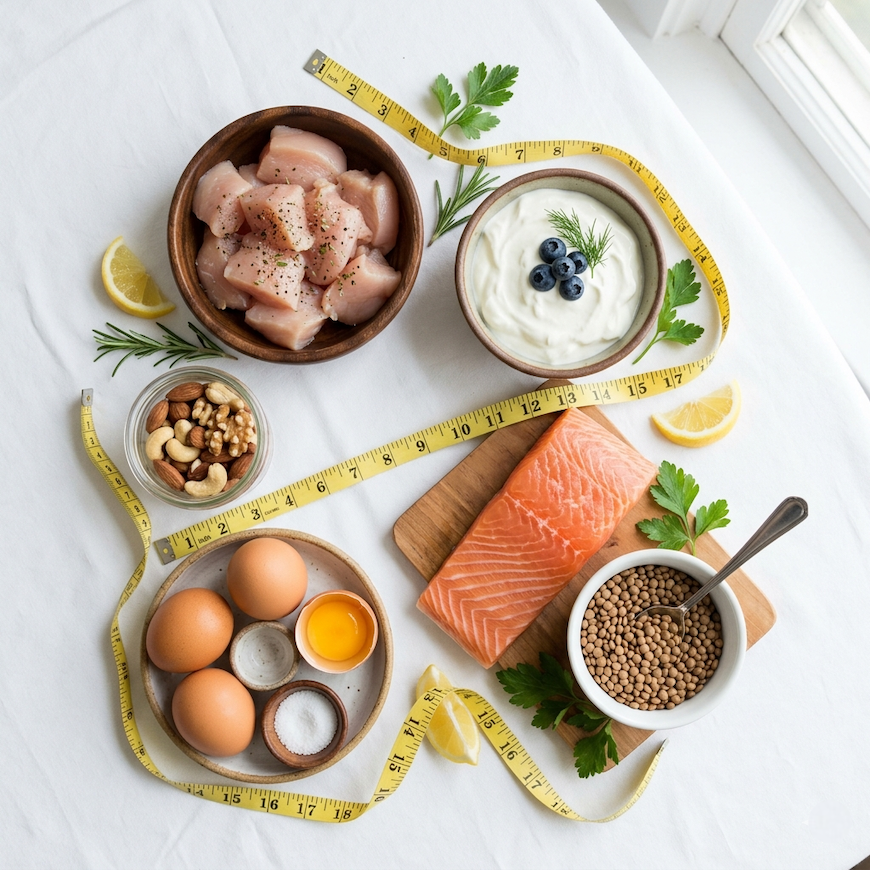
Once the protein calculator gives you a number, the next question is where it comes from. Here are the best protein sources per 100g (cooked unless noted).
Animal proteins (complete):
Chicken breast: 31g protein / 165 calories, the most efficient lean protein
Canned tuna (in water): 26g protein / 109 calories, the highest protein-to-calorie ratio of common foods
Salmon (3.5oz / 100g): 25g protein plus omega-3 EPA/DHA, covered in the fish oil and omega-3 article
Greek yogurt (plain, 170g): 17g protein, also a good source of casein, useful before sleep
Eggs (2 large): 12g protein, complete but lower in leucine per gram than whey or chicken
Cottage cheese (100g): 11g protein, very high in casein, low in calories
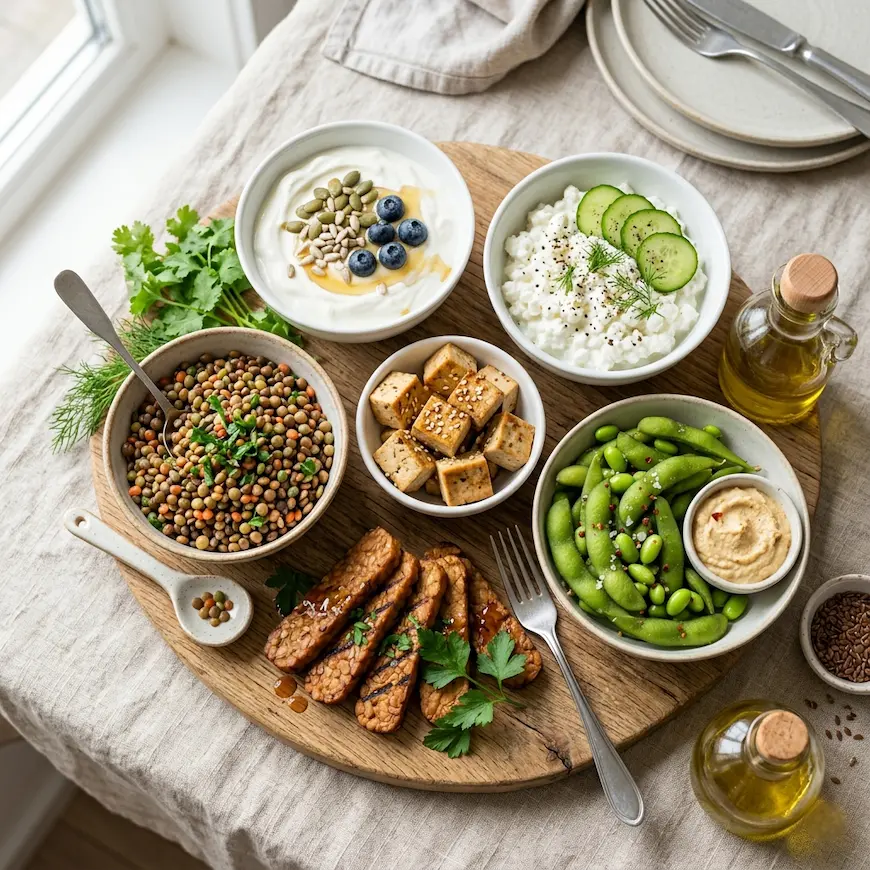
Plant proteins (mostly incomplete, exceptions noted):
Cooked edamame (100g): 11g protein, complete (soy), high leucine for a plant
Cooked lentils (100g): 9g protein, incomplete, low leucine, needs combining
Tofu (firm, 100g): 8 to 12g protein, complete (soy)
Tempeh (100g): 19g protein, complete (soy), fermented for better digestibility
Cooked quinoa (100g): 4g protein, complete but low density, combine with legumes
Hemp seeds (30g): 10g protein, complete, high in omega-3 ALA
Protein per calorie for weight management. The protein calculator already bakes your goal into the number, so the job here is filling it with the right foods. In a deficit, you want high-satiety, high-leucine, calorie-efficient sources to maximize protein without overspending calories. Chicken breast, tuna, and Greek yogurt lead here. For sources with anti-inflammatory benefits, the omega-3 benefits article covers fatty fish specifically.
Quick Answer: The narrow 30-minute “anabolic window” after training has largely been revised. Current evidence supports a broader 3 to 5 hour post-exercise window for most MPS optimization, and pre-workout protein (1 to 2 hours before) adds to the stimulus much like post-workout protein. Total daily protein and per-meal leucine matter more than precise timing. The one timing factor with consistent support: a 30 to 40g protein meal with casein (cottage cheese, Greek yogurt, milk) before sleep cuts overnight muscle breakdown.
Timing is the one piece the protein calculator doesn’t try to capture, so here’s where the evidence lands.
Revising the 30-minute window. The post-workout “window” idea came from studies comparing fasted versus fed states after exercise. Among people who aren’t fasted, the window stretches out considerably. A 2013 meta-analysis found that protein timing, independent of total daily protein, added no extra muscle in resistance-trained people [verify citation before publishing]. Total protein intake stayed the main driver.
Pre-sleep protein. The sleep period, 7 to 9 hours of fasting, is the longest daily muscle-catabolism window. A 2012 study by Res et al. found 40g of casein before sleep raised overnight muscle protein synthesis by 22% versus placebo in young men [verify citation before publishing]. Greek yogurt, cottage cheese, or milk an hour or two before bed applies this in practice.
Post-workout protein for women. Women may have a slightly shorter effective post-workout synthesis window, tied to estrogen’s role in muscle metabolism. A conservative guideline: a protein meal within 2 hours of training (not necessarily right after) is enough for most non-fasted sessions. The signs of magnesium deficiency article covers magnesium’s role in muscle recovery, relevant for anyone training consistently.
Quick Answer: The most common mistakes: front-loading protein into one or two big meals instead of spreading it across 3 to 5 (missing the leucine threshold each meal); eating too little while training hard (a gap between MPS potential and substrate); leaning on supplements as a foundation rather than an addition to whole foods (which bring micronutrients and satiety that powders don’t); and underestimating actual intake because portions get eyeballed instead of measured. The protein calculator gives an evidence-based target; tracking for 7 to 14 days with a food log shows the gap.
Underestimating actual intake. This was my own mistake. My gut said I ate “plenty of protein.” My food log said 68g/day at 63kg. The gap between perceived and actual intake is consistently large in research: people overestimate vegetables, underestimate calorie-dense foods, and misjudge protein because portions vary so much. Tracking for two weeks after you set a target with the protein calculator shows whether you actually have a gap.
Front-loading protein. Eating 20g at breakfast, 25g at lunch, and 100g at dinner gives 145g, the same as 48g across three meals. But that 100g dinner doesn’t produce five times the MPS of a 20g breakfast. MPS plateaus above roughly 40g per meal in most people, so the excess from a huge dinner gets oxidized for energy instead of going into muscle. Three balanced meals hit the leucine threshold more times across the day. The protein calculator gives the daily number; how you split it across meals is on you.
Protein and fiber interaction. Some high-fiber plant proteins (beans, lentils) digest more slowly, which slows amino acid delivery but extends satiety. That’s generally good for weight management, with one caveat: when timing protein around training, animal or soy proteins deliver amino acids faster and suit the pre/post-workout window. The detox water article covers hydration’s role in digesting macronutrients, and adequate water matters on a high-protein diet to support renal clearance of urea.
Yes, with planning. The challenge is leucine density: plant proteins run about 5 to 8% leucine by weight, animal proteins 8 to 10%, so hitting the 2.5 to 3g threshold per meal from plants takes larger portions. A plant-based athlete targeting 2.0g/kg should lean on soy (edamame, tofu, tempeh), legumes combined with grains, and, if they want, pea or soy protein supplements, which sit closer to animal protein in leucine profile than most whole-food plant sources.
In people with healthy kidneys, intake up to 2.2g/kg hasn't shown kidney damage in controlled studies running up to two years. The "high protein wrecks your kidneys" worry comes from research on people who already had compromised kidney function, where cutting dietary protein is a management tool. One caveat: hydration matters on a high-protein diet, since urea from amino acid oxidation raises urinary output. If you have diagnosed kidney disease, get personalized guidance from a nephrologist.
No. Protein powder is a convenience tool, not a requirement, and every target in the protein calculator is reachable from whole foods. Where supplements help: hitting high targets (2.0g/kg and up) without proportionally high calories, convenience when traveling, and fast pre/post-workout delivery. Whey protein isolate has the highest PDCAAS and fastest absorption; pea protein is the best plant-based option by amino acid profile.
Because g/kg goals differ by activity and goal. A 75kg sedentary person maintaining weight needs 60g/day (0.8g/kg); the same person training five days a week for muscle needs 139g/day. Both are right for their context. The protein calculator uses a target matrix from goal and activity combinations drawn from ISSN, WHO/FAO, and PROT-AGE guidelines.
The protein calculator sets the target; consistency over weeks delivers the result. For muscle building, measurable strength gains usually show within 4 to 6 weeks alongside consistent training, and visible body composition changes take 8 to 12 weeks. Weight loss moves faster, since satiety is immediate and the calorie-displacement effect (protein replacing calorie-dense foods) shows within days. For 65+ adults targeting sarcopenia prevention, the muscle-preservation effect builds over months and is better tracked by DEXA or BIA than scale weight.
The protein calculator gives you a daily total; this is how to spread it. Distribution matters more than specific timing. Aim for 3 to 5 eating occasions across the day, each with 20 to 40g of protein, to keep stimulating MPS. If you had to rank: breakfast (most people undereat protein here), post-training (within 3 hours), and pre-sleep (40g casein). A breakfast with at least 30g reliably lowers total daily calorie intake through the satiety-hormone mechanism, arguably the single most impactful timing choice.
This article provides general nutritional information. Protein needs vary by individual health status, medical conditions, and body composition goals. People with kidney disease, liver disease, or other metabolic conditions should consult a registered dietitian or physician before significantly increasing protein intake. The protein calculator is an evidence-based estimation tool, not a medical prescription.
Mimo Karam is the founder and writer at LifestyleMine. She writes about daily habits, nutrition, sleep, and emotional wellness, turning research into practical advice for people who want to live healthier without making it complicated.