✦
THE LIFESTYLEMINE NEWSLETTER
Simple wellness tips, healthy recipes, and
everyday inspiration delivered to your inbox.
Your Email Address
Quick Answer: Human tissue measurements show CoQ10 peaking around age 20 in most organs, then declining continuously. In heart and skeletal muscle the drop between age 20 and age 80 is commonly cited at roughly 50 percent. Statin use lowers CoQ10 further through a separate mechanism.
This is not primarily a dietary problem, which sets CoQ10 apart from most nutrients discussed on this site.
The foundational evidence is a 1989 study by Kalén, Appelkvist and Dallner in Lipids , which measured CoQ10 across human tissues from newborns to age 81 . In most organs, content peaked at age 20 and then fell continuously. The figure repeated everywhere, a roughly 50 percent decline in heart and muscle tissue between 20 and 80, comes from this work.
Two caveats you rarely see attached to that statistic. It is a postmortem tissue study from 1989 with a small sample, and a decline in tissue concentration is not the same as a deficiency that produces symptoms. The drop happens slowly enough that nobody wakes up one morning noticing it, unlike B12 or vitamin D deficiency, which produce recognizable clinical pictures.
So the honest framing is that age-related CoQ10 decline probably contributes incrementally to reduced cellular energy efficiency, alongside a dozen other things that change with age. That is a reasonable case for considering supplementation after 40 or 50. It is not a diagnosis.
Two groups have a stronger case earlier: statin users, covered below, and people with chronic conditions that raise oxidative stress and cellular energy demand at the same time.
Quick Answer: CoQ10 for energy works through its direct role in mitochondrial ATP production. Research shows the clearest effects in people with genuinely low baseline levels or mitochondrial dysfunction. Someone with adequate levels supplementing further is unlikely to notice a dramatic difference.
The energy claim here is unusually well grounded mechanistically, which is rare in supplements.
Because CoQ10 is a required part of the electron transport chain, low levels directly cap how efficiently mitochondria make ATP. At the whole-body level that shows up as fatigue, reduced exercise tolerance, and in severe deficiency, muscle weakness. That clarity is why CoQ10 research in fatigue-linked conditions has produced steadier findings than research on CoQ10 for general energy in healthy people.
Set expectations accordingly. The pattern across nutrients, and this site’s coverage keeps landing on it, is that correcting a real shortfall feels like something and topping up an adequate level usually does not. Someone with normal CoQ10 taking more should not expect a noticeable lift. Someone correcting an age-related or statin-related decline might.
Quick Answer: The strongest evidence for CoQ10 is the Q-SYMBIO trial, which gave 300 mg daily to patients with severe chronic heart failure over two years and found reduced major cardiovascular events and mortality. This does not extend to healthy people taking CoQ10 preventively.
Heart health is where CoQ10 benefits have real clinical backing rather than mechanism alone, and it is worth being precise about what was tested.
Q-SYMBIO was a randomized, double-blind, multicenter trial. Patients with NYHA class III or IV chronic heart failure, meaning symptoms with minimal exertion or at rest, received either 100 mg of CoQ10 three times daily or placebo, on top of standard heart failure therapy. After two years, the CoQ10 group had significantly fewer major cardiovascular events and lower mortality than placebo.
That is a serious result. It measured hospitalizations and deaths, not a lab marker or a symptom questionnaire, and previous CoQ10 heart failure trials had been too small to attempt that.
Two things belong next to it. The trial received partial funding from Pharma Nord, Kaneka, and the International Coenzyme Q10 Association, all with a commercial stake in CoQ10. That does not invalidate the findings, and disclosed industry funding is normal in supplement research, but it is context a reader deserves.
The second is scope. These were people with advanced, diagnosed heart failure already on medication. Nothing in Q-SYMBIO says a healthy 45-year-old taking CoQ10 preventively gets the same protection, and the evidence for that population is much thinner. CoQ10 is not a substitute for the things that actually manage cardiovascular risk.
Anyone with a heart failure diagnosis should raise CoQ10 with their cardiologist specifically, both for the potential benefit and for the interactions covered next.
Quick Answer: Statins inhibit an enzyme pathway the body also uses to make CoQ10, so statin use measurably lowers CoQ10 levels. Whether supplementing reverses statin-related muscle pain is unsettled. A 2007 systematic review found insufficient evidence to recommend routine CoQ10 for statin users.
If you read one section of this guide, make it this one.
Statins work by inhibiting HMG-CoA reductase to lower cholesterol. The same pathway produces CoQ10, so statins reduce CoQ10 as a direct consequence of how they work, not as an unrelated side effect. Blood CoQ10 also travels in low-density lipoproteins, so lowering LDL lowers measured CoQ10 twice over.
That logic drove a lot of research into whether CoQ10 could relieve statin-associated muscle pain, which is one of the most common reasons people quit an otherwise effective drug.
Here the draft version of this story usually oversells. Marcoff and Thompson’s systematic review in the Journal of the American College of Cardiology found that statins consistently lower blood CoQ10 but have inconsistent effects on CoQ10 inside muscle tissue, that supplementation trials conflict with each other, and that there is insufficient evidence to advocate routine CoQ10 use in statin-treated patients . That is a firmer negative than “mixed but promising.” Later meta-analyses have revisited the question and the field has not settled it.
What that means in practice: if you take a statin and your muscles ache, CoQ10 is a legitimate thing to raise with your doctor. The mechanism is real even if the symptom relief is unproven, it is inexpensive, and the safety profile is good. It is a reasonable experiment run with your prescriber, not a proven fix.
What it does not mean: stopping a statin on your own. Statins have strong evidence for reducing cardiovascular events. Side effects are a conversation with the person who prescribed the drug, not a problem to solve with a supplement bought instead.
Talk to your doctor before starting CoQ10 if you take a statin, have a heart condition, or take blood thinners.
Quick Answer: The brain’s high energy demand and vulnerability to oxidative stress make CoQ10 a plausible research target for neurological conditions. Evidence here is early and inconclusive, and large trials in Parkinson’s disease have not shown benefit. CoQ10 is not a proven cognitive supplement.
The brain burns a disproportionate share of the body’s energy for its size, which makes CoQ10’s mitochondrial role an obvious thing to investigate.
The reasoning connects both of CoQ10’s core functions: energy support for a metabolically demanding organ, and antioxidant protection against oxidative stress implicated in neurodegeneration. Plausible enough that it has been tested in Parkinson’s disease and age-related cognitive decline.
Plausible is where it has stayed. Large trials have not delivered the results the mechanism suggested, and this is a good illustration of why mechanistic reasoning is a starting point rather than evidence. The same caution applies to the site’s coverage of brain fog , where the causes are usually sleep, stress, and nutrient status rather than anything a single supplement resolves.
If you are considering CoQ10 for a neurological concern specifically, that is a conversation with a neurologist, not a self-directed purchase.
Quick Answer: Ubiquinone is the oxidized, cheaper form the body converts to ubiquinol before use. Ubiquinol is the active form and skips that step. One small study found ubiquinol produced higher blood levels at the same dose, though other research has found the opposite, so the superiority claim is not settled.
Two forms sit on the shelf under the same CoQ10 name, and the price gap between them is significant.
Ubiquinone is the oxidized form and the cheaper one. Your body has to convert it to ubiquinol before it enters the electron transport chain, so how well it works depends partly on how efficiently you perform that conversion.
Ubiquinol is already reduced and needs no conversion. The study everyone cites here is Langsjoen and Langsjoen, who gave 12 healthy volunteers 200 mg daily of each form in sequence and found plasma CoQ10 rose to 4.3 µg/mL on ubiquinol versus 2.5 µg/mL on ubiquinone .
Before you pay the premium on the strength of that, two things. The study had 12 participants, and the authors run a commercial CoQ10 laboratory. Separately, López-Lluch and colleagues reported better absorption from a ubiquinone formulation, which suggests the carrier oils and formulation may matter as much as which form is on the label. The ubiquinol-is-better claim is a reasonable lean, not a settled finding, and the supplement industry has an obvious incentive to present it as settled.
Practical read: ubiquinol is a defensible choice over 50, when conversion capacity may be reduced. Ubiquinone is perfectly reasonable for younger adults and costs less. Check the label for “ubiquinol” or “ubiquinone” and the milligram dose, since the two are not always dosed the same way.
Quick Answer: Typical research doses run 100 to 200 mg daily for general use, with 300 mg used in heart failure trials under medical supervision. CoQ10 is fat-soluble, so take it with a meal containing fat. Absorption is poor regardless of form, which makes the meal timing matter more than the brand.
Turning the research above into something actionable, without pretending precision that does not exist:
For general use or energy support, 100 mg daily is the common starting point across most research, in either form.
For statin users, doses of 100 to 200 mg appear in the muscle symptom trials, though as covered above this is a conversation with your prescriber first.
For heart failure, Q-SYMBIO used 300 mg daily split into three doses, in patients under cardiology care. That is not a general wellness dose.
On timing, take it with food containing some fat. CoQ10 absorption is genuinely poor and dietary fat improves it meaningfully, the same principle covered in the site’s vitamin D deficiency guide for other fat-soluble compounds. Taking a premium ubiquinol on an empty stomach probably wastes more of it than choosing the cheaper form and eating breakfast with it.
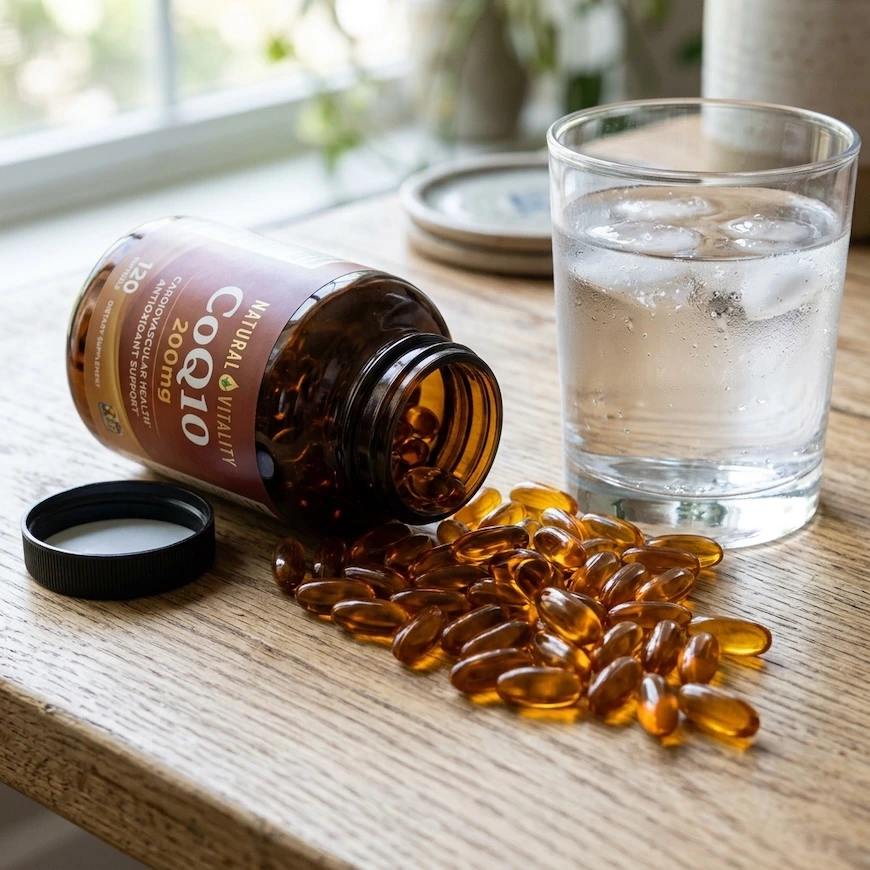
For products, a ubiquinol softgel suits adults over 50 or anyone prioritizing absorption, while a well-reviewed ubiquinone covers younger adults at lower cost. Anyone assembling a broader routine can see how this fits alongside other options in the guide to supplements for healthy aging , with the individual cases covered in the magnesium deficiency and B12 deficiency guides.
Supporting mitochondrial ATP production, providing fat-soluble antioxidant protection, offsetting statin-induced CoQ10 depletion, and improving outcomes in severe chronic heart failure. The heart failure evidence is the strongest, and it comes from a population already under cardiology care.
No. Healthy younger adults generally produce enough, and there is little reason to supplement without a specific reason. It becomes more relevant after 40 to 50, and considerably more relevant for statin users and anyone with a diagnosed heart condition, both of which warrant a doctor's input rather than a self-directed purchase.
Ubiquinol is not a separate compound. It is the active, reduced form of CoQ10, as opposed to ubiquinone, the oxidized form your body converts before use. A product labeled only "CoQ10" is usually ubiquinone, which is worth checking if the form matters to you.
Unresolved. The mechanism is sound, since statins directly reduce CoQ10 production, but the systematic review evidence concluded there is not enough support for routine use, and individual trials disagree with each other. It is worth discussing with your prescriber, not worth treating as established.
Common doses are 100 to 200 mg for general use, with 300 mg reserved for heart failure under supervision. There is no universally correct dose, and anyone on medication or managing a health condition should settle on one with their doctor rather than following a label.
For adults over 50, possibly, given reduced conversion capacity and the bioavailability data, thin as it is. For younger adults, ubiquinone is a sound choice and the money is better spent on taking it consistently with a fatty meal, which affects absorption more than the form does.
Mimo Karam is the founder and writer at LifestyleMine. She writes about daily habits, nutrition, sleep, and emotional wellness, turning research into practical advice for people who want to live healthier without making it complicated.