✦
THE LIFESTYLEMINE NEWSLETTER
Simple wellness tips, healthy recipes, and
everyday inspiration delivered to your inbox.
Your Email Address
What causes pimples isn’t simply “dirty skin,” and that misconception drives the most counterproductive things people do to their acne. Understanding the cycle is the real first step in how to get rid of pimples for good.
Sebum (skin oil) overproduction. Sebaceous glands make sebum, a lipid-rich secretion that lubricates and waterproofs skin. Androgens (testosterone and its more potent derivative DHT) stimulate sebum production directly through androgen receptors in the glands. That’s why puberty, menstrual cycles, stress (cortisol raises androgens), and conditions like PCOS all link to more acne. Genetics sets your baseline sebum level; some people simply produce more, no matter what they eat or how often they wash.
Follicle blockage (comedone formation). The follicle clogs when shed skin cells stick together instead of shedding normally, a process called retention hyperkeratosis. In a healthy follicle, dead cells shed outward and wash away. In acne-prone follicles, they clump with sebum into a plug. That plug is a comedone: closed (a whitehead) below the surface, open (a blackhead) when exposed to air. Blackheads are dark from oxidized melanin, not dirt.
Bacterial proliferation. Cutibacterium acnes (C. acnes) is a normal skin commensal that lives on everyone. In a blocked, sebum-filled follicle it multiplies fast in the low-oxygen environment. As it breaks down sebum, it releases lipases, proteases, and inflammatory mediators, and its cell wall components activate toll-like receptor 2 (TLR2) on nearby immune cells, starting an inflammatory cascade.
The inflammatory response. Neutrophils and macrophages move in to clear the bacteria. The inflammation that follows produces the redness, heat, swelling, and pus of an inflamed pimple. Cystic acne happens when that inflammation reaches deep into the dermis, producing large, painful nodules with no surface head. Those need different treatment than surface pustules.
Quick Answer: Acne is either non-inflammatory (comedonal) or inflammatory. Comedonal acne, blackheads and closed whiteheads, responds best to exfoliating acids and retinoids that tackle follicle plugging. Inflammatory acne, papules and pustules, responds to antibacterial treatments (benzoyl peroxide, topical antibiotics). Nodular and cystic acne is deeper, more severe, and often needs prescription treatment. Using the wrong treatment, say benzoyl peroxide on blackheads while skipping comedone-clearing retinoids, slows results because it targets the wrong step in the acne pathway.
Knowing your acne type is the part of how to get rid of pimples that most people skip, and it decides which active works.
Comedones (non-inflammatory):
Blackheads (open comedones): the pore is open, and the dark color comes from oxidized melanin and lipids, not dirt. These don’t need antibacterial treatment. They need pore clearing with salicylic acid or a retinoid.Whiteheads (closed comedones): the pore is closed, leaving a small flesh-colored or white bump with no inflammation. These respond well to adapalene (a retinoid) or salicylic acid.
Inflammatory acne:
Papules: raised red bumps with no visible pus. C. acnes has triggered inflammation, but pus hasn’t built up yet. Benzoyl peroxide is first-line.Pustules: the classic pimple, raised with a visible white or yellow pus head. Benzoyl peroxide or spot treatments work well, and hydrocolloid patches are very effective.Nodules: large, solid, painful bumps deep in the skin with no surface head. Not a standard pimple. Pressing or picking them does real damage. They need prescription treatment.Cysts: the most severe form. Cystic acne usually needs dermatologist-prescribed oral medication. Cysts are deep inflammatory lesions that can linger for weeks and carry a high scarring risk.
Quick Answer: Benzoyl peroxide (2.5 to 10%) kills C. acnes by oxidation and works best on inflammatory papules and pustules. Salicylic acid (0.5 to 2%) is a lipid-soluble beta-hydroxy acid that gets into pores and dissolves the sebum-cell plug, best for blackheads and whiteheads. Adapalene 0.1% (Differin, now OTC) is a third-generation retinoid that regulates cell turnover and prevents comedones, best for mixed and comedonal acne and the most effective OTC option for long-term prevention. Use one primary active at a time; stacking actives raises irritation without a matching gain in results.
For most people, how to get rid of pimples over the counter comes down to three actives: benzoyl peroxide, salicylic acid, and adapalene.
Benzoyl peroxide. It generates benzoyloxy free radicals inside the follicle that oxidize and destroy C. acnes. Unlike topical antibiotics, C. acnes can’t develop resistance to it, because the mechanism is purely chemical. The best OTC concentration is 2.5%, which matches 10% for efficacy with far less irritation. Apply a thin layer once or twice a day, and expect dryness in the first two to four weeks. You’ll see improvement at four to six weeks and maximum effect at eight to twelve.
Salicylic acid. A beta-hydroxy acid (BHA) that’s lipid-soluble, unlike water-soluble glycolic acid, so it penetrates the oily follicle and dissolves the keratin-sebum plug. It’s also mildly anti-inflammatory through cyclooxygenase inhibition. The useful concentration is 1 to 2% in a daily face wash or toner. Gentler than benzoyl peroxide, it suits sensitive or dry skin, and it’s weaker than BP on inflammatory pimples but better for blackheads and comedone-dominant acne.
Benzoyl peroxide versus salicylic acid, which to pick:
Mostly blackheads and whiteheads: salicylic acid
Mostly red pimples and pustules: benzoyl peroxide
Mixed: rotate them, salicylic acid in the morning and benzoyl peroxide at night, or use a salicylic acid face wash with a BP spot treatment
Adapalene 0.1% (Differin). The biggest OTC acne development in years, available without a prescription in the US since 2016. It’s a third-generation retinoid that works on retinoic acid receptors, speeding cell turnover and preventing the dead-cell buildup that forms comedones. Over twelve weeks it beats salicylic acid or benzoyl peroxide for cutting total lesion count. It needs six to twelve weeks of consistent use before peak effect, and an initial “purge” (temporary worsening) in weeks two to four is normal. Apply it at night, since retinoids raise photosensitivity.
Quick Answer: For a fully formed pustule, hydrocolloid patches are the most effective acute fix: they create a sealed, moist environment that pulls excess fluid from the pimple (you can see it collect on the patch), shield it from bacteria and touching, and shorten healing time versus an uncovered pimple. A 2021 RCT found hydrocolloid patches cut pustule healing time by about 40% versus controls [verify citation before publishing]. Ice briefly reduces swelling and redness (for two to three hours) by vasoconstriction; it doesn’t treat the pimple but improves how it looks before an event.
When people search how to get rid of pimples fast, this is the section they want: spot treatments act on a lesion that’s already there.
Hydrocolloid patches (acne patches). The hydrocolloid material (usually carboxymethylcellulose) absorbs wound fluid down an osmotic gradient. That moist environment supports faster epithelial healing, lowers infection risk as a physical barrier, and stops the touching and picking that drags out healing. The fluid pulled into the patch shows as it turns white, the pimple’s contents being drawn out rather than squeezed through the skin. They only work on pustules and early papules with some surface access, not nodules or cysts.
How to get rid of pimples overnight, practically:
Night 1: clean the skin, apply adapalene or BP to the area, and cover the active pustule with a hydrocolloid patch
Morning: the pimple is smaller and less red, less obvious
Repeat for two to three nights until it clears
This won’t erase the pimple in a single night, but it noticeably speeds the timeline
Tea tree oil (5%). It has real antibacterial activity against C. acnes, since terpinen-4-ol, its main antimicrobial component, damages bacterial cell membranes. Studies put it on par with 5% benzoyl peroxide at eight weeks, though it acts more slowly, eight to ten weeks versus four to six [verify citation before publishing]. It’s less irritating. It has to be diluted to 5%, because undiluted tea tree oil causes significant irritation and contact sensitization. Add it to a carrier oil (one drop in a teaspoon of jojoba) or buy a pre-diluted gel. The omega-3 benefits article covers internal anti-inflammatory support that complements topical treatment.
Ice. Ice reduces a pimple’s visibility before an event but doesn’t treat it. Wrap it in a clean cloth, never straight to skin, and work in 10-minute intervals with 10-minute breaks. The vasoconstriction temporarily calms redness and swelling, with no effect on bacteria, sebum, or the healing timeline.
Sulfur. Keratolytic and antimicrobial, and gentler than BP or salicylic acid. You’ll often find it in spot-treatment masks. It’s good for sensitive skin where other actives irritate too much, and works more slowly than BP.
Quick Answer: Hormonal acne has a telltale distribution: jaw, chin, lower cheeks, and neck, the areas with the most androgen-sensitive sebaceous glands. It usually worsens in the one to two weeks before menstruation (the luteal phase, when progesterone drops and androgens are relatively elevated) and often shows up as deeper, more painful cystic pimples rather than surface pustules. Standard OTC treatments do less here because the root cause, androgen-driven sebum overproduction, is systemic rather than topical. The most effective treatments are prescription anti-androgens: spironolactone and combined oral contraceptives.
Hormonal acne is one of the most frustrating patterns, because it comes back on schedule no matter how rigorous your topical routine is. Here, how to get rid of pimples means treating the hormonal driver, not just the surface.
The androgen mechanism. Testosterone and DHT bind androgen receptors in sebaceous glands and ramp up sebum production. During the luteal phase (days 15 to 28), progesterone peaks and then drops sharply, which relatively raises androgen activity and sebum output. The jaw and chin react most because androgen receptor density is highest there.
Why OTC treatments are limited. Benzoyl peroxide lowers bacterial load and inflammation, salicylic acid clears follicles, and adapalene prevents comedones. None touch the androgen stimulation of sebum, so pimples keep forming at the source. They’re still useful maintenance, but they’re handling downstream effects of the real driver.
Prescription options for hormonal acne (Rx only):
Spironolactone (Rx). An oral anti-androgen (originally a diuretic) that blocks androgen receptors in sebaceous glands and cuts sebum production directly. Very effective for jaw and chin hormonal acne in women. It takes three to six months for full effect. It’s not appropriate for men (feminizing side effects) and needs a prescription from a dermatologist or gynecologist.
Combined oral contraceptives (Rx). Several formulations are FDA-approved for acne (Yaz, Ortho Tri-Cyclen, Estrostep). They lower free androgen levels by raising sex hormone binding globulin (SHBG), which binds testosterone and keeps it away from sebaceous glands. Effective for hormonal acne, but only worth it after weighing their full benefits and risks.
The relaxation habits article is directly relevant here: cortisol drives androgen production through the HPA axis, so stress management is a legitimate and underused part of hormonal acne care.
Quick Answer: High glycemic index (GI) foods have the strongest, most consistent evidence linking diet to acne. A 2012 randomized controlled trial found that 10 weeks on a low-glycemic-load diet (swapping white bread, white rice, and sugary drinks for whole grains and low-GI alternatives) cut inflammatory acne lesion count by 25% versus a high-GI control diet. The proposed mechanism: high-GI foods spike insulin and IGF-1, which raise androgen synthesis in sebaceous glands, the same androgenic pathway behind hormonal acne. Dairy shows a weaker but consistent link. Chocolate and greasy food lack consistent evidence.
Diet is the most argued-over piece of how to get rid of pimples, so it’s worth separating what the evidence supports from what it doesn’t.
Why glycemic index matters for acne. High-GI foods trigger an insulin and IGF-1 (insulin-like growth factor 1) spike. IGF-1 activates the PI3K/Akt/mTOR pathway in sebaceous glands, raising sebum and lipid synthesis, and it suppresses FOXO1, a transcription factor that normally reins in gland activity. The net effect is basically the same as androgen stimulation: more sebum, more follicle blockage, more C. acnes.
High-GI foods most linked to acne:
White bread, white rice, instant oatmeal
Sweetened drinks (soda, juice, sports drinks)
Sugary breakfast cereals
Chips, crackers, and refined snack foods
Lower-GI swaps:
Whole grain bread, rolled oats, brown rice
Legumes (beans, lentils), which are very low GI
Non-starchy vegetables
Berries and whole fruit (lower GI than juice)
The anti-inflammatory foods article covers the Mediterranean pattern in detail. It’s low-GI, high in omega-3, and tied to lower acne severity in several observational studies. The diet changes for acne prevention line up closely with the ones for lowering systemic inflammation.
Dairy. Several large observational studies (including a Harvard Nurses’ Health Study cohort analysis) found links between skim milk and acne, especially in adolescents [verify citation before publishing]. The proposed mechanism: IGF-1 in milk (which survives pasteurization), plus bioactive whey proteins that prompt insulin secretion independent of glycemic index. The evidence is observational and weaker than the GI data, but if you’ve sorted your GI intake and still break out, cutting dairy (skim milk in particular) for eight to twelve weeks is a reasonable test.
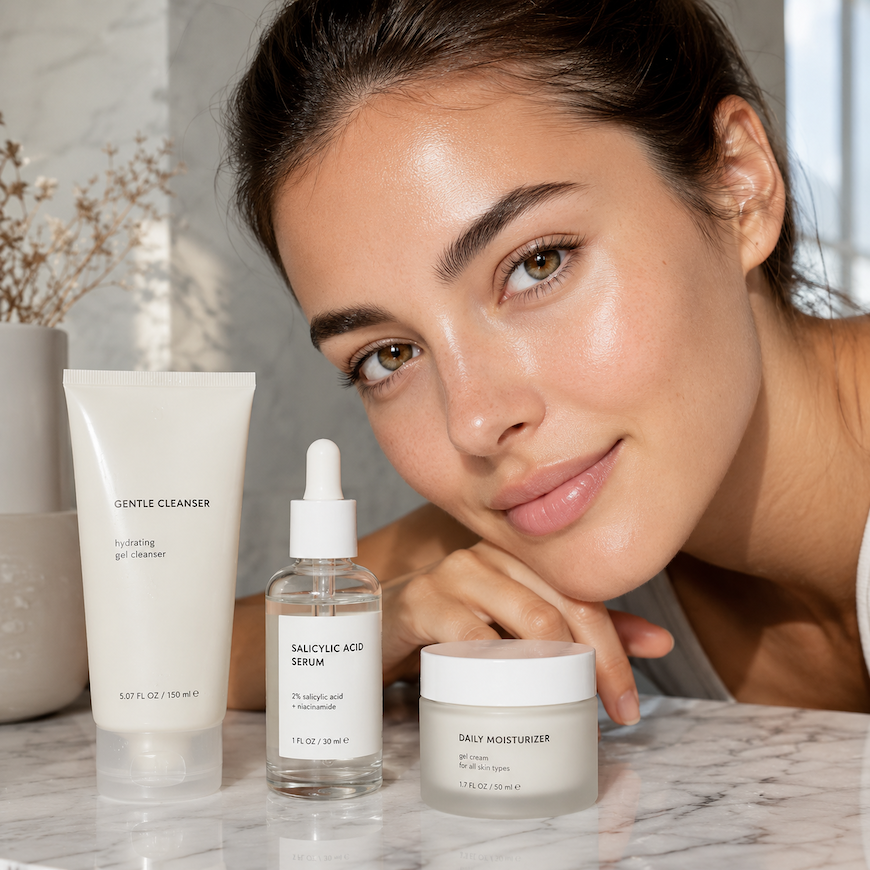
Quick Answer: For most people an effective prevention routine is three steps: cleanse twice daily with a gentle, non-comedogenic face wash containing salicylic acid or niacinamide (it clears excess sebum and dead cells without stripping the barrier); treat with adapalene 0.1% at night (it prevents comedones, the earliest step in the acne pathway); and moisturize with a non-comedogenic, oil-free moisturizer (a compromised barrier worsens inflammation). Add daily sunscreen if you use retinoids, since adapalene raises photosensitivity. Simplicity beats complexity: one active used consistently outperforms six rotated at random.
A consistent routine is the backbone of how to get rid of pimples over the long run, where most people overcomplicate things.
Best face wash for acne, what to look for:
Key ingredients: salicylic acid (0.5 to 2%), niacinamide (lowers sebum and calms inflammation), or benzoyl peroxide (for oilier or inflammation-prone skin)
Avoid: sodium lauryl sulfate (SLS) as the main surfactant (too stripping, disrupts the barrier), fragrance, and alcohol-heavy formulas (they dry without treating)
Format: gel or foaming for oily skin, cream or milk cleansers for dry or sensitive skin
Look for “non-comedogenic,” meaning tested not to clog pores (note: that’s manufacturer-tested, not an FDA certification)
Choosing non-comedogenic products. Products that cause acne mechanically, by blocking follicles, are called comedogens. Common ones to avoid in moisturizers, sunscreens, and makeup include coconut oil, isopropyl myristate, wheat germ oil, algae extract (different from some other seaweeds), and heavy silicones in some formulas. “Oil-free” doesn’t automatically mean non-comedogenic, and some oils are non-comedogenic. A 2014 review of non-comedogenic moisturizers for acne breaks down which constituents actually matter.
The barrier disruption mistake. Over-washing (more than twice a day), over-exfoliating, or running too many actives at once disrupts the skin barrier. A compromised barrier raises transepidermal water loss, triggers inflammation, and paradoxically worsens acne by making skin more reactive. That’s the mechanism behind “purging” from overusing products. The signs of magnesium deficiency article covers how mineral deficiencies (zinc especially) affect barrier integrity and sebum regulation.
Quick Answer: See a dermatologist if OTC treatments have been used properly (daily, right concentration, right formulation) for 12 weeks without meaningful improvement; if acne is nodular or cystic; if it’s scarring or likely to; if a hormonal pattern persists despite topical and dietary changes; or if acne is hitting your confidence and quality of life. Prescription treatments, tretinoin, topical antibiotics, oral antibiotics, isotretinoin, or spironolactone, work substantially better than OTC options and are the right move once OTC has genuinely been tried. The AAD acne treatment guidelines lay out this escalation in detail.
Sometimes how to get rid of pimples means escalating to prescription care, and the signs it’s time are clear.
Every medication below is prescription-only (Rx) and needs evaluation and a prescription from a dermatologist or physician.
Tretinoin (Retin-A and generics), Rx. The gold-standard prescription topical, a naturally occurring retinoic acid derivative versus adapalene’s synthetic retinoid. It speeds cell turnover faster than adapalene, clears comedones more aggressively, and has anti-aging effects. It irritates more, so it’s usually started at 0.025% and titrated up. Full effect takes 12 to 16 weeks. It’s the most evidence-backed topical acne medication available.
Topical antibiotics (clindamycin 1%, doxycycline), Rx. They lower C. acnes load. Effective, but should almost always be paired with benzoyl peroxide to head off resistance (C. acnes can resist antibiotics but not BP’s mechanism). Use as an adjunct, not on their own.
Oral antibiotics (doxycycline, minocycline), Rx. For moderate-to-severe inflammatory acne. Usually given in limited courses (three to six months max) to limit systemic resistance, then paired with a topical retinoid for maintenance.
Cystic acne treatment with isotretinoin (formerly Accutane), Rx. The most effective acne medication there is. It cuts sebum production by 70 to 80% (the only treatment that meaningfully hits the earliest step), reduces follicle hyperkeratosis and C. acnes, and produces lasting remission in 85% of patients after one course. It requires iPLEDGE participation in the US (birth control plus monthly pregnancy tests for women) because of teratogenicity, and needs significant side-effect monitoring.
Spironolactone, Rx (for hormonal acne in women). See the hormonal acne section. It’s most appropriate for adult women with jaw and chin breakouts that track with the menstrual cycle.
Cortisone injection, Rx. A dermatologist injects a dilute corticosteroid straight into a cyst or nodule, dropping inflammation and size within 24 to 48 hours. It’s for individual large lesions, not chronic management, and repeated use can cause small skin depressions (atrophy).
Realistic timelines are part of how to get rid of pimples without making things worse. An untreated pustule usually runs its course in 3 to 7 days. With a hydrocolloid patch and spot treatment, it's often visibly better in 2 to 3 days. Papules (no head) clear more slowly, 1 to 2 weeks untreated. Nodules and cysts can last weeks or months untreated. Scarring (post-inflammatory hyperpigmentation or atrophic scars) takes much longer: hyperpigmentation usually fades in 3 to 6 months, while atrophic scars need procedural treatment.
No. Twice a day is right for most acne-prone skin. Washing more strips protective lipids from the barrier, triggering compensatory sebum and disrupting the microbiome that competes with C. acnes. Same goes for physical exfoliants used more than once or twice a week. The urge to scrub acne-prone skin to "clean" it backfires; gentle cleansing with a mild surfactant is the evidence-based move.
Only if the formula is comedogenic. Many older sunscreens, especially heavy mineral ones, can clog pores. Modern sunscreens labeled "non-comedogenic" or "for acne-prone skin," usually lighter chemical formulas, don't cause acne. Sunscreen is essential with retinoids (adapalene, tretinoin), which raise photosensitivity, so skipping it to dodge sunscreen-related acne is a net loss.
Yes, but carefully. Putting them in the same product or layering them back-to-back can cause real dryness and irritation. The standard approach is a salicylic acid face wash in the morning (rinsing off limits irritation) and a benzoyl peroxide spot treatment at night, or a salicylic acid toner in the morning and adapalene at night. Using benzoyl peroxide and a retinoid (adapalene) at the same time generally isn't recommended, since BP can oxidize the retinoid and cut its efficacy.
They look alike but have completely different causes and treatments. Cold sores (oral herpes, HSV-1) show up as clusters of small fluid-filled blisters, usually on or near the lips, with tingling or burning beforehand, and they respond to antivirals. Pimples can appear anywhere on the face, including near the lips, and are bacterial and sebum-related. If you keep getting "pimples" in the same lip-adjacent spot with a burning sensation first, see a dermatologist.
Yes. Adult acne affects roughly 50% of women in their 20s and up to 25% in their 40s, versus about 35% of adult men. The principles for how to get rid of pimples stay the same at any age, even when the triggers differ. It's disproportionately common in women because of the hormonal shifts of the menstrual cycle, pregnancy, perimenopause, and conditions like PCOS. Adult acne tends to be more inflammatory (fewer blackheads, more red bumps and cysts) and more concentrated on the lower face.
This article is for informational purposes and isn’t medical or dermatological advice. If you have severe, nodular, or cystic acne, or if acne is scarring or causing distress, see a board-certified dermatologist. All prescription medications require evaluation and a prescription from a licensed healthcare provider. Don’t use or adjust prescription acne medications based on this article.
Mimo Karam is the founder and writer at LifestyleMine. She writes about daily habits, nutrition, sleep, and emotional wellness, turning research into practical advice for people who want to live healthier without making it complicated.