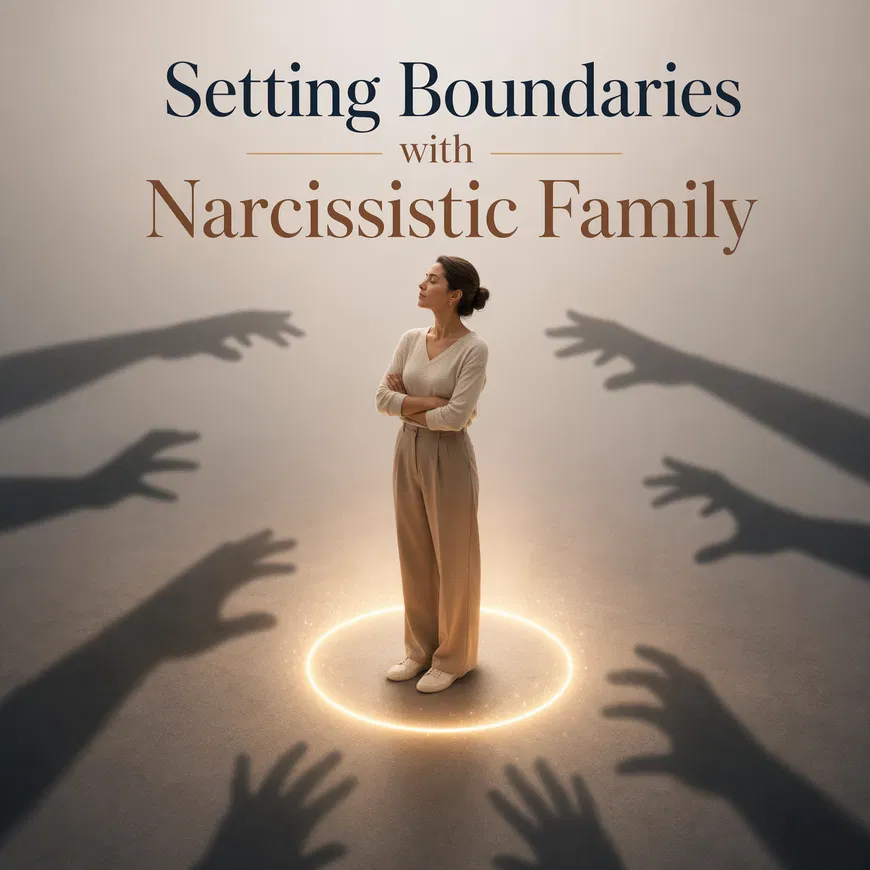
The first time I said no to my mother, I cried for forty-five minutes after.
She had asked me to come help her with something on a Saturday I had already promised to myself, and I said, gently, that I couldn’t. She wasn’t even upset. That part is the funny thing. The reaction was almost all internal. My chest tight, my stomach in knots, the running tape in my head telling me I was being cold, selfish, ungrateful, all of it. I sat in my car in a parking lot and cried like I’d done something genuinely cruel.
I had said one word. No. That was the whole “infraction.”
If you’ve ever felt that exact storm, I want to tell you something I wish someone had told me years earlier: the guilt doesn’t mean the boundary was wrong. The guilt means the boundary is new.
This is going to be a more honest piece on how to set boundaries than the cheerful, listicle-style guides out there. There are scripts. There’s a step-by-step. But there’s also the actual emotional part, which most articles skip, which is the part that decides whether the boundaries you set actually hold.
First, What a Boundary Actually Is
I think half the trouble with boundaries is that people use the word to mean fifteen different things.
A boundary is not a wall. It’s not punishment. It’s not a dramatic announcement. It’s not cutting someone off forever. Most people who struggle with how to set boundaries are actually picturing the most extreme, confrontational version, which is exactly why they avoid doing it at all.
A real boundary is just this: a clear statement of what you will or won’t do, said out of self-respect rather than anger.
That’s it. Quiet. Kind. Often not even a confrontation. “I’m not available to talk after 9pm.” “I don’t lend money to family.” “I can stay for an hour, then I need to head home.” Boring, when you write them out. Earth-shattering, when you actually live them.
The other thing nobody says clearly: boundaries are mostly for *you*, not the other person. You’re not really informing them. You’re informing yourself. You’re deciding what you’ll do, and then doing it. The other person’s response is theirs. Your job stops at saying the sentence.
That mindset shift is the single biggest unlock for figuring out how to set boundaries. It’s not a negotiation. It’s not a request. It’s information.
Why Setting Boundaries Feels So Awful (Even When You’re Right)
Here’s the part of the boundaries conversation almost nobody tells you, and the reason I think most people give up on it after one try.
The guilt is not a signal that you’ve done something wrong. The guilt is a signal that you’ve done something new.
If you grew up in a family where being agreeable kept the peace, where your needs were quietly de-prioritized, where your worth was tied to being helpful, then your nervous system genuinely registers saying no as a kind of small danger. That tightness in your chest, the looping thoughts at 2am, the running explanation you keep mentally rehearsing — that’s not your conscience. That’s an old reflex showing up where it doesn’t belong anymore.
Brené Brown, the researcher who probably did more than anyone to mainstream this conversation, has a line I keep coming back to: the most compassionate people she’s met are also the most boundaried. That’s counterintuitive until you live it. People without boundaries don’t end up endlessly generous. They end up resentful, exhausted, and chronically unavailable in the ways that matter most.
So the guilt isn’t a stop sign. It’s a speed bump. You go through it. The first time you set the boundary, the guilt is loud. The fifth time, it’s quieter. By the twentieth, it’s mostly gone.
That’s the part the cheerful “10 ways to set boundaries” articles never mention. Knowing how to set boundaries is half mechanics and half just outlasting the guilt response while it rewires.
The Five Boundaries Most People Actually Need
When I’m helping someone figure out where to start with boundaries, it’s almost always one of these five. You probably don’t need fifteen. You need two or three.
1. Time boundaries. Who gets your hours, and when. “I’m not available after 8pm.” “I take Saturdays off from work email.” “I can give you twenty minutes, not the full afternoon.”
2. Energy boundaries. Who you’ll talk to about what, and how often. The friend who only ever vents and never asks. The family member who only calls when they need something. The colleague who treats you as their personal therapist. You don’t have to be cold. You can be loving and still not be the dumping ground.
3. Money boundaries. Lending, gifting, splitting, covering. The lines you don’t cross, with anyone. “I don’t lend money to family.” “I split the bill, not cover it.” Quiet, firm, no over-explanation.
4. Physical and space boundaries. Touch, proximity, who gets access to your home, when your phone is on. This one matters more than most people realize, especially for parents and partners.
5. Emotional boundaries. What you’ll absorb, and what you’ll send back. Other people’s bad moods are not yours to fix. Other people’s chaos doesn’t have to become yours by proximity.
When you’re learning how to set boundaries, pick the category that’s costing you most right now. Start there. Don’t try to overhaul your whole relational life on a Tuesday. Pick one.
The Actual Scripts (Steal These)
The biggest thing that helps people figure out how to set boundaries isn’t motivation. It’s words. Real, specific sentences you can borrow on the fly when your brain is too flustered to write its own.
Here are the ones I use the most.
For “can you…?”:
– “I can’t make that work, but thank you for thinking of me.”
– “That’s not going to be possible for me.”
– “I’m at capacity right now.”
For unsolicited advice:
– “I’m not looking for advice right now, just venting.”
– “I appreciate it, but I’ve got a plan I’m sticking with.”
– “Thanks. I’ll come to you if I’m stuck.”
For people who keep pushing after you’ve said no:
– “I’ve already said no. I’m not going to keep explaining.”
– “My answer isn’t going to change.”
– (Silence. You don’t have to fill it.)
For work boundaries:
– “I can get to that tomorrow, not tonight.”
– “That falls outside my role, but I can point you to who handles it.”
– “I’m not available outside working hours.”
For family:
– “I love you, and I’m not coming to that.”
– “I’m going to step away from this conversation.”
– “That’s not something I’m willing to discuss.”
Notice what these scripts have in common. They’re short. They don’t over-explain. They don’t apologize for existing. They don’t justify the boundary with a paragraph of reasons.
That last one is the trap most people fall into when figuring out how to set boundaries. Over-explanation reads like an invitation to negotiate. The shorter your sentence, the more it holds. A long, breathless “I’m so sorry, I just have so much going on right now, and my schedule is so packed, and…” reads as a draft of a no. A simple “I can’t make that work” reads as a final one.
You don’t owe a paragraph. You owe a sentence.
What Happens After You Set the Boundary
This is the section most articles on how to set boundaries leave out, and it’s the most important one. Because setting it is rarely the hard part. Holding it is.
After you set a boundary, one of three things will happen.
Option A: Nothing. The person says “ok, no worries,” and life goes on. This happens way more often than people expect. The thing you were dreading was almost entirely in your head. Welcome to the most common outcome.
Option B: A small flicker of disappointment, which passes. They’re a little hurt, or surprised, or annoyed for a beat, and then it’s done. Healthy adults can handle small disappointment. You don’t have to fix it for them. The flicker is part of the deal.
Option C: A big reaction. Anger, guilt-tripping, silent treatment, lectures, the works. This one stings, and it’s the one most people dread, and here’s the honest thing to know about it: a big reaction to a reasonable boundary tells you something important. It tells you the relationship was working partly because you didn’t have boundaries. That’s information you needed. Hard, but necessary.
If you’ve set a small, reasonable boundary and the response is disproportionate, the issue isn’t your boundary. It was always there. The boundary just made it visible.
This is also why how to set boundaries is, in the long run, a clarifying tool. It shows you who can meet you as a whole person and who was relying on a version of you that wasn’t sustainable.
How to Survive the Guilt After
The guilt is going to come. Pretending otherwise is part of why people fail at this. Better to plan for it.
A few things that genuinely help me:
Don’t act on the guilt for 24 hours. The single most important rule. Most boundary collapses happen in the first night after you set one, when the guilt is at peak and the urge to “smooth it over” with a long apology text is enormous. Sit on it. The next morning, the urge is usually gone.
Name what’s happening. “I’m feeling guilty, but the boundary is still right.” That naming, out loud or written, creates a tiny gap between the feeling and the action. Affect labeling, as the psychologists call it, measurably reduces emotional intensity. (Same mechanism that makes journaling work.)
Talk to one trusted person. Not five. Not a friend who’s already enmeshed in the situation. One person who isn’t part of it, who can reflect back what you actually said vs. what your guilt is telling you that you said.
Lean on self-compassion, not willpower. Kristin Neff’s research on self-compassion at the University of Texas (her field-defining work) found that people who treat themselves kindly through hard emotional moments are more, not less, likely to follow through on hard choices. White-knuckling makes you collapse faster. Compassion makes you steady.
Remember the cost of the unset boundary. This sounds dramatic, but it works. Picture the version of you in six months if you keep absorbing what you’ve been absorbing. The guilt of the boundary is small. The cost of the unset one compounds.
When Boundaries Don’t Work
I want to be honest about this part, because most articles on how to set boundaries oversell the strategy.
Boundaries work in relationships where both people are capable of meeting one. With a friend who’s tired but loving, a family member who’s wired but not malicious, a partner who slipped but cares, a colleague who didn’t realize a clear boundary usually fixes more than it breaks.
Boundaries don’t work the same way with people who are using you as a regulation tool. With someone who genuinely doesn’t have your wellbeing in mind, boundaries aren’t a fix. They’re a clarifier. The boundary reveals who the person is. What you do with that information is a separate question, and sometimes a harder one.
For workplace situations where you have very little power, boundaries are a partial tool. You can hold the line on what you’ll work outside hours, but you can’t single-handedly fix a culture that doesn’t respect anyone’s time. Sometimes the answer is a boundary. Sometimes the honest answer is leaving.
And if you’re in any situation that involves emotional abuse, manipulation, or threat, the right resource isn’t a wellness article. It’s a qualified therapist or counselor, and (where relevant) trained domestic violence support. LifestyleMine is a wellness platform, not a substitute for that. Please reach out to a professional if any of this is more than what an article can hold.
Frequently Asked Questions
How do I set boundaries with family members who don’t take them seriously?
Is it bad to feel guilty after setting a boundary?
How do I know if a boundary is too rigid or too loose?
How long does it take to get comfortable setting boundaries?
What if setting a boundary loses me the relationship?
The Takeaway
The most important thing about how to set boundaries isn’t the scripts (though use them). It isn’t the categories (though they help). It’s the willingness to sit with the discomfort of being someone new — someone whose worth doesn’t depend on absorbing everything, fixing everyone, and being endlessly available.
You’re going to feel guilty the first ten times. You’re going to second-guess yourself. You’re going to want to write a long apology text at 11pm. Don’t. Wait twenty-four hours. The morning version of you almost always knows the boundary was right.
Boundaries aren’t about getting better at saying no. They’re about getting better at choosing what your yes actually means. Your time, your energy, your care, your money, your presence — these are not infinite. The work isn’t to be endlessly generous. The work is to be intentionally generous, with the people and situations that can actually meet that generosity back.
That’s what figuring out how to set boundaries actually gives you, when you stay with it long enough. Not a colder life. A clearer one.
Related: Micro habits for emotional wellness — the small daily moves that make boundaries easier →
All content on LifestyleMine is for informational and educational purposes only. It is not a substitute for advice from a qualified mental health professional.

Mimo Karam is the founder and writer at LifestyleMine. She writes about daily habits, nutrition, sleep, and emotional wellness, turning research into practical advice for people who want to live healthier without making it complicated.