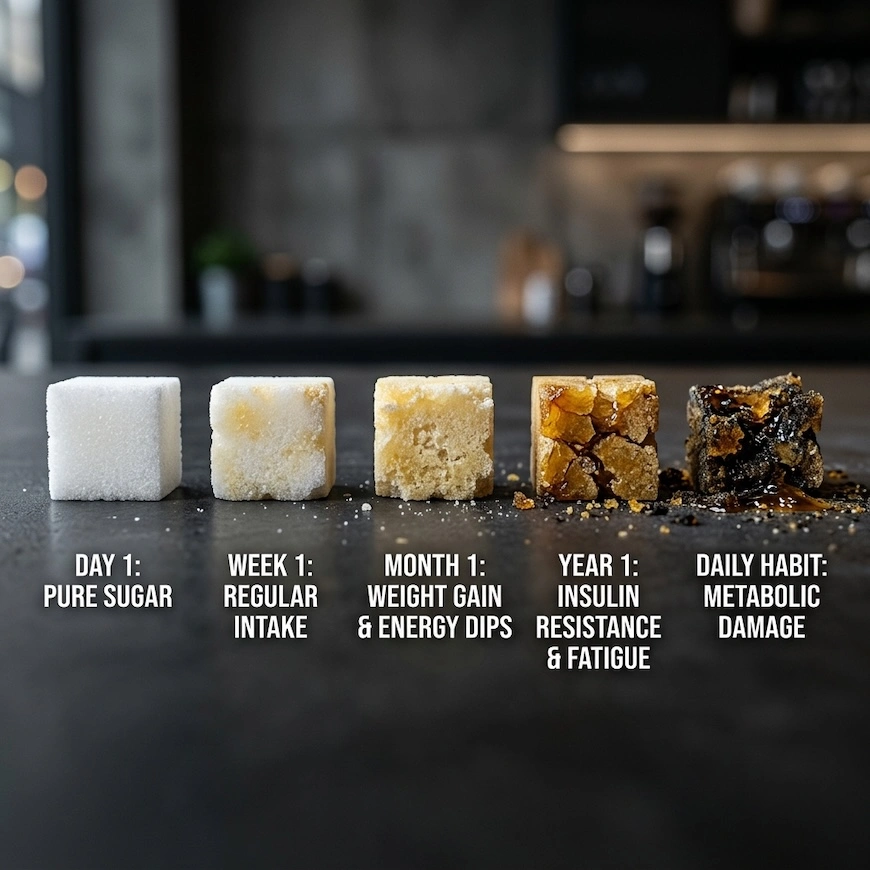
What happens in your body in the first 60 minutes after eating sugar
Quick Answer: Within 30 minutes of eating added sugar, blood glucose spikes, the pancreas releases insulin, and the liver starts taking up glucose. By 60 minutes, if the meal was high in refined carbohydrates, blood glucose drops below baseline (the “crash”). That drop triggers hunger signals, irritability, and cravings for more sugar, which completes one turn of the addiction loop.
To understand what happens when you eat too much sugar, it helps to watch a single episode first, before zooming out to the long-term picture. One meal tells you most of the story. And the biggest variable in that story is how often you eat too much sugar.
The hour-by-hour response to a high-sugar meal:
| Time | What is happening |
|---|---|
| 0–10 min | Blood glucose rises; taste receptors trigger dopamine release in reward centers |
| 15–30 min | Pancreas releases insulin; liver begins storing excess glucose as glycogen |
| 30–45 min | Blood glucose peaks; insulin keeps working; surplus glucose is converted to fat (de novo lipogenesis) |
| 45–60 min | Blood glucose drops below fasting baseline (reactive hypoglycemia in susceptible people) |
| 60–90 min | Energy crash; cortisol rises; hunger and carbohydrate cravings spike |
The important step happens around the 30 to 45 minute mark: de novo lipogenesis, where the liver turns surplus glucose, especially from fructose, into triglycerides. This is the pathway by which sugar drives weight gain independently of total calories under high-fructose conditions.
The energy crash at 60 to 90 minutes is not a willpower problem. It is a predictable response to rapid glucose clearance followed by relative hypoglycemia. The brain reads the glucose drop as a threat and asks for more carbohydrates, which is exactly how the daily cycle keeps itself going once you eat too much sugar on a regular basis.
How sugar damages your heart: the research the industry buried
Quick Answer: Yang et al. (2014, JAMA Internal Medicine) found that adults who got 25% or more of their daily calories from added sugar had 2.75 times the cardiovascular mortality risk of those who got under 10%. The relationship was dose-dependent and held after accounting for age, sex, physical activity, and body weight.
In 1967, researchers at Harvard were paid by the Sugar Research Foundation to publish a review that played down sugar’s role in heart disease and pointed the finger at saturated fat instead. The documents proving this stayed hidden until 2016. Either way the conclusion is the same: eat too much sugar and the heart pays for it.
The cardiovascular evidence is now well established. Yang et al. (2014, JAMA Internal Medicine, PMID 24493081) looked at NHANES data covering 31,147 US adults and found a dose-dependent link between added sugar and cardiovascular death. Adults getting 25% or more of daily calories from added sugar had 2.75 times the cardiovascular mortality risk of those staying under 10%. The link held after adjusting for total calories, physical activity, body mass index, and alcohol. In other words, people who eat too much sugar carry the risk even when the rest of their diet looks reasonable.
Several mechanisms sit underneath that statistic. Excess fructose, the sweeter half of table sugar and high-fructose corn syrup, is processed almost entirely by the liver, which turns the surplus into triglycerides. High triglycerides are an independent risk factor, separate from LDL cholesterol. Fructose metabolism also produces uric acid, and elevated uric acid blocks nitric oxide in blood vessel walls, which reduces vasodilation and raises blood pressure. Over years, this is the quiet damage that builds up in people who eat too much sugar without noticing the cost. Eat too much sugar for long enough and the vessels stiffen quietly, years before any symptom shows up.
Then there is the liver itself. Chronic excess fructose drives fat accumulation in the liver, which progresses to non-alcoholic fatty liver disease (NAFLD) in roughly 30% of the US population, and NAFLD tracks with cardiovascular disease on its own. Add chronic insulin demand to the picture and the insulin signaling system starts to wear down. The National Institutes of Health estimates that over 96 million US adults have prediabetes, much of it driven by dietary patterns that include too much added sugar. Most of those adults never binged; they simply eat too much sugar across ordinary, unremarkable meals.
Sugar and inflammation: the mechanism behind most chronic disease
Quick Answer: Excess dietary sugar raises inflammatory markers such as C-reactive protein, interleukin-6, and tumor necrosis factor-alpha. This low-grade inflammation is a shared driver of cardiovascular disease, type 2 diabetes, some cancers, and Alzheimer’s disease, all of which are more common where added sugar intake is high.
Inflammation runs underneath almost every modern chronic disease, and sugar is one of the most reliable dietary triggers of the low-grade kind. The mechanisms are well understood.
When excess glucose binds to proteins and fats without enzyme control, it forms advanced glycation end products, or AGEs. These compounds cross-link tissue proteins, stiffen blood vessel walls, and keep inflammatory signaling switched on. They build up in skin (where they speed visible aging), kidneys, nerves, and cardiovascular tissue. The more often you eat too much sugar, the more of these cross-links pile up.
The gut is the second front. Refined sugars feed pathogenic bacteria and yeasts and crowd out the short-chain fatty acid producers that keep the intestinal barrier intact. When that barrier loosens (increased intestinal permeability), bacterial endotoxins leak into the bloodstream, which is a direct inflammatory trigger. People who eat too much sugar often see this show up first as bloating and low energy. For the bacterial diversity connection, see our full guide at anti-inflammatory foods.
Insulin resistance compounds the problem. Fat tissue in insulin-resistant people releases extra pro-inflammatory cytokines (IL-6, TNF-alpha) in proportion to glucose and fructose exposure. And because the liver handles fructose almost alone, that processing throws off reactive oxygen species; the resulting oxidative stress activates nuclear factor-kappa B, the master switch of the inflammatory response.
Te Morenga et al. (2013, BMJ, PMID 23321486) pooled 68 studies (30 randomised trials and 38 cohort studies) and found that the effect of sugar on body weight was driven mainly by changes in total energy intake. People gained weight when sugar pushed their calories up and lost it when sugar came back down. That finding matters because it separates the calorie story from the metabolic one: weight tracks energy, but the fructose-specific damage to the liver and blood vessels does not need a calorie surplus to do harm. You can eat too much sugar, stay inside your calorie budget, and still push your metabolic risk up.
Sugar addiction is neurologically real: what the dopamine data shows
Quick Answer: Sugar activates the same mesolimbic dopamine reward pathway as nicotine and alcohol. In animals, intermittent sugar access produces bingeing, withdrawal, craving, and cross-sensitization to other addictive substances, which lines up with several of the DSM-5 criteria for substance use disorder when the same patterns appear in people.
The sugar addiction debate gets waved off as pop psychology. The neuroscience does not deserve that dismissal.
Eating something sweet releases dopamine in the nucleus accumbens, the brain’s main reward center, on a scale comparable to several recreational drugs, though it fades faster. The dopamine does not only fire when you eat. It fires in anticipation, set off by cues tied to sugar, like the sight of a dessert case, the smell of a bakery, or the crinkle of a wrapper. That cue-triggered, anticipatory dopamine is the defining feature of addiction, more than the substance itself. It is also why people who eat too much sugar describe wanting it before they are anywhere near it.
Dependence then escalates in a few predictable ways. With repeated exposure, dopamine receptors in the reward circuit lose sensitivity (downregulation), so the same amount of sugar delivers less reward and you need more to get the old hit. Cut sugar after chronic use and measurable withdrawal-like symptoms follow: irritability, headaches, fatigue, low mood, and strong cravings, usually peaking around days 3 to 5. Stress makes it worse, because cortisol sharpens dopamine receptor sensitivity in food reward circuits, which is why cravings hit hardest on the worst days.
Lustig et al. (2012, Nature, PMID 22297952) argued that sugar meets the criteria for a public health toxin, not because of its calories but because of these dose-dependent, addictive, and metabolically harmful properties. By that measure, the choice to eat too much sugar looks less like a treat and more like a habit.
How much sugar per day is actually safe
Quick Answer: The American Heart Association recommends no more than 25 grams (6 teaspoons) of added sugar a day for women and 36 grams (9 teaspoons) for men. The average American eats about 77 grams a day, three times the women’s limit and more than double the men’s.
“Added sugar” means sugar put in during manufacturing or preparation, not the sugar that occurs naturally in whole fruit, vegetables, or plain dairy. Whole fruit comes with fiber that slows glucose absorption and softens the insulin response. Added sugar has no such buffer, which is part of why it is so easy to eat too much sugar without realizing it.
Common foods and their hidden sugar content:
| Food | Added sugar | % of daily women’s limit |
|---|---|---|
| 1 can regular soda (355ml) | 39 grams | 156% |
| Flavored yogurt (6oz) | 17–22 grams | 68–88% |
| Breakfast cereal (1 cup) | 8–15 grams | 32–60% |
| Bottled salad dressing (2 tbsp) | 5–7 grams | 20–28% |
| Granola bar (1 bar) | 10–15 grams | 40–60% |
| Pasta sauce (1/2 cup) | 6–12 grams | 24–48% |
The AHA’s daily limits work out to 25 grams (6 teaspoons) for women, 36 grams (9 teaspoons) for men, and 24 grams (3 to 4 teaspoons) for children aged 2 to 18. Children under 2 should get no added sugar at all. The numbers look generous until you read a few labels and see how easy it is to eat too much sugar before lunch.
The gap between the recommendation and reality, 77 grams on average versus 25 for women, is the size of the public health problem. Most of that excess does not come from candy or dessert. It comes from foods sold as healthy: yogurt, granola, protein bars, flavored oatmeal, vitamin waters, and fruit juice. You can eat too much sugar all day while believing you are eating clean.
What sugar does to your skin, teeth, and joints
Quick Answer: Advanced glycation end products (AGEs) formed by excess blood glucose cross-link collagen in skin, which speeds wrinkles and reduces elasticity. High sugar intake feeds acid-producing oral bacteria that decay teeth, and fructose-driven uric acid worsens gout and inflammatory joint conditions.
The damage from eating sugar every day is not confined to internal organs. Three visible systems show it.
Skin goes first. Glycation, the non-enzymatic bonding of glucose to collagen and elastin, produces AGEs that stiffen and cross-link the proteins holding skin together. You see it as faster wrinkling, less elasticity, and a duller, more uneven complexion. AGE formation is essentially permanent: glycated collagen cannot be repaired, only diluted over years as new collagen comes in. The more often you eat too much sugar, the harder it is for new collagen synthesis to keep pace with the ongoing damage.
[AMAZON AFFILIATE LINK]: Vital Proteins Collagen Peptides (hydrolyzed collagen to support new collagen synthesis alongside reduced sugar intake)
Teeth take a similar hit. Oral bacteria, mainly Streptococcus mutans, turn dietary sugar into acids that start demineralizing enamel within about 20 minutes of exposure. That clock resets with every sugar-containing food or drink, including “healthy” ones like fruit juice, dried fruit, and flavored sparkling water. High sugar frequency plus reduced saliva (common with mouth-breathing or dry mouth) speeds enamel erosion further. Frequency is the enemy, so people who eat too much sugar in small doses all day do more damage than those who eat it all at once.
Joints round out the list. Fructose metabolism produces uric acid, and in susceptible people that uric acid crystalizes in joints (gout) or fuels the kind of systemic inflammation that worsens osteoarthritis. High dietary fructose, especially from high-fructose corn syrup and juice, is one of the most consistent triggers of gout flares, so people who eat too much sugar in liquid form tend to feel it in their joints. For existing joint inflammation, the anti-inflammatory pattern at anti-inflammatory foods covers the nutritional side of joint support.
Sugar and mental health: the mood and blood sugar connection
Quick Answer: The glucose volatility caused by high-sugar diets disrupts mood. Sugar-driven spikes followed by insulin-triggered crashes line up with irritability, anxiety, and brain fog, and population studies link high added sugar intake to a 24–30% higher risk of incident depression.
The link between sugar and mental health runs through several pathways at once.
Start with glucose volatility. The brain runs almost entirely on glucose and is sensitive to swings in it. A sharp spike followed by reactive hypoglycemia produces measurable shifts in mood, attention, and emotional control inside the crash window. That mid-afternoon slump after a sugary lunch, the one that comes with irritability and trouble concentrating, is physiological, not a character flaw.
The gut-brain axis is the second pathway. The gut microbiome talks to the brain through the vagus nerve and by making neurotransmitter precursors, including 90–95% of the body’s serotonin. High-sugar diets thin out microbial diversity and deplete the bacteria that feed serotonin production,, the most direct dietary link between processed food and depression. See the gut-mood connection documented at mood-boosting foods.
Inflammation reaches the brain too. The same cytokines raised by high sugar intake (IL-6, TNF-alpha, C-reactive protein) cross the blood-brain barrier and activate microglia, the brain’s immune cells. This neuroinflammation is one of the leading suspects in treatment-resistant depression. None of this means one cookie causes depression, but it does mean people who eat too much sugar day after day are loading the dice.
Finally, there is the cortisol loop. Stress raises cortisol, cortisol raises blood glucose, the higher glucose triggers a craving for something sweet, the sweet gives a brief lift, and the crash that follows raises cortisol again. That loop is the biology under emotional eating, and it is why stressful stretches are when people eat too much sugar.
What sugar withdrawal actually feels like, and how long it lasts
Quick Answer: Sugar withdrawal usually peaks at days 3 to 5 after cutting added sugar and settles within about two weeks. Expect headaches, irritability, fatigue, strong cravings, poor concentration, and low mood. These are neurochemical withdrawal symptoms tied to dopamine receptors normalizing, not signs of a nutritional deficiency.
Sugar withdrawal is real, documented, and predictable. Knowing the timeline keeps most people from quitting on day 3, the worst day.
The typical withdrawal timeline:
| Days | What to expect |
|---|---|
| Day 1–2 | Mild cravings, some irritability, possible mild headache |
| Day 3–5 | Peak withdrawal: strong cravings, fatigue, headache, low mood, brain fog |
| Day 6–10 | Symptoms ease; energy starts to stabilize; sleep often improves |
| Week 2 | Cravings drop sharply; natural sweetness starts tasting sweeter again |
| Week 3+ | Steadier energy, clearer thinking, lower overall appetite |
A few things make the rough stretch easier. Eating more fat during the withdrawal window helps, since fat satisfies without spiking glucose. Staying hydrated matters too, because some of the headache is dehydration. Sleep is non-negotiable: short sleep raises ghrelin and amplifies cravings, which is how a tired week turns into a week where you eat too much sugar by default. Reach for naturally sweet whole foods (berries, carrots, sweet potato) instead of substitutes, and front-load protein at breakfast to flatten the morning glucose swing. These steps matter most in the first week, when the pull to eat too much sugar is strongest.
The practical guide to finding and cutting hidden sugar
Quick Answer: The fastest way to cut added sugar is not giving up dessert. Most of the excess hides in processed “savory” and “healthy” foods: sauces, dressings, flavored yogurt, cereals, protein bars, and drinks. Read labels for every form of added sugar and cut liquid calories first for the biggest quick win.
The average American’s 77 grams of daily added sugar does not come mostly from candy and soda anymore. It comes from foods marketed as health foods, which is precisely why it is so easy to eat too much sugar while thinking you are being good.
Sugar hiding in “healthy” products:
- Flavored oat milks: 7–12 grams per cup (more than a can of Coca-Cola per liter)
- “Protein” bars: 10–25 grams of added sugar in many mainstream brands
- Bottled smoothies: 40–60 grams per bottle in commercial brands
- “Low-fat” products: manufacturers usually replace the fat with sugar
- Jarred pasta sauce: 6–12 grams per half-cup serving
- Flavored instant oatmeal: 12–18 grams per packet
Sugar also hides behind its own names. It shows up on labels under more than 55 of them, including high-fructose corn syrup, dextrose, maltose, sucrose, evaporated cane juice, corn sweetener, rice syrup, agave nectar, barley malt, fruit juice concentrate, and maltodextrin. When you see two or three of these stacked in one ingredient list, you are about to eat too much sugar whether the front of the package says so or not.
The fastest way to cut intake by roughly 40% without feeling deprived:
- Cut every liquid calorie with added sugar (soda, juice, flavored coffee, sports drinks, sweet tea)
- Swap flavored yogurt for plain Greek yogurt with fresh fruit
- Read the label on every condiment and sauce in your kitchen and replace the worst three
- Eat whole fruit instead of dried fruit or juice
Do those four things and it gets hard to eat too much sugar.
For structured ways to rebuild eating patterns, see our guides on intermittent fasting at [INTERNAL LINK: intermittent fasting guide] and gut health support at [INTERNAL LINK: gut health drinks article].
The I Quit Sugar cookbook by Sarah Wilson (a practical sugar-elimination plan with recipes). [Check on Amazon]
Lingo continuous glucose monitor by Abbott (a wearable CGM for non-diabetics to track real-time glucose response to food). [Check on Amazon]
Frequently Asked Questions
Does fruit count toward daily sugar limits?
No. The AHA's added-sugar limits and the WHO's free-sugar guidelines both exclude the sugar naturally present in whole, intact fruit. Fruit fiber slows glucose absorption, produces a lower glycemic response than the same amount of refined sugar, and brings vitamins, minerals, and anti-inflammatory polyphenols along with it. Fruit juice does not get the same pass: removing the fiber makes juice behave more like added sugar than like whole fruit.
Is honey, maple syrup, or agave healthier than table sugar?
Only marginally, and it depends. Honey and maple syrup carry trace minerals and antioxidants that table sugar lacks, and honey's fructose-to-glucose ratio may give a slightly gentler glycemic response than pure sucrose. At normal serving sizes, though, the difference is small. Agave gets marketed as a "natural" low-glycemic option despite running 85–90% fructose, one of the highest concentrations of any sweetener, and fructose is the sugar most tied to liver fat and triglycerides. Treat every caloric sweetener as sugar, because that is how your body treats it, and it is just as easy to eat too much sugar from honey as from the white stuff.
What happens if you completely stop eating sugar?
Cutting all added sugar while keeping the natural sugars in whole foods is well tolerated and good for most people over the medium term. Short term, expect withdrawal around days 3 to 5 (headaches, cravings, irritability). By week 2, energy steadies and glucose swings shrink, and many people notice less appetite. By months 1 to 3, triglycerides, blood pressure, inflammatory markers, and often body composition improve. This is general information, not medical advice; anyone managing diabetes or a blood glucose condition should talk to a healthcare provider before making big changes. For most people the harder problem is not quitting outright but noticing how routinely they eat too much sugar in the first place.
How does alcohol relate to sugar and liver health?
The liver runs fructose and ethanol through overlapping pathways, which is why sugar-linked non-alcoholic fatty liver disease and alcoholic fatty liver disease end up looking alike: fat buildup, inflammation, and possible fibrosis. Lustig et al. (2012, Nature, PMID 22297952) used exactly this parallel to argue that sugar should be regulated at the public health level the way alcohol is. If you drink regularly and also eat too much sugar, the two loads compound on the same organ.
Can reducing sugar improve skin?
Over time, yes. Cutting added sugar slows new AGE formation, which is the main driver of sugar-related skin aging. Low-glycemic diets consistently help with acne; acne vulgaris tracks with high glycemic-load eating, and intervention studies show a 25–50% drop in lesion count on low-glycemic diets. You cannot reverse wrinkles already set by glycated collagen, but you can halt new damage and partly offset it by supporting fresh collagen. See a dermatologist for guidance specific to your skin.
This article is for general information and is not a substitute for personalized medical advice. Consult a qualified healthcare provider before making significant changes to your diet, especially if you manage a chronic condition.

Mimo Karam is the founder and writer at LifestyleMine. She writes about daily habits, nutrition, sleep, and emotional wellness, turning research into practical advice for people who want to live healthier without making it complicated.