✦
THE LIFESTYLEMINE NEWSLETTER
Simple wellness tips, healthy recipes, and
everyday inspiration delivered to your inbox.
Your Email Address
This is the foundation, and the step most people assume they’ve already nailed. A lot haven’t.
Washing your feet properly means actively scrubbing between the toes. Those folds hold moisture, warmth, and almost no air, which is exactly the environment dermatophyte fungi (the cause of athlete’s foot) love. Water trickling down your leg and over your foot doesn’t count as cleaning. Use soap, use your hands or a soft brush, and get between every toe.
Drying matters just as much. Fungi and bacteria need moisture, so after washing, dry between each toe individually. This is the step skipped more than any other, and it’s the single most effective thing you can do against athlete’s foot and nail fungus.
Athlete’s foot (tinea pedis) hits roughly 15% of people worldwide at any given moment , which makes it one of the most common skin infections going. Treating it means antifungal cream for two to four weeks. Preventing it means drying your feet properly. Prevention is by far the easier road.
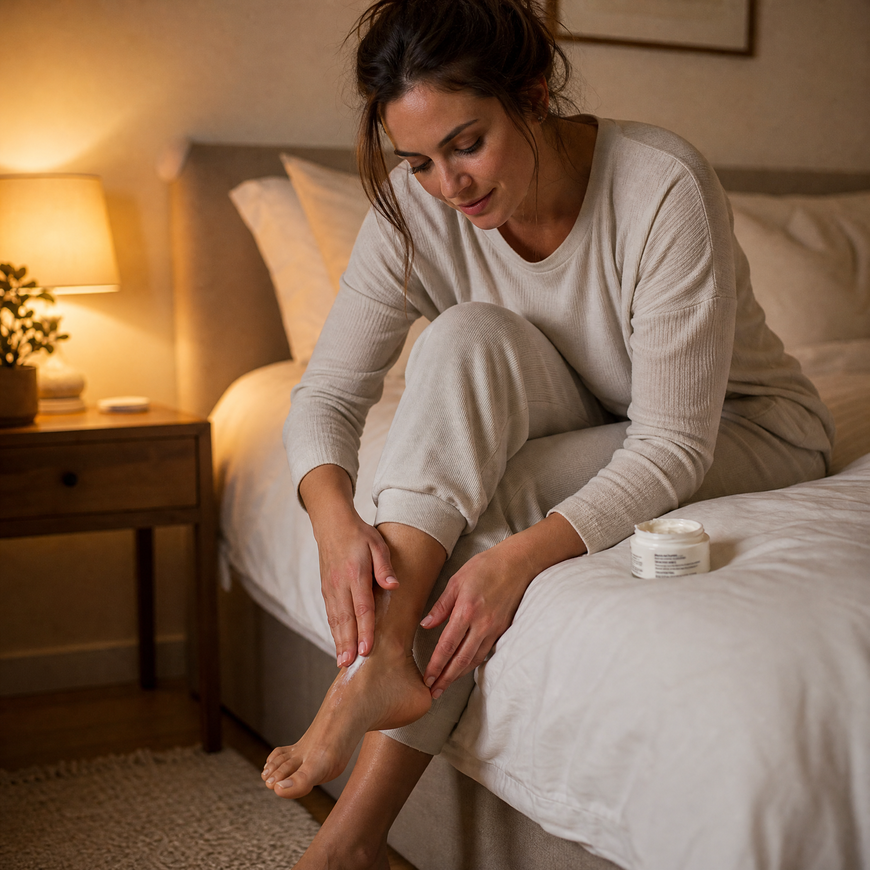
Then, while the skin is still warm, put moisturizer on your heels and soles right away. Skip the spaces between your toes. That area stays dry, since trapped moisture there is exactly what invites fungus in.
Standard body lotion isn’t your best option here. Urea-based creams are.
Urea is a keratolytic, which is a fancy way of saying it dissolves the protein bonds in thick, hardened skin. At 10 to 20% concentration, urea cream softens calluses, repairs cracked heels, and holds heel hydration far better than glycerin or petrolatum lotions. It breaks down the matrix of overly thick skin, makes it pliable, and stops it cracking.
Cracked heels aren’t only a looks problem. Deep fissures are open wounds that can get infected, especially if you have diabetes or poor circulation. Urea cream applied nightly stops those fissures forming in the first place, which is the whole point of a foot care routine that takes prevention seriously.
To apply: rub 10 to 25% urea cream into your heels and soles right after your evening shower, then pull on thin cotton socks to lock it in overnight. Within three to five days of doing this consistently, your heels should feel noticeably softer in the morning.
If your heels are already badly cracked, soak your feet in warm water for ten minutes first, use a pumice stone (only ever on wet skin, since dry scrubbing causes micro-tears), then apply the cream and socks. For severe cracking there’s 40% urea cream, which breaks down thick skin faster but is usually a short-term fix.
Toenail care belongs in any foot care routine, and it’s botched often enough to cause real trouble. Mainly: ingrown toenails.
An ingrown toenail happens when the nail edge curves down and grows into the skin at the border. The usual cause is cutting the nail in a curve instead of straight across. Curved cutting shortens the corners, which nudges the nail to grow down into the soft tissue rather than straight out.
So cut straight across, flat. Leave a small white edge of a millimeter or two rather than cutting down to the skin. File any sharp corners with a file instead of chasing them with the clippers.
Cut your nails when they’re slightly soft, right after a shower or a soak. Dry nails are harder and split more easily when you cut them. Never dig into the corners, and never cut so short that the skin at the tip overhangs the nail, which sets up the exact pressure that drives ingrown growth.
Doing this every two to three weeks (toenails grow about 1.5mm a week) heads off most ingrown nails. It’s a simpler fix than people think. Ingrown toenail surgery is common and almost entirely avoidable with the right cutting technique from the start.
This is the step most people skip, because it doesn’t feel like foot care at all. It’s also the most important part of the whole foot care routine if you want to avoid plantar fasciitis, and I learned that the hard way.
Your two main calf muscles, the gastrocnemius and soleus, attach through the Achilles tendon to your heel bone. When they’re tight, they pull the Achilles upward, which ratchets up tension on the plantar fascia. Tight calves push more stress through that fascia with every step you take.
Clinical studies on plantar fasciitis keep ranking stretching as the first thing to try, ahead of orthotics, anti-inflammatories, and injections for most people. The two best-supported moves are a straight-leg calf stretch against a wall and a direct plantar fascia stretch, pulling the toes back.
The American College of Foot and Ankle Surgeons’ plantar fasciitis guidelines make stretching a core part of every conservative treatment plan. Stretch consistently for six to eight weeks and the research says 80 to 90% of plantar fasciitis cases clear up with nothing else.
For the calf stretch: stand facing a wall, hands at shoulder height. Step one foot back and keep it flat on the floor. Lean into the wall until you feel the stretch in the back calf. Hold 30 seconds, three times per leg, morning and evening.
For the plantar fascia stretch: sit with one leg crossed over the other, take the toes of the crossed foot, and pull them gently back toward your shin. Hold 30 seconds. Do this before you even get out of bed, when the fascia is coldest and tightest.
Step 5: Footwear that fits
Your shoes are the environmental factor that acts on your feet for the 16 hours a day they’re inside them, so footwear is where a foot care routine quietly does most of its work.
Most people wear shoes that are too small. Studies put the share of adults in shoes shorter than their feet somewhere between 63 and 88%, depending on the study. The rule of thumb, literally, is about a thumb’s width (roughly 1cm) between your longest toe and the end of the shoe.
Feet swell over the course of the day, too, by around 8% from morning to evening as fluid settles. Shoes bought first thing and fitted snug can turn painful by mid-afternoon. Trying or buying shoes later in the day gives you a more honest sense of how they’ll feel after hours of wear.
Width counts as much as length. Narrow shoes that squeeze your toes together can cause bunions over the years, as the big toe gets pushed inward. Bunions are bony deformities at the base of the big toe from cumulative sideways pressure: common, largely preventable, and not reversible without surgery.
If your foot care routine includes running or a lot of walking, replace athletic shoes every 400 to 500 miles (640 to 800km) or every 12 months, whichever comes first. The midsole cushioning that absorbs impact compresses and goes flat long before the outsole looks worn. Running in broken-down shoes is a top cause of plantar fasciitis and shin splints.
Foot circulation drops with age and gets worse the more you sit. If you’re at a desk most of the day, the circulation side of a foot care routine matters more for you, not less.
When you sit, the calf muscle pump (the contractions during walking that push blood from your legs back to your heart) goes quiet. Blood pools in your lower legs and feet. Over time that feeds varicose veins, swelling, and dulled sensation.
A few simple habits help:
Stand and walk for at least five minutes every 60 to 90 minutes of desk work.
Do 15 to 20 calf raises when you’re up, which fires the calf pump and pushes blood back toward your heart.
Put your feet up for 10 to 15 minutes in the evening, above heart level, to drain the fluid that’s collected.
Try a contrast soak: two minutes in warm water (40°C / 104°F), one minute in cool (15°C / 59°F), three or four rounds. Warm widens the vessels, cold narrows them, and alternating creates a pumping effect that beats either temperature on its own.
Self-massage earns its place too. Roll a golf ball, tennis ball, or frozen water bottle under your arch for two to three minutes per foot. It puts targeted pressure on the plantar fascia and foot muscles, releases tension, and gets blood moving. It works as both upkeep and early treatment for plantar fasciitis, which is why physical therapists recommend it so often.
Keeping overall inflammation down with anti-inflammatory foods supports foot circulation as well, since systemic inflammation stiffens arteries and cuts peripheral blood flow.
The last habit in the foot care routine is the one that matters most if you have diabetes, peripheral neuropathy, or poor circulation.
Peripheral neuropathy, common in diabetes and some autoimmune conditions, dulls sensation in the feet. A small blister, a cut, or a forming sore can go completely unnoticed because the pain signal just isn’t there. On the feet of someone with diabetes, an undetected wound can turn into a serious infection fast, since poor circulation also slows healing. Between 15 and 25% of people with diabetes develop a foot ulcer at some point, and diabetic foot complications are the leading non-traumatic cause of lower-limb amputations worldwide.
If you have diabetes or reduced sensation, look at your feet every single day. Use a mirror to check the sole and heel if you need to. Watch for cuts, blisters, redness, swelling, or color changes, and check between the toes. That daily look is the number-one recommendation from every major diabetes and podiatry guideline.
Without those risk factors, a weekly check is plenty. Learn what your feet look like healthy so changes stand out. Kidney disease, which can cut circulation to the extremities , is another reason foot inspection matters earlier than most people expect.
If you spot a wound that won’t heal, ongoing numbness in your feet or toes, or color changes in the skin (pallor, a bluish tint, or unusual redness), get it looked at instead of self-treating. Those point to circulatory or nerve issues that need a diagnosis.
Here’s a simple gauge for whether your foot care routine is working: how your feet feel the moment you get up.
Sharp heel pain in those first few steps out of bed is the classic sign of plantar fasciitis. The fascia shortens overnight while you’re off your feet, and the first steps yank it taut all at once. It usually eases after a few minutes of walking.
General stiffness that loosens up is normal. Sharp, localized heel pain that’s worst first thing and improves as you move is plantar fasciitis until proven otherwise.
Cold, numb feet in the morning that take a long while to warm up point toward circulation issues worth looking into. Ways to reduce stress and managing chronic inflammation matter here too, since cortisol affects peripheral circulation directly. The broader set of morning habits that shape how you feel all day reaches into foot health in ways that are easy to miss until something goes wrong.
For most people without existing foot trouble: clean and dry thoroughly (between the toes included) after showering, put urea-based cream on your heels right after drying, and do two minutes of calf stretching morning and evening. Done consistently, that short foot care routine prevents most common problems, athlete's foot and cracked heels and plantar fasciitis among them.
Soak your feet in warm water for ten minutes to soften the skin. Use a pumice stone in small circles on wet, softened skin only, never dry. Rinse, dry, and apply 25 to 40% urea cream to your heels right away. Cover with thin cotton socks overnight, and repeat nightly for five to seven days. Keeping urea cream in your foot care routine after that stops them coming back.
Every two to three weeks for most people. Toenails grow about 1.5mm a week, slower than fingernails. Cut straight across, not curved, leaving a small white edge of a millimeter or two. Use a file on sharp corners rather than cutting curves. This part of the foot care routine prevents ingrown nails, which almost always trace back to bad cutting technique.
Ones that leave a thumb's width between your longest toe and the tip, and that don't squeeze your toes sideways (a wide toe box). Replace athletic shoes every 400 to 500 miles. For daily shoes, go easy on consistently high heels, which shove weight onto the ball of the foot and shorten the Achilles over time. Building shoe checks into your foot care routine is one of the highest-impact preventive habits there is.
In most cases, yes. Consistent calf stretching (30 seconds, three times per leg, twice a day) and plantar fascia stretching (the toe pull-back before you get out of bed) clear 80 to 90% of plantar fasciitis cases within six to eight weeks with nothing else. Alongside the best supplements for energy that aid recovery, magnesium in particular supports muscle relaxation and may ease calf tightness. If things don't improve, a podiatrist can check for structural factors (high arch, leg-length difference) that call for orthotics.
See one if heel pain hangs on after six to eight weeks of consistent stretching, a foot wound isn't healing normally within two weeks, you notice new numbness or reduced sensation, you see a new growth or change in skin color or texture, or toenail fungus (yellow, thick, crumbling nails) spreads past one nail or shrugs off over-the-counter antifungal. A home foot care routine handles maintenance and prevention well, but structural, neurological, and infectious problems need a professional.
This article is for educational purposes only and isn’t medical advice. If you have diabetes, peripheral neuropathy, or any condition affecting circulation or sensation, see a podiatrist or physician for personalized foot care guidance.
Mimo Karam is the founder and writer at LifestyleMine. She writes about daily habits, nutrition, sleep, and emotional wellness, turning research into practical advice for people who want to live healthier without making it complicated.