Quick Answer: Yes. Doing Pilates at home on a mat delivers real, research-supported gains in core endurance, flexibility, and muscular endurance without a reformer machine. The reformer adds spring resistance and assisted range of motion, which matters more as you advance. A $700 machine and a $40 class are not the entry price of this method. A mat and 20 minutes are.
Pilates at home has become one of the most searched fitness questions for an obvious reason: reformer studios run $30 to $45 a class in most cities, and the machines themselves cost $500 to $3,000 for home use. That price has kept a lot of people out of Pilates entirely, when the mat version of the method works and needs almost nothing.
What follows is a complete starter guide to Pilates at home: what mat work can and cannot do against the reformer, the equipment actually worth buying, the ten exercises a beginner needs, and a four-week plan to get from zero to a practice you keep.
What You Can Achieve With Mat Pilates (Without the Reformer)
Quick Answer: Mat work builds core and muscular endurance and improves flexibility. A 12-week randomized trial found significant gains in abdominal endurance, hamstring flexibility, and upper-body muscular endurance from twice-weekly mat sessions, though it found no significant change in posture or balance. What mat work does not replicate is external spring resistance and assisted range of motion, which matter more for advanced practitioners than beginners.
For anyone weighing Pilates at home against a studio membership, start with what the reformer actually adds: springs that provide adjustable resistance in both directions, and a sliding carriage that assists ranges of motion which are harder to control with bodyweight alone. For an advanced practitioner that is a real difference.
For a beginner it is a much smaller gap than the pricing implies. A 12-week randomized controlled trial put 50 active middle-aged adults into either a Pilates mat class or a control group. The class met for an hour twice a week and ran roughly 25 essential mat exercises per session. After 12 weeks the Pilates group showed significant improvement in abdominal endurance, hamstring flexibility, and upper-body muscular endurance (Kloubec, 2010).
The rest of that result matters too. Posture and balance did not improve significantly, despite both appearing in the study’s title. Bodyweight mat work produces real strength and flexibility gains. It is not a starter version that does not count, but it is also not the posture cure that a lot of Pilates at home content sells.
Mat work does have one real limitation for absolute beginners. Exercises that demand core control to stabilize the spine, like a full roll-up, are harder to execute correctly without the assistance a spring-based machine provides. The beginner progression later in this guide handles that by starting with modified versions.
he Essential Equipment for Pilates at Home
Quick Answer: A true beginner needs one thing: a mat, ideally thicker than a standard yoga mat at 6mm or more, since Pilates spends real time on the spine and tailbone. Everything past that, a ring, bands, blocks, adds variety and progression but is not required to start Pilates at home.
The biggest mistake people make when setting up Pilates at home is buying equipment before knowing whether the practice sticks. In priority order:
- A thicker mat. Standard yoga mats at 3 to 4mm are too thin for how much time Pilates spends directly on the spine and tailbone. A 6mm mat noticeably reduces discomfort in the first few weeks, before core strength develops enough to take pressure off.
- A Pilates ring, or magic circle. The highest value add-on by a distance. It adds light resistance across inner thigh work, arm work, and core engagement cues, and stores anywhere.
- Light resistance bands. Useful for arm and leg work, and the natural bridge toward reformer-style resistance if that becomes a goal.
- Blocks. Helpful for modifications, elevating hips or supporting the head, but the lowest priority of the four.
Anything past this list, a balance ball chair or a home reformer, is a once-you-know-you-love-this purchase. The same logic applies to any home fitness equipment worth the money: buy after the habit exists, not before.
Manduka PRO Yoga Mat 6mm, thick enough for extended spine contact and the single most important purchase
Pilates ring / magic circle, the best value per dollar of any add-on
The 10 Mat Pilates Exercises Every Beginner Needs to Know
Quick Answer: The ten foundational exercises for Pilates at home: the hundred, modified roll-up, single leg circles, rolling like a ball, single leg stretch, double leg stretch, spine stretch forward, saw, swan prep, and the side kick series. They build from core activation toward full-body coordination, and most beginner programs are built around some version of the same list.
Check with a doctor before starting if you have an existing back or joint injury, are pregnant, or have any condition affecting core or spinal movement. Skip any exercise that produces sharp pain rather than muscular effort.
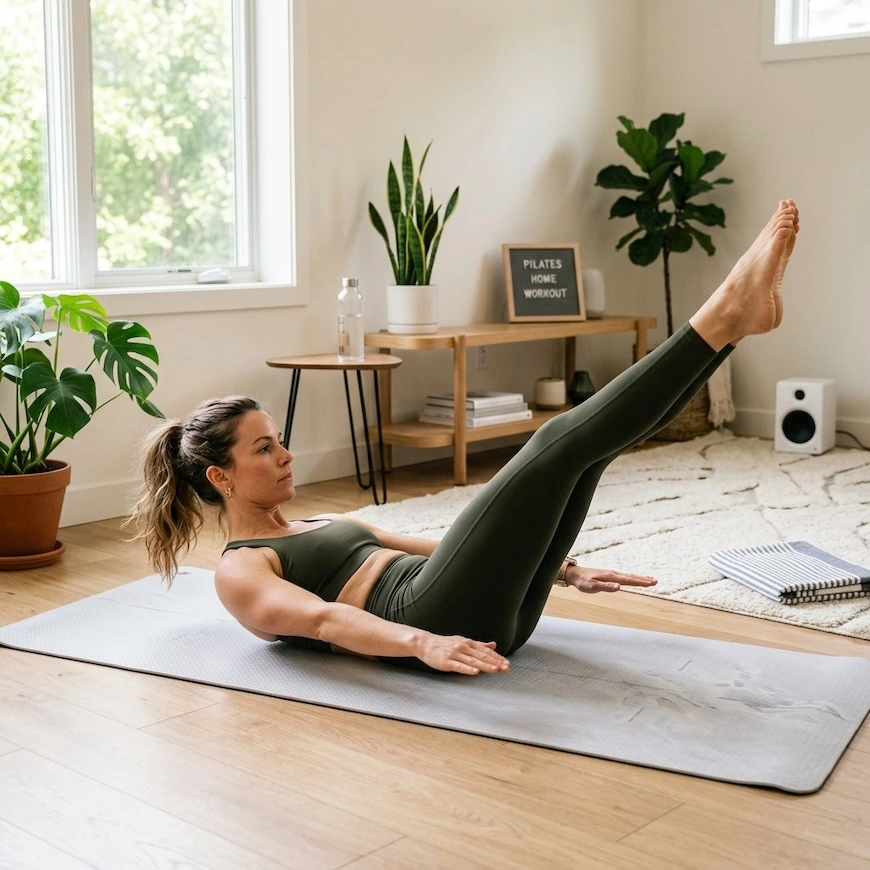
- The Hundred. The signature warm-up. Legs raised, upper body curled forward, arms pumping in small pulses. Builds core endurance and breath control. Modification: knees bent at tabletop instead of legs extended.
- Roll-Up, modified. Rolling from flat to seated and back with control. The full version needs serious abdominal strength, so beginners should bend the knees and use the hands to assist.
- Single Leg Circles. On your back, one leg extended toward the ceiling, drawing small circles. Trains hip mobility and core stability at once.
- Rolling Like a Ball. A controlled backward and forward roll in a tucked position. Builds spinal articulation. Skip it if you have a diagnosed disc issue.
- Single Leg Stretch. Alternating knee-to-chest pulls while the upper body stays curled. A core endurance staple in nearly every class.
- Double Leg Stretch. Both arms and legs extend, then pull back in. The natural progression once single leg stretch feels controlled.
- Spine Stretch Forward. Seated with legs extended, reaching forward through a rounded spine. Works hamstring and spinal flexibility.
- Saw. A seated rotating reach that adds rotation to the spine stretch. Targets the obliques.
- Swan Prep. Face down, lifting the chest with control. Strengthens the back muscles that balance out all the forward flexion above.
- Side Kick Series. On your side, controlled leg lifts and circles. Hits the hips and outer thighs, which most core-focused routines skip entirely.
The list is not arbitrary, and it is the same backbone under most structured Pilates at home programs. It moves through flexion, rotation, extension, and lateral work, the four patterns the method is built on, which is why nearly every established beginner program covers some version of the same ten.
How Pilates Works Differently From Yoga and Why It Matters
Quick Answer: Pilates is built around core-centered, controlled, repeated movement aimed at muscular strength and endurance. Yoga is built around held poses, breath work, and flexibility, often with a meditative component. Both improve body awareness. Pilates tends to produce more noticeable core and muscular endurance gains, yoga more noticeable flexibility and stress-reduction benefits.
This comes up constantly for anyone deciding what to actually do for Pilates at home, because both practices are mat-based, breath-focused, and low impact, but the mechanics differ enough to matter when choosing.
Pilates is controlled, repeated movement organized around a stable engaged core, often described as working from a powerhouse of abs, lower back, hips, and glutes. Movements are dynamic and done for reps, structurally closer to strength training than to a held stretch.
Yoga holds poses for longer durations, with breath and stillness as central elements, and frequently carries meditative or philosophical components that Pilates does not.
Neither is better in the abstract. If the goal is core strength and controlled movement, Pilates at home is the more direct route. If the goal is flexibility and stress reduction, yoga fits better. Plenty of people do both for different reasons rather than treating one as a substitute.
Pilates for Core Strength: What the Muscle Activity Research Shows
Quick Answer:Electromyography research comparing Pilates abdominal exercises against sit-ups and crunches found several Pilates movements produced greater rectus abdominis activation than the traditional exercises. What makes Pilates core work distinct is not that it skips the superficial muscles but that nearly every exercise requires holding core engagement while the limbs move independently.
The word core gets used loosely in fitness content, and one claim circulates constantly in Pilates at home content that the research does not actually support.
Researchers put surface electrodes on the upper and lower rectus abdominis of 17 women with no Pilates experience and measured activation across five Pilates exercises against sit-ups and crunches. Double leg stretch, coordination, crisscross, and foot work all produced greater muscle activation than the traditional exercises, mostly in the upper rectus abdominis (Silva et al., 2015).
Note carefully what that does and does not show. It measured the rectus abdominis, the superficial muscle a crunch targets, and found Pilates hits it harder. It did not measure the transverse abdominis or the deep spinal stabilizers, so it cannot be used to claim Pilates uniquely trains deep muscles that crunches miss. That claim is everywhere online and this study does not support it. The sample was also 17 people.
What does distinguish Pilates at home from a floor ab routine is structural: nearly every exercise asks you to hold trunk engagement while the arms or legs move independently. That pattern, stabilize the middle while the limbs travel, is closer to how the core works in ordinary movement than a crunch is.
Theraband resistance bands light/medium, which add resistance to the leg and arm work inside the exercises above
Pilates for Back Comfort: What the Evidence Actually Supports
Quick Answer: Pilates has real but moderate-quality evidence for reducing pain and disability in chronic low back pain. A Cochrane review found it outperformed minimal intervention in the short and intermediate term, with medium effect sizes, but did not find it clearly better than other forms of exercise. That makes it a reasonable evidence-informed choice, not a guaranteed treatment.
Back discomfort is one of the most common reasons people search for Pilates at home rather than fitness content generally, and the research here is more substantial than for most wellness trends.
A Cochrane systematic review, the gold standard for evidence synthesis in medicine, pooled the randomized trials on Pilates for non-specific low back pain. It found low-to-moderate quality evidence that Pilates beat minimal intervention on pain intensity and disability in the short and intermediate term, with most effect sizes in the medium range. The review was explicit that the evidence was not strong enough to recommend Pilates over other exercise approaches (Yamato et al., 2016).
The practical translation: Pilates is a defensible option for general back comfort in people without a diagnosed condition, it is not established as superior to other structured exercise, and it does not replace medical evaluation of persistent or worsening back pain.
One correction worth making here, since so much Pilates at home content leans on it. Posture improvement is the weakest claim in the category. The 12-week trial above specifically measured posture and found no significant change. Pilates may well help how your back feels; the evidence that it measurably alters postural alignment is thin.
A simple back-focused sequence from the ten above: spine stretch forward, swan prep, and the side kick series, which together cover front, back, and side. Roughly ten minutes, three or four times a week.
The Beginner 4-Week Plan for Pilates at Home
Quick Answer: A realistic four-week progression. Week 1: the hundred, single leg circles, single leg stretch, three sessions of 15 to 20 minutes. Week 2 adds double leg stretch and spine stretch forward. Week 3 introduces the roll-up and saw. Week 4 adds swan prep and the side kick series, completing the ten-exercise foundation at a pace you can actually sustain.
Trying to do all ten well in the first session is the most common reason people quit Pilates at home inside two weeks. Competence builds faster from a smaller, cleaner set repeated consistently. It is the same principle behind building any habit small enough to survive.
Week 1, three sessions, 15 to 20 minutes. The hundred with bent knees, single leg circles, single leg stretch. Focus entirely on breath and engagement, not speed or rep count.
Week 2, three sessions, 20 minutes. Add double leg stretch and spine stretch forward, keeping everything from week one. This is where holding the core while the limbs move starts to click.
Week 3, three to four sessions, 25 minutes. Add the modified roll-up and the saw. Start extending the hundred toward straighter legs if control allows.
Week 4, three to four sessions, 25 to 30 minutes. Add swan prep and the side kick series to complete the foundation. Reassess which modifications, the roll-up especially, are ready to progress.
By the end of week four most beginners have a sustainable 25 to 30 minute practice they can repeat indefinitely. That is the actual goal, not perfecting any single exercise.
CorePower Yoga blocks 2-pack, a useful modification tool through weeks one and two especially
How to Progress From Beginner to Intermediate Without a Trainer
Quick Answer: Progress in mat Pilates comes from three levers rather than from constantly adding exercises: removing modifications, increasing reps and hold duration, and adding light resistance with a ring or bands. A beginner can progress for months on the same ten-exercise foundation by adjusting these three.
The instinct once the four-week plan feels manageable is to hunt for a harder routine online. That is where most Pilates at home progress stalls. The better move keeps the same movements and changes how they are performed.
- Remove modifications first. The roll-up without hand assistance, the hundred with fully extended legs. This is usually the biggest jump in difficulty available from the same exercise.
- Extend duration and reps. More reps of the hundred, longer holds in the side kick series. This builds endurance inside movements that are already technically sound.
- Add light resistance. The ring or the bands turn nearly every exercise on the list into a harder version without changing the pattern.
This path can carry two to three months of continued improvement on the same ten exercises. Chasing new routines online rarely does, and steady repetition is the more durable approach to keeping any routine going. It also builds the movement literacy that makes a reformer class approachable later, if that ever becomes the goal.
Choosing an Online Program for Pilates at Home
Quick Answer: Structured options fall into three tiers: free video channels covering the exact exercises in this guide, low-cost subscription apps with real progressions at $10 to $20 a month, and hybrid programs for anyone adding a ring, bands, or a reformer alternative. A subscription is optional for everything described here.
This guide works as a standalone starting point for Pilates at home, but if you prefer video guidance, two things separate a good program from a frustrating one. Look for programs organized by actual skill level rather than generic “all levels” classes, which tend to move far too fast for someone in week one. And favor programs that build from foundational exercises toward combinations, rather than themed daily workouts with no skill arc, since those match the progression model above.
Everything in the four-week plan can be done without paying anyone, using the descriptions in this guide as the reference.
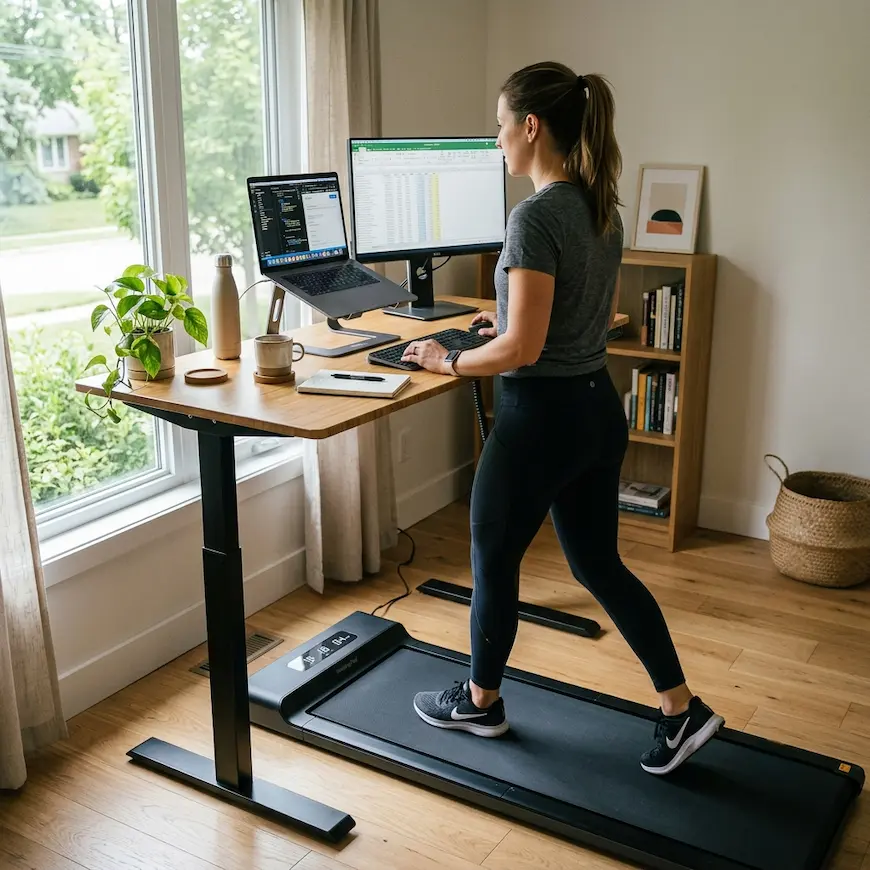
One adjacent note. If you sit at a desk most of the day, the core engagement you build here erodes fast in a bad chair, and how your workspace is set up affects your back more hours per week than three Pilates sessions do.
Gaiam Balance Ball Chair, for extending core engagement into desk time between sessions.
Frequently Asked Questions
How long until I see results from Pilates at home?
The controlled research showing meaningful strength and flexibility gains used a 12-week timeline at twice weekly. Improvements in body awareness and control usually show up sooner, often within two to four weeks.
Can I do Pilates at home every day?
Most programs recommend two to four sessions a week rather than daily, allowing recovery like any strength-focused training. Daily gentle stretching sessions are fine. Daily core-intensive sessions are not necessary for results.
Is Pilates safe if I have back pain?
The research supports it as generally helpful for chronic low back pain in the general population, but anyone with a diagnosed back condition or injury should check with a doctor or physical therapist first, since individual conditions vary a lot.
Do I need to be flexible to start Pilates at home?
No. Flexibility is an outcome of consistent practice, not a prerequisite. Every exercise in the ten above has a modification for limited flexibility or strength.
Will Pilates fix my posture?
Probably less than the marketing suggests. The 12-week controlled trial that measured posture directly found no significant change, even while endurance and flexibility improved. Pilates may help how your back feels and how aware you are of your alignment, but treat measurable posture correction as unproven.
What’s the difference between Pilates and a regular ab workout?
Pilates asks you to maintain trunk engagement while the limbs move independently, which is closer to how the core functions in daily life. Muscle activity research also found several Pilates exercises produce more abdominal activation than sit-ups and crunches. A typical ab workout targets the same muscles through a narrower movement.
Is Pilates enough exercise on its own?
Not quite. It builds strength, endurance, and flexibility but does little for cardiovascular fitness. Pairing it with something aerobic, and walking is the most underrated option, covers what mat work leaves out.

Mimo Karam is the founder and writer at LifestyleMine. She writes about daily habits, nutrition, sleep, and emotional wellness, turning research into practical advice for people who want to live healthier without making it complicated.