Quick Answer: A good night routine has four core parts: a screen cutoff roughly 60 to 90 minutes before bed, one calming ritual such as skincare, reading, or stretching, a quick bedroom environment check, and a short written brain dump to close the day’s mental loose ends. It does not need to be elaborate. Five consistent minutes beats a 45-minute night routine you abandon after a week.
The night routine is the most underrated piece of the wellness habit puzzle. Morning routines get the attention, the 5am alarms and the cold plunges, but the last 60 to 90 minutes before bed decide two things at once: how well you sleep tonight, and what condition tomorrow starts in.
The version worth building is a small repeatable sequence that tells your body and mind the day is closing, so sleep arrives easier and the next morning does not begin already behind.
What follows is what belongs in a night routine, what to skip, and how to build one that survives a chaotic life, since that is where most routines fall apart. Plenty of the advice floating around is optimization for its own sake; very little of it is necessary.
Why Your Night Routine Determines Your Morning
Quick Answer: How you end the day shapes how the next one starts. A rushed, screen-lit evening produces a groggy, reactive morning. A closed-out evening produces a morning with less to catch up on. That is a sequencing problem more than a mindset one. Whatever is unfinished at bedtime is the first thing your brain reaches for when you wake.
Most people treat mornings and evenings as separate problems. They are one loop, and the night routine is the handoff point.
A chaotic evening costs you more than sleep quality. Doom-scrolling until your eyes close, an inbox left open, dishes in the sink, a to-do list still spinning: all of it hands your morning self a backlog before the day starts. A closed-out evening hands your morning self a clean slate instead, which is why a night routine and a solid morning routine work as a pair rather than as two separate projects.
That is the real reason a night routine earns its place, and it has little to do with which specific habits you pick. The point is deliberately closing a loop before sleep, so your brain has stopped processing an unfinished day by the time you are trying to shut down.
The Phone Wind-Down: The Most Important and Most Ignored Step
Quick Answer: Evening use of light-emitting screens measurably delays melatonin release, lengthens the time it takes to fall asleep, and reduces next-morning alertness in controlled laboratory research. A phone cutoff 30 to 60 minutes before bed, even an imperfect one, is the single highest-leverage change available in most people’s night routine.
Almost everyone knows about this step and almost nobody does it, which is exactly why it goes first in this night routine.
A tightly controlled study had participants read on a light-emitting eReader on some nights and a printed book on others, in the same sleep laboratory under a fixed 10pm bedtime. After the light-emitting device, participants took longer to fall asleep, secreted less melatonin, had a delayed circadian clock, got less REM sleep, and were sleepier the next morning (Chang et al., 2015). That design, the same people measured under both conditions, is why it remains the strongest evidence on this specific question.
A full phone-free hour is the ideal. It is also not what most people will do every night. The sustainable version is to cut social media and email specifically, the content most likely to spike stress or restart your thinking, even if the phone stays nearby for an alarm or a podcast. The content matters as much as the device. A calm phone call is not the same experience as 45 minutes of scrolling.
Realistic version: phone on do-not-disturb, face down, 30 to 60 minutes before target bedtime, ideally charging outside the bedroom.
The 90-Minute Wind-Down Window: What to Do and Not Do
Quick Answer: The 90 minutes before bed is the highest-leverage window for a night routine, because the body’s own pre-sleep changes, the core temperature drop and the melatonin rise, are already underway. Do: dim the lights, pick one low-stimulation activity, stretch or do skincare. Avoid: intense exercise, hard conversations, work email, and bright white light.
Think of the night routine window as three loose 30-minute blocks rather than one long stretch.
First 30 minutes, finishing up. Wrap up anything active. Tidy one small thing, the dishes or tomorrow’s bag. Send the last work message if it genuinely cannot wait. This is the loop-closing phase.
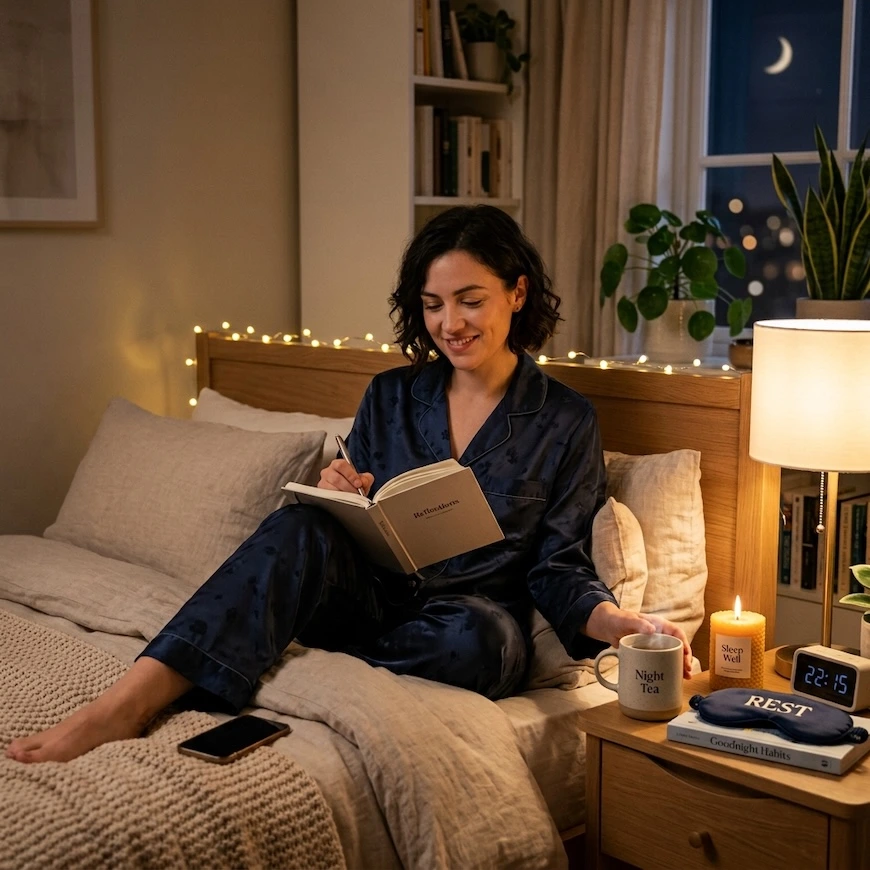
Middle 30 minutes, transitioning. Kill the overhead lights in favor of lamps. Start the calming ritual, whether that is skincare, tea, or light reading. Phone goes down.
Final 30 minutes, settling. In bed or near it, doing the lowest-stimulation thing of the night: reading, stretching, or lying in the dark.
What works against the window: intense exercise, which raises core temperature and alertness exactly when the body is lowering both; emotionally difficult conversations; checking work email one more time; and bright overhead lighting, which suppresses melatonin much the way screen light does.
The window does not need to be exactly 90 minutes. The shape matters more than the clock: a gradual step down in stimulation rather than an abrupt stop.
Skincare as a Wind-Down Ritual (Not Just a Routine)
Quick Answer: A tightly controlled study had participants read on a light-emitting eReader on some nights and a printed book on others, in the same sleep laboratory under a fixed 10pm bedtime. After the light-emitting device, participants took longer to fall asleep, secreted less melatonin, had a delayed circadian clock, got less REM sleep, and were sleepier the next morning (Chang et al., 2015). That design, the same people measured under both conditions, is why it remains the strongest evidence on this specific question. Evening skincare works as a wind-down cue independent of what it does for your skin, because it is a consistent, hands-on, low-stimulation ritual that signals the day is ending through sheer repetition. The products matter for your skin. The ritual matters for the sleep transition. Both are real at once.
There is real overlap between a night routine and a skincare routine, and it is worth naming why: repetitive, tactile, low-effort physical rituals work as wind-down cues almost regardless of content. Skincare happens to double as a skin habit and a psychological transition marker.
It works particularly well because most people already do it, so the night routine gains a step without gaining a chore. Only the timing changes. Doing it earlier in the 90-minute window rather than rushed at lights-out gives it more of the wind-down effect, because it is not competing with the final settling minutes.
If you do not do evening skincare at all, a two-step version, cleanse and moisturize, captures most of the ritual benefit without a full regimen.
Journaling and Reflection: The 5-Minute Practice That Closes the Day
Quick Answer: A brief bedtime writing practice, specifically writing a to-do list for the days ahead, helped people fall asleep faster than writing about tasks already finished in a controlled sleep-lab study. The more specific the list, the faster sleep came. This is a rare case where a five-minute habit inside a night routine has directly measured sleep-onset evidence behind it.
This finding cuts against what a lot of wellness content assumes, which is that reflecting on the day is the calming choice and thinking about tomorrow is the anxious one.
Fifty-seven healthy adults aged 18 to 30 spent five minutes writing before overnight polysomnography, the gold-standard lab measurement rather than a self-report survey. Those randomly assigned to write a to-do list for the next few days fell asleep significantly faster than those assigned to write about tasks completed over the previous few days. Specificity mattered: more detailed to-do lists predicted faster sleep onset, while the opposite trend showed up in the completed-task group (Scullin et al., 2018). The sample was young adults, though, so treat the finding as promising rather than settled.
The likely mechanism is worth understanding, because it explains where this belongs in a night routine: an unwritten to-do list is an open loop your brain keeps reopening as bedtime approaches. Writing it down externalizes it, which appears to reduce the mental rehearsal that delays sleep.
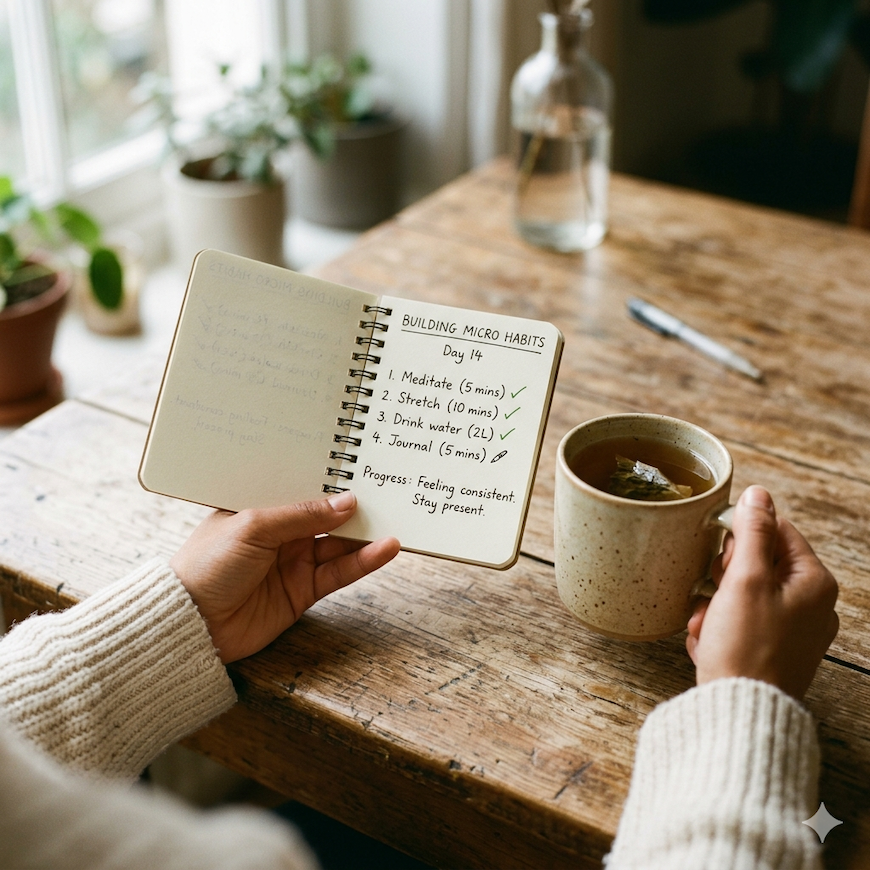
Practical version: keep a notepad by the bed rather than using your phone’s notes app, which would undo the screen cutoff you just made, and write three to five specific things for tomorrow. Not a reflection journal. A brain dump.
Movement, Stretching, and the Physical Preparation for Sleep
Quick Answer: Light stretching in the wind-down window helps release the physical tension a day builds up, but intensity is the variable that matters. Gentle mobility work fits a night routine. Hard exercise works against it by raising core temperature and alertness at exactly the wrong time.
This distinction is worth being precise about, since exercise in a night routine gets both recommended and warned against depending on which kind people mean.
Moderate-to-vigorous exercise close to bedtime raises heart rate, core temperature, and alertness, all of which push against what the body is trying to do in the pre-sleep window. This is not universal. Some people sleep fine after an evening workout. But it is the more common pattern.
Gentle stretching is a different category. Five to ten minutes on hips, shoulders, neck, and lower back targets tension from a day of sitting without raising heart rate or core temperature. It fits naturally into the middle or final block.
If you prefer a full evening workout, the fix is to move it earlier, ideally two to three hours before bed, so your body has time to come back down before the wind-down starts.
The Bedroom Environment Check: Light, Temperature, Sound
Quick Answer: The three environmental factors with the most evidence behind them are darkness, since light suppresses melatonin, temperature, since a cooler room supports the body’s natural pre-sleep temperature drop, and consistent low-level sound. A nightly check of all three takes under a minute and is the highest-return, lowest-effort part of any night routine.
This is the part of a night routine that happens to the room rather than to you, which is why it gets skipped. Nobody thinks of closing curtains as a habit.
Light. Even small amounts of light during sleep can disrupt sleep architecture. Blackout curtains or an eye mask fix this directly and cheaply.
Temperature. A cooler bedroom supports the core-temperature drop that is part of falling asleep. The full breakdown on where to actually set the thermostat is covered in the sleep temperature guide.
Sound. Consistent low-level background sound, a fan or white noise, usually beats a silent room, because it masks the sudden noise spikes that cause micro-awakenings you will not consciously remember.
A 60-second check, curtains closed, thermostat set, fan on, compounds every night for almost no effort.
Reading vs. Screen: The Comparison Before Bed
Answer Block: A printed book or a non-backlit e-ink reader is a better pre-sleep choice than a phone or backlit tablet, and the reason is the light source rather than the activity. Reading is not inherently more restful than other calm activities. The backlighting is what makes the difference.
Night routine advice tends to flatten this into “reading good, screens bad,” which is not quite right. The controlled research comparing light-emitting eReaders to print books traced the effect to blue-light-heavy backlighting specifically, not to the act of reading (Chang et al., 2015).
So the accurate advice is more specific than “read instead of scrolling.”
- Best: a printed book, or a non-backlit e-ink reader such as a basic Kindle Paperwhite in warm mode.
- Fine: a phone or tablet with a strong warm-light filter on, used for something short and calm rather than a social feed.
- Worst: any backlit screen at full brightness running content built to be engaging. Social media, news, work email.
If you read on a phone out of convenience, turning on the device’s warm-light mode from early evening onward, not just at bedtime, captures a decent share of the benefit without switching to paper.
Building a Night Routine That Works Even When Life Is Chaotic
Quick Answer: A night routine only works if it survives a properly bad day, which means it needs a minimum viable version, usually just the phone cutoff and the environment check, that takes under five minutes and requires almost no willpower. Save the fuller version for normal nights, and do not treat a skip as failure.
A night routine rarely fails for lack of motivation on an ordinary day. It fails because it has no smaller version for the nights it is needed most: after a long day, a late night out, a stressful event. Exactly when winding down matters and energy for a multi-step sequence is lowest.
The fix is to define your minimum night routine in advance rather than in the moment. For most people that is two things: phone down 15 to 30 minutes before bed, and the environment check. Everything else, skincare and journaling and stretching, is the full version for a normal night. This is the same logic behind building habits small enough to survive a bad week, and it is the difference between a routine that lasts and one that collapses after the first missed night.
One caveat about scope. A large review of the sleep hygiene evidence found that individual components each show a relationship to sleep, yet bundling them together as a general education package has performed poorly as a clinical treatment for insomnia, and the authors argue the evidence base for population-level sleep hygiene advice is thinner than its popularity suggests (Irish et al., 2015). Read that as a useful caution rather than a reason to skip the whole thing. A night routine is a reasonable set of habits for generally healthy sleepers, but it is not a treatment, and if you are dealing with real insomnia the research says a checklist will not fix it.
Frequently Asked Questions
Do I need to do everything in this article every single night?
No. The core is the phone cutoff and the environment check. Skincare, journaling, and stretching are additions for a normal night, not requirements.
What if kids or my job make a fixed bedtime impossible?
The framework scales down. Screen cutoff, one calming activity, environment check, compressed into whatever 10 or 15 minutes actually exist before lights-out, rather than a fixed 90-minute block.
Should I avoid all exercise in the evening?
Not entirely. Gentle stretching fits a night routine well. Harder training is better scheduled two to three hours before bed, since it raises alertness and body temperature when the body is trying to lower both.
Is it better to read a physical book or use my phone before bed?
A printed book or non-backlit e-reader is better specifically because of the light emission, not because reading is more restful than other calm activities.
I have trouble falling asleep even with a good night routine. What should I do?
A night routine supports healthy sleep habits but is not a treatment for a sleep disorder, and the research is fairly clear that habit checklists underperform as insomnia treatment. There are other approaches worth trying first, but if the difficulty is persistent or affecting your daily life, that is worth raising with a doctor rather than troubleshooting alone.

Mimo Karam is the founder and writer at LifestyleMine. She writes about daily habits, nutrition, sleep, and emotional wellness, turning research into practical advice for people who want to live healthier without making it complicated.