✦
THE LIFESTYLEMINE NEWSLETTER
Simple wellness tips, healthy recipes, and
everyday inspiration delivered to your inbox.
Your Email Address
The two-process model of sleep regulation: Sleep runs on two independent systems in parallel.
Process S (homeostatic): Adenosine accumulates in the basal forebrain throughout waking hours. Higher adenosine means higher sleep pressure. After 16 hours of wakefulness it peaks, and sleep feels irresistible. Caffeine blocks adenosine receptors and doesn’t eliminate it, which is why the crash comes when caffeine clears.
Process C (circadian): The suprachiasmatic nucleus (SCN) in the hypothalamus runs a near-24-hour oscillation driven by light input, controlling melatonin release (typically beginning 2-3 hours before habitual sleep time), core temperature rhythms, and cortisol patterns. When both processes align, high adenosine meeting the circadian sleep window, sleep is deep and architecturally complete. When they’re misaligned through irregular schedules, jet lag, or shift work, both N3 and REM suffer.
N3 distribution across the night: N3 is front-loaded. Most slow-wave sleep falls in the first half of the night; most REM falls in the last 1-3 hours. Cutting sleep short by 2 hours removes mainly REM. Delayed sleep onset from caffeine, blue light, or anxiety can displace N3. This distribution matters because it reveals which habits threaten the right stages, and is worth grasping before asking how to get deep sleep.
Quick Answer: Waking at the same time every day, including weekends, is the single most impactful sleep habit in clinical sleep medicine. Variable wake times shift the circadian phase, producing social jet lag equivalent to flying across time zones each week. Social jet lag of even 1-2 hours is associated with increased daytime sleepiness, reduced cognitive performance, and poorer metabolic health. A fixed wake time anchors the circadian clock, ensures adenosine accumulates properly, and makes sleep pressure peak reliably at the intended bedtime. This is the foundation of how to get deep sleep consistently.
The mechanism is direct: the SCN is primarily set by light at waking time. Wake at 7am and morning light sets melatonin onset around 9-11pm. Wake at 10am on weekends and that entire cycle shifts 3 hours forward. By Monday, your body’s natural wake time is 10am, not 7am. Sleep researchers call this social jet lag.
The weekend sleep-in problem: Sleeping in 2+ hours on weekends doesn’t restore sleep debt efficiently; it mainly disrupts circadian timing for the week ahead. Sleep debt gets partially repaid, but Monday and Tuesday pay the price. Better approach: same wake time 7 days, and if you’re sleep-deprived, go to bed 30-60 minutes earlier.
This is the foundational habit because everything else flows from it. Light exposure timing, temperature rhythm, melatonin onset, cortisol peak, all are downstream of wake time. Anchor the wake time and the rest arranges itself.
Quick Answer: 65-68°F (18-20°C) for most adults. Core body temperature naturally drops 0.5-1°C at sleep onset, and this temperature fall is a prerequisite, not a consequence, of entering N3 slow-wave sleep. Rooms warmer than 70°F (21°C) impair this thermoregulatory drop, reducing N3 time and increasing nighttime awakenings. The fastest way to accelerate the drop: a warm bath 1-2 hours before bed. Warming the skin dilates peripheral blood vessels, which dissipates heat from the core, dropping core temperature faster than if you’d skipped the bath entirely.
Temperature is one of the fastest levers for how to get deep sleep. Body temperature follows the same circadian rhythm as the SCN clock, peaking in late afternoon (around 4-6pm) and falling through the evening to a nadir around 4am. Sleep onset aligns with the descent; REM peaks align with the nadir.
The warm bath mechanism: Hot water causes peripheral vasodilation, blood vessels in the skin dilate to dissipate heat to the environment, transferring it from the body core to the periphery and out. A 10-15 minute bath at 40-42°C (104-108°F) taken 1-2 hours before bed reduces sleep onset latency and increases slow-wave sleep duration.
Room temperature in practice:
Target: 65-68°F (18-20°C), the optimal range for most adults
Cool sheets (percale cotton, bamboo, or moisture-wicking fabrics) support skin temperature regulation
Socks in bed: warming the feet vasodilates foot vessels, accelerating core cooling, useful for people who find cold feet delay sleep onset
Temperature is especially important in the first half of the night when N3 predominates
Quick Answer: Light is the primary input to the SCN circadian clock. Morning bright light (within 30-60 minutes of waking, outdoor or 10,000-lux light box, 20-30 minutes) anchors the circadian phase and sets the 14-16 hour timer until melatonin onset. Evening blue light from phone, laptop, and TV screens (peak sensitivity at 480nm) suppresses melatonin via intrinsically photosensitive retinal ganglion cells (ipRGCs) and can delay sleep onset by up to 90 minutes. Both morning light and evening light restriction have direct documented effects on sleep quality, and both are part of how to get deep sleep through circadian alignment.
Morning light protocol: ipRGC cells in the retina contain melanopsin, maximally sensitive to 480nm blue light. They connect directly to the SCN and override other inputs. Morning bright light (outdoor or a 10,000-lux lamp) within the first hour of waking:
Anchors the circadian phase
Triggers a cortisol pulse that creates natural morning alertness
Sets melatonin onset timing roughly 14-16 hours out
Has documented antidepressant effects equivalent to some medications in seasonal depression
Even on overcast days, outdoor light provides 10,000-30,000 lux. Indoor light runs 100-500 lux. On cloudy days, 20-30 minutes outside gives 10-100x more light signal than staying in.
Evening light restriction: The same ipRGC-melanopsin system that anchors the clock in the morning suppresses melatonin in the evening. Screens emit blue-enriched white light; smartphones, laptops, and LED TVs all stimulate ipRGCs. Two practical options with different trade-offs:
Blue-light filtering glasses (amber-tinted): Block the 480nm wavelength while allowing normal screen use. Research shows they reduce melatonin suppression by 50-80%. More practical for people who need screens in the evening.
Screen elimination after 9pm: More effective than filtering because it removes the stimulus entirely. Physical books, podcasts, dim-light social activity all preserve natural melatonin onset timing.
The fall asleep faster article covers the 90-minute blue light rule in detail. For deep sleep specifically, the benefit of evening light restriction is less about sleep onset and more about preserving the melatonin-driven circadian temperature drop that triggers early-night N3.
Quick Answer: The advice to avoid all afternoon or evening exercise is outdated and not supported by current evidence. A 2019 Sports Medicine systematic review and meta-analysis (Stutz et al., 23 studies, N=1,000+) found that evening exercise ending at least 1 hour before bedtime does not impair sleep onset, duration, or quality in healthy adults. The actual evidence-based caveat: vigorous high-intensity exercise within 60 minutes of bedtime may delay sleep onset in some people due to elevated core temperature, adrenaline, and heart rate. Moderate evening exercise has no such effect.
This matters for working adults who can only exercise late. Skipping workouts out of fear of disrupting sleep is significantly more harmful to sleep than any modest timing effect.
What regular exercise does to sleep architecture, regardless of timing:
Increases total N3 slow-wave sleep time by 30-40% vs sedentary controls
Reduces sleep onset latency
Improves sleep efficiency (time asleep vs time in bed)
Reduces anxiety-related nighttime awakenings
Increases daytime alertness, cutting the tendency to doze during the day (which itself undermines nighttime sleep)
The practical guideline: finish vigorous exercise (HIIT, heavy strength training, competitive sport) at least 60-90 minutes before bed. Moderate-intensity exercise (brisk walking, recreational cycling, easy swimming) can be done within 60 minutes of bed without impairing sleep for most people. If specific workouts disrupt sleep, experiment with timing. But don’t eliminate the workout. Exercise is one of the most reliable answers to how to get deep sleep, and skipping it to protect sleep is one of the more self-defeating trades you can make.
The protein calculator article covers post-exercise nutrition timing, which intersects with sleep here: a moderate-protein snack (cottage cheese, Greek yogurt) 1-2 hours before bed supports overnight muscle protein synthesis without the sleep-disrupting thermogenic effect of a large meal.
Quick Answer: Alcohol is the most commonly used sleep aid that doesn’t work for sleep quality. Its GABA-A agonist effect creates sedation (faster sleep onset) while simultaneously suppressing REM in the first half of the night and fragmenting N3 in the second half. You fall asleep faster but wake feeling less restored because the architecturally restorative stages were chemically suppressed. Even 1-2 drinks within 3 hours of sleep measurably reduces REM duration and increases nighttime awakenings after the alcohol has cleared. For anyone focused on how to get deep sleep, alcohol is a direct obstacle.
Alcohol’s primary action is enhancing GABA-A receptor activity, the same receptor class benzodiazepines target. It produces rapid sedation that feels like a benefit, while simultaneously suppressing REM-generating circuits in the brainstem, the cholinergic systems that drive REM. REM is mostly absent in the first 3-4 hours after drinking.
The second-half rebound: As the liver metabolizes alcohol, blood alcohol drops. When it clears, suppressed REM rebounds, producing vivid dreams and fragmented sleep. This is the “I slept 8 hours after drinking but woke exhausted” experience. Architecture collapse, not hangover.
Dose-response: The relationship is dose-dependent. Low doses (1 drink, consumed 3+ hours before sleep) have modest effects. Moderate doses (2-3 drinks, consumed closer to sleep) produce measurable REM suppression and second-half fragmentation. High doses amplify all of this and add snoring and sleep-disordered breathing risk since alcohol relaxes upper airway muscles. The safest approach for sleep: no alcohol within 3 hours of bedtime. For people who are sensitive, within 4-6 hours.
The stress reduction article is relevant here. One of the main reasons people drink to sleep is anxiety-driven insomnia. Addressing the anxiety through CBT-I or cognitive restructuring produces better sleep without the REM suppression cost.
Quick Answer: A small carbohydrate-plus-tryptophan snack 1-2 hours before sleep supports serotonin/melatonin synthesis; magnesium glycinate (200-400mg) activates GABA-A receptors and reduces sleep onset latency; a large meal within 2 hours of bedtime raises core body temperature through diet-induced thermogenesis, which impairs the temperature drop needed for N3 entry. The caffeine half-life (5-7 hours) and quarter-life (10-14 hours) means a 3pm 200mg coffee still leaves roughly 25mg of caffeine in your system at midnight, directly undermining how to get deep sleep that night.
Caffeine math: Caffeine has a half-life of roughly 5-7 hours in most adults (longer in pregnancy, with hormonal contraceptives, and in people with specific CYP1A2 genetic variants):
8am coffee (200mg): ~12-25mg caffeine at midnight (quarter-life)
12pm coffee (200mg): ~25-50mg caffeine at midnight
3pm coffee (200mg): ~50-100mg caffeine at midnight
5pm coffee (200mg): ~100mg caffeine at midnight (half remaining)
50-100mg of caffeine circulating at midnight measurably reduces N3 even if you fall asleep without difficulty. Caffeine blocks adenosine receptors during the night, preventing the full sleep pressure signal from translating into deep sleep. Recommended cutoff: before 2pm for most people; before noon for caffeine-sensitive individuals.
Tryptophan-carbohydrate snack: Tryptophan competes with other large neutral amino acids for blood-brain barrier transport. A small carbohydrate portion alongside tryptophan-rich food triggers insulin release, driving competing amino acids into muscle tissue and improving the tryptophan-to-competitor ratio in the blood. Turkey or chicken plus a small banana or rice cake works well. Warm milk does the same through dairy tryptophan plus lactose.
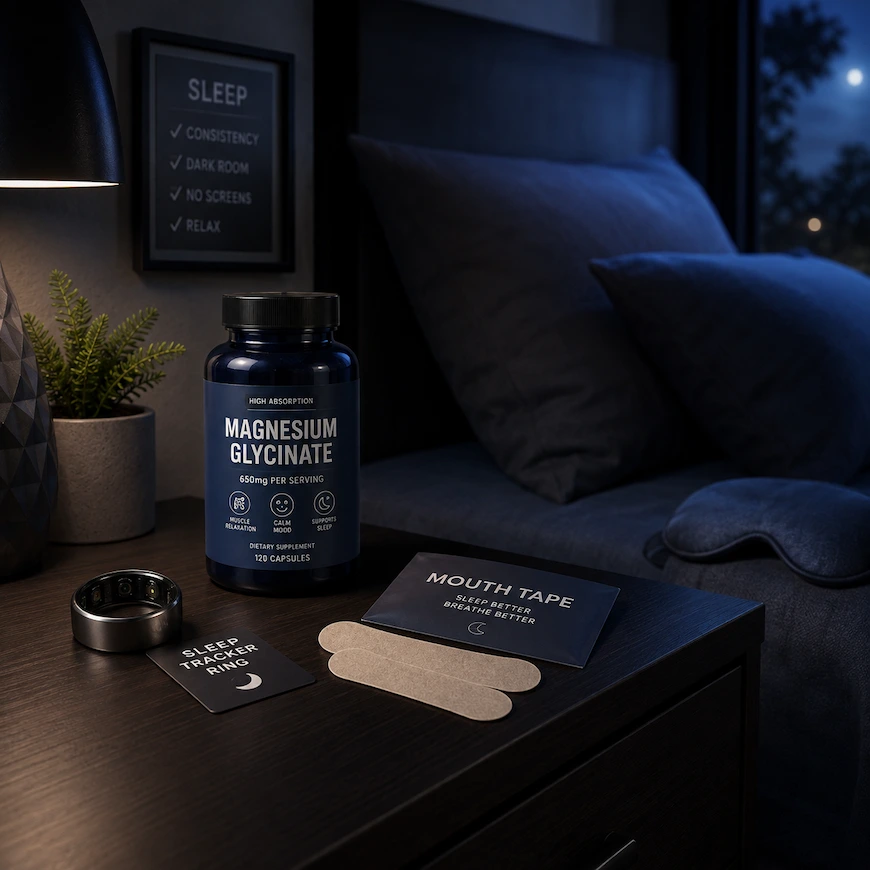
Magnesium glycinate: Magnesium activates GABA-A receptors, the central inhibitory neurotransmitter system, reducing the hyperexcitable neuronal state that characterizes both insomnia and anxiety. The glycinate form is better for sleep because glycine promotes sleep via hypothalamic thermoregulation (lowering core body temperature) and GABA-B receptor activity in the brainstem. The signs of magnesium deficiency article covers the full picture; 48% of Americans consume below the EAR for magnesium, which directly impairs sleep through GABA underactivation.
Quick Answer: Stimulus control is the most effective single behavioral component of CBT-I (Cognitive Behavioral Therapy for Insomnia), the first-line treatment for chronic insomnia. The principle: the bed should be exclusively associated with sleep and sex, not work, watching content, scrolling, or lying awake anxiously. Through classical conditioning, the brain learns to associate the bed with wakefulness and frustration when non-sleep activities happen there regularly. Breaking this association is a primary reason CBT-I outperforms sleep medication in long-term head-to-head trials, and it’s one of the most practical answers to how to get deep sleep when the problem is behavioral rather than physiological. If how to get deep sleep consistently has stumped you and nothing else has worked, this is usually where the answer lives.
The rules of stimulus control:
Use the bed only for sleep (and sex). No phone, no TV, no work, no reading in bed.
Go to bed only when genuinely sleepy, not just tired and not just at “bedtime.”
If you’re in bed and not asleep within about 20 minutes, get up. Do a quiet, non-stimulating activity in dim light elsewhere. Return when sleepy again.
Maintain consistent wake time regardless of how long sleep took.
Rule 3 is the one people resist. Getting out of bed feels counterproductive when you’re already struggling. But lying awake for 45-90 minutes does real damage: it trains the brain to associate the bed with alertness and frustration, creating conditioned arousal. Every night you stay in bed awake reinforces that association. Getting up and breaking the arousal cycle keeps the bed’s identity as a sleep cue intact.
Why sleep hygiene tips alone often don’t work: Cool room, dark room, consistent schedule, all necessary. But insufficient for chronic insomnia. The conditioned arousal component, the bed triggering wakefulness rather than sleepiness, is the behavioral mechanism that keeps insomnia going even after the original cause is gone. Stimulus control targets this directly. The how to stop overthinking guide is directly applicable to the rumination and cognitive hyperarousal that often accompany lying awake. The busy mind at bedtime is addressable through the same cognitive techniques used in CBT-I.
3am awakening is characteristic of the N3-to-REM transition in the second half of the night. The most common physiological cause: cortisol begins its pre-dawn rise around 3-4am, and in people with HPA axis dysregulation or blood sugar instability, the rise is exaggerated enough to break sleep continuity. Alcohol is the second most common cause; acetaldehyde accumulates around 3-4 hours after drinking and acts as a stimulant. In perimenopausal and menopausal women, estrogen fluctuations lower the temperature threshold for night sweats, which often land in this same window.
It can improve awareness and support behavior change, but orthosomnia (anxiety about sleep tracker data) is a documented phenomenon that can worsen sleep quality. If you check your data in the morning and feel fine, tracking is neutral or positive. If you wake during the night and immediately check your tracker, or feel anxious before bed about getting enough deep sleep, the tracking is counterproductive. Use it to identify patterns, not to optimize every number. If it's causing pre-bed anxiety, take a week off.
Partially. N3 rebound, increased slow-wave sleep after deprivation, happens automatically. The first recovery night after sleep restriction produces more N3 than normal. REM rebound also occurs. Cumulative cognitive impairment from a week of sleep restriction doesn't fully reverse with one recovery night; studies show 2-3 full nights are needed to return to baseline. The key limitation: weekend sleep-ins shift the circadian clock, delaying the phase and impairing Monday and Tuesday performance regardless of total hours recovered.
No, for most adults. The short sleeper gene (DEC2 mutation) allows roughly 1-3% of the population to genuinely function well on 6 hours. For everyone else, 6-hour sleep produces objective cognitive impairment that isn't subjectively perceived. People feel they've adapted, but performance testing shows deficits equivalent to 24 hours of total sleep deprivation after two weeks at 6 hours. The dangerous part: sleep-deprived people consistently rate their impairment as fine. The perceived adaptation is an artifact of impaired self-assessment, not actual recovery.
Three with real evidence: magnesium glycinate (200-400mg, 1 hour before bed), documented to improve sleep onset and subjective quality in the Abbasi 2012 RCT; low-dose melatonin (0.5-1mg, 5-6 hours before bedtime), a chronobiotic for phase-shifting, not a sedative; and L-theanine (200mg before bed), which promotes alpha brain wave activity and reduces sleep onset without sedation. Without solid support: valerian root (inconsistent across trials), oral GABA supplements (poor blood-brain barrier penetration), and high-dose melatonin (5-10mg), common in US products but no more effective than low-dose.
It depends on length and timing. A 20-minute nap (Stage 1/2 NREM only, no N3) before 3pm has minimal impact on nighttime adenosine accumulation and sleep. A 90-minute nap (one full cycle including N3) in early afternoon provides real restorative benefit but measurably reduces homeostatic sleep pressure, potentially delaying sleep onset and reducing N3 in the first portion of nighttime sleep. Napping after 3pm consistently delays sleep onset regardless of length. If you're napping to compensate for chronic nighttime deficiency, the root issue is nighttime sleep quality. The real answer to how to get deep sleep is fixing the nighttime architecture, not managing the shortfall with daytime naps.
This article provides general educational information about sleep habits and sleep quality. If you experience chronic insomnia (difficulty sleeping 3+ nights per week for more than 3 months), excessive daytime sleepiness, witnessed apnea events, or restless legs symptoms, consult a physician. Cognitive Behavioral Therapy for Insomnia (CBT-I) is the first-line treatment for chronic insomnia and outperforms sleep medication in long-term outcome studies. Ask your GP for a referral or look into digital CBT-I programs (Sleepio, SHUTi).
Mimo Karam is the founder and writer at LifestyleMine. She writes about daily habits, nutrition, sleep, and emotional wellness, turning research into practical advice for people who want to live healthier without making it complicated.