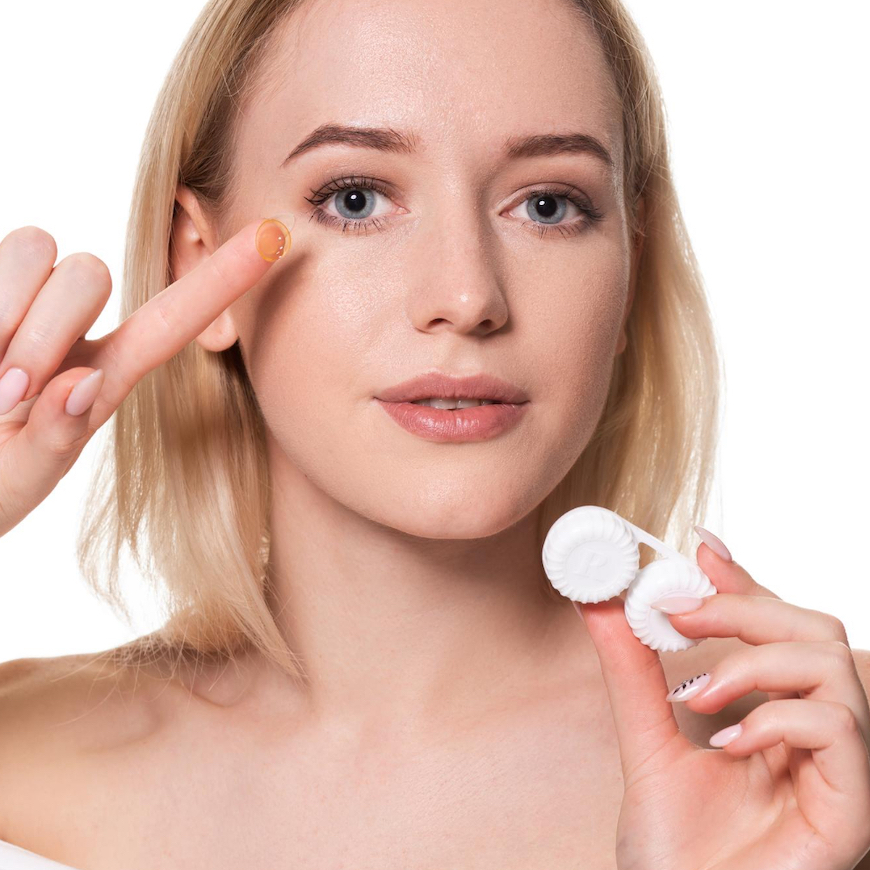
I wore monthly soft contacts from age 17 into my late 20s without much trouble. Comfortable in the morning, a little dry by evening. I assumed that was just how contacts felt. By hour eight my eyes felt gritty and tired, and I’d peel the lenses out with relief.
It took me years to realize the end-of-day discomfort wasn’t inevitable. It was a specific, fixable problem: the lens material had a design flaw for my tear chemistry. I switched, and the difference was big enough that I still think about the decade I spent needlessly uncomfortable.
Contact lenses and dry eyes are closely connected, but the mechanism is more specific than “contacts dry your eyes out.” Whether contact lenses cause dry eyes comes down to how exactly they disrupt the tear film, and understanding that is the key to managing the problem instead of just living with it.
What Is Contact Lens-Induced Dry Eye?
The clinical term is contact lens-induced dry eye, or CLIDE. It affects an estimated 50% of contact lens wearers to some degree, which makes it less a rare complication than the normal experience of regular lens wear.
CLIDE is distinct from pre-existing dry eye syndrome, though the two can coexist and feed each other. If you have no symptoms without lenses but develop them during or after wear, that’s CLIDE. If you have baseline dry eye that worsens with contacts, you have both conditions at once.
The distinction matters because the fixes differ. CLIDE-specific management focuses on lens design, wear duration, and lens care. Pre-existing dry eye also needs treatment of the underlying lacrimal and meibomian gland function.
How Contact Lenses Disrupt the Tear Film
There are five distinct mechanisms. Most discussions name one or two. All five are real, and they interact.
Mechanism 1: Tear Film Splitting
When a contact lens sits on the eye, it splits the tear film into two layers: a pre-lens film above the lens and a post-lens film between the lens and the cornea. Both are thinner than the normal combined film, and thinner films are less stable, so they break up faster between blinks. That premature breakup is one of the most direct ways contact lenses cause dry eyes, producing the gritty, drying sensation wearers know well.
Mechanism 2: The Lens Dehydration Cycle
This is the mechanism that explains why symptoms worsen as the day goes on, and why high-water-content lenses aren’t automatically the answer.
Hydrogel contact lenses are made with a specific water content, typically 38% to 75%. In theory, higher water content sounds like it should mean more hydrated eyes. In practice, high-water lenses actively pull moisture from your tear film as the day wears on. A lens that starts at 55% water content, sitting in dry, air-conditioned air, works to hold that water content, and the nearest available source is your tears.
By hour seven or eight, the lens has drawn down a good portion of the tear film, dehydrated slightly, and left the ocular surface measurably drier than at insertion. This dehydration cycle is a big part of why contact lenses cause dry eyes that flare in the evening, and why the pattern is so predictable with conventional hydrogel lenses.
Mechanism 3: Reduced Oxygen Transmission
The cornea has no blood vessels; it takes oxygen directly from the air through the tear film. Contact lenses cut that supply, and how much depends on the material. Conventional PMMA lenses (now rare) blocked nearly all oxygen, while modern silicone hydrogel lenses transmit far more.
Reduced corneal oxygenation triggers neovascularization over time (new blood vessel growth at the corneal periphery) and increases surface inflammation. That chronic hypoxic stress on the corneal epithelium is another route by which contact lenses cause dry eyes with extended wear, feeding the inflammatory cycle.
The metric that matters is Dk/t, oxygen transmissibility. Values above 24 Dk/t are considered minimally acceptable for daily wear, and values above 87 Dk/t count as high-oxygen-transmission for extended or overnight wear. Most silicone hydrogel lenses now clear 100 Dk/t, while most conventional hydrogel lenses fall in the 18 to 35 range.
Mechanism 4: Meibomian Gland Compression
Long-term contact lens wear mechanically compresses the meibomian glands, the oil glands along the eyelid margins that produce the lipid layer of the tear film. Studies using meibography (infrared gland imaging) have found significantly higher rates of meibomian gland dropout in long-term wearers than in non-wearers of the same age.
Meibomian gland loss is permanent. Gland tissue that atrophies doesn’t grow back. So when contact lenses cause dry eyes over many years, the damage isn’t fully reversible by stopping lens wear; it leaves structural changes behind. That’s one of the stronger reasons to address lens-related dryness early rather than tolerate it indefinitely.
Mechanism 5: Deposit Accumulation and Inflammatory Load
Contact lenses pick up protein, lipid, and microbial deposits over the day. Tear proteins that denature on the lens surface trigger immune recognition, and the immune system starts treating the lens as a mildly foreign surface. That low-grade response drives conjunctival hyperemia (redness), discomfort, and over time a chronic surface inflammation that compounds the other four mechanisms.
Daily disposable lenses remove this mechanism entirely, since each lens starts clean. Reusable lenses depend on cleaning efficacy, and neither multipurpose solution nor a hydrogen peroxide system strips 100% of protein deposits from every lens material.
The End-of-Day Pattern: Why It Gets Worse Over Hours
The way symptoms build through the wearing day reflects all five mechanisms stacking up. In the morning the lens is fully hydrated, the tear film is at its best after overnight recovery, and discomfort is minimal. By noon the film is thinner and the lens slightly dehydrated. By 6pm the dehydration is substantial, the film significantly depleted, the discomfort pronounced. By 9pm many wearers describe gravel in the eye and are counting the minutes to lens removal. This daily arc is the clearest illustration of how contact lenses cause dry eyes through cumulative, hour-by-hour effects.
It isn’t inevitable, though. It’s addressable. But the fix isn’t just “use more rewetting drops”; it’s matching lens material and design to your individual tear chemistry.
Related: Dry eye treatment options
Risk Factors That Make CLIDE Worse
Not every wearer ends up with significant symptoms, and several factors decide how strongly contact lenses cause dry eyes in a given person:
- Screen use during lens wear. Blink rate drops about 66% during focused screen work. Fewer blinks means less tear film renewal and faster lens dehydration, so working at a computer with contacts in is a major amplifier.
- Air-conditioned or low-humidity environments. Indoor heating and cooling pull humidity down to 20 to 35%, and the pre-lens tear film evaporates faster in dry air.
- Female sex, particularly over 40. Androgen hormones regulate meibomian gland function, and lower androgen levels track with both poorer lipid layer quality and higher CLIDE prevalence.
- Antihistamine use. As the dry eyes vs allergies discussion covers, antihistamines reduce tear production. Wearing contacts while on them makes lens-related dryness considerably worse.
- Caffeine and alcohol. Both have a mild diuretic effect, and dehydration of just 1 to 2% (easy to hit) measurably reduces tear production.
- Sleep deprivation. Tear film quality is at its worst after poor sleep, since the overnight stretch is when meibomian glands do much of their oil secretion.
Choosing Better Materials: What Actually Helps
The Silicone Hydrogel Upgrade
The single most useful change most wearers can make is switching from conventional hydrogel to silicone hydrogel. Silicone hydrogel:
- Transmits a lot more oxygen (Dk/t typically 100 to 170, versus 18 to 35 for hydrogel)
- Holds its water content more steadily through the day (less lens dehydration)
- Lowers corneal hypoxia, which in turn lowers chronic surface inflammation
The tradeoff is that silicone hydrogel is less wettable (more hydrophobic) than plain hydrogel. Earlier versions had more surface friction, which some wearers disliked. Newer-generation silicone hydrogels (Acuvue Oasys, Dailies Total 1, Air Optix Aqua Plus) use surface coatings or moisture-gradient designs that mostly resolve that.
The Water Content Counterintuition
For lens-induced dryness, lower water content lenses often perform better. The logic: a 38% water content lens doesn’t need to pull as much from your tear film to hold its hydration as a 67% lens does, so the tear-film depletion behind CLIDE is gentler.
That’s why some optometrists steer dry eye patients toward lenses like the Proclear Compatibles (38% water, phosphorylcholine coating) or standard Air Optix (33% at the lens core) rather than high-water alternatives.
Daily Disposables for CLIDE
Daily disposables wipe out the deposit-accumulation mechanism entirely. Each lens is fresh, there’s no cleaning protocol to keep up, no case to contaminate, no biofilm from case storage. When deposit-related inflammation or shaky lens-care habits are the main driver, switching to dailies is often the single most effective change.
The cost per day runs higher than monthlies. But the comfort gain is real, and for wearers fighting CLIDE symptoms, the trade is usually worth it.
Scleral Lenses: The Severe CLIDE Option
For wearers with significant pre-existing dry eye syndrome who still need correction, scleral lenses take a fundamentally different approach. Sclerals are large-diameter rigid lenses that vault over the whole cornea and rest on the sclera (the white of the eye) rather than the cornea itself. The gap between lens and cornea is filled with saline, which keeps a continuous liquid reservoir over the ocular surface all day.
Sclerals need fitting by a specialist and cost considerably more than soft lenses. But for severe dry eye with real correction needs, they often deliver comfort no soft lens can touch, because the cornea stays lubricated regardless of ambient humidity or blink rate.
Management Strategies: Seven Evidence-Graded Steps
Step 1: Reduce Wearing Hours (High evidence)
Every hour past 8 to 10 of daily wear adds tear-film depletion and deposit burden. Most management protocols put cutting total daily wear first. Even dropping from 14 hours to 10 makes a measurable difference.
Step 2: Take Scheduled Lens-Free Days (Moderate evidence)
One or two full lens-free days a week lets the corneal surface recover: the tear film restores, meibomian gland function normalizes without lens pressure, and oxygen transmission returns to baseline. Long-term continuous wear raises the risk of meibomian gland atrophy.
Step 3: Switch to Silicone Hydrogel or Daily Disposables (High evidence)
See above. This is the most impactful material change for most CLIDE patients.
Step 4: Use Preservative-Free Rewetting Drops During Wear (Moderate evidence)
Standard preserved rewetting drops contain benzalkonium chloride, which is incompatible with many lens materials and gets absorbed by the lens. Use only drops labeled “for use with contact lenses” or “preservative-free.” Products like Systane Contacts, Blink Contacts, or Optase are made for this. Use them before symptoms start, not only once your eyes already hurt.
Step 5: Warm Compresses in the Morning Before Wear (Moderate evidence)
Ten minutes of warm compress before inserting lenses softens meibomian gland secretions and improves lipid layer quality before lens wear depletes it. It’s especially useful for wearers whose worst symptoms come at the end of the day, which usually points to evaporative rather than aqueous-deficient dry eye.
Step 6: Reduce Screen Blink Deficit During Lens Wear (Moderate evidence)
The 20-20-20 rule, conscious blinking, screen position (looking slightly down rather than up reduces lid opening and tear evaporation), and regular breaks all help. These are particularly effective for wearers who spend the day at a computer.
Step 7: Review Systemic Medications with Your Doctor (Low evidence, high individual impact)
If you take antihistamines, antidepressants, diuretics, beta-blockers, or isotretinoin and you wear contacts, ask your prescribing doctor whether they’re relevant to your dryness. Some medications can’t be changed. But knowing the mechanism lets you compensate with more aggressive lubrication.
When Contacts Aren’t the Right Choice Anymore
For some wearers, the symptoms reach a point where contacts genuinely aren’t the right long-term choice. Signs it may be time for an honest conversation with your eye care provider:
- Comfortable wear time has fallen below 4 to 5 hours despite switching lenses and following every management step
- You’re using rewetting drops every 30 to 60 minutes to stay functional
- Meibography shows significant meibomian gland loss
- You have progressive surface staining on the cornea with fluorescein
- You’re losing vision stability from chronic surface disruption
Laser vision correction (LASIK, PRK, SMILE) is an option for some, though LASIK itself carries a short-term dry eye risk from corneal nerve disruption (the same mechanism as cataract surgery). Talk it through with a corneal specialist before deciding. PRK may be the better choice for patients with pre-existing dry eye, since it preserves more corneal integrity.
Frequently Asked Questions
Do contact lenses cause permanent dry eyes?
No, contact lenses typically don’t cause permanent dry eyes, but they can exacerbate dryness symptoms while worn. Proper lens choice, hygiene, and regular breaks usually help manage symptoms, though severe or persistent dryness should be evaluated by an eye doctor.
Are daily contacts better for dry eyes?
Yes, daily contacts are often better for dry eyes because they are fresh each day, reducing the risk of deposits that can cause dryness and irritation. Their design also promotes moisture retention, making them more comfortable for people with dry eyes.
The Bottom Line
Contact lenses and dry eyes are linked through five distinct mechanisms: tear film splitting, lens dehydration, reduced oxygen, meibomian gland compression, and deposit-driven inflammation. Those are the five ways contact lenses cause dry eyes, and end-of-day discomfort is the most common presentation. It isn’t inevitable. Silicone hydrogel materials, daily disposables, fewer wear hours, and proper lens-compatible rewetting drops each address one of the mechanisms.
What matters most: don’t tolerate it indefinitely. Chronic CLIDE drives meibomian gland atrophy that is structural and permanent. Address it early, not after years of cumulative damage.
The information provided here is not a substitute for professional medical advice. Always consult with a licensed healthcare provider before beginning any new treatment or making wellness changes.

Mimo Karam is the founder and writer at LifestyleMine. She writes about daily habits, nutrition, sleep, and emotional wellness, turning research into practical advice for people who want to live healthier without making it complicated.