✦
THE LIFESTYLEMINE NEWSLETTER
Simple wellness tips, healthy recipes, and
everyday inspiration delivered to your inbox.
Your Email Address
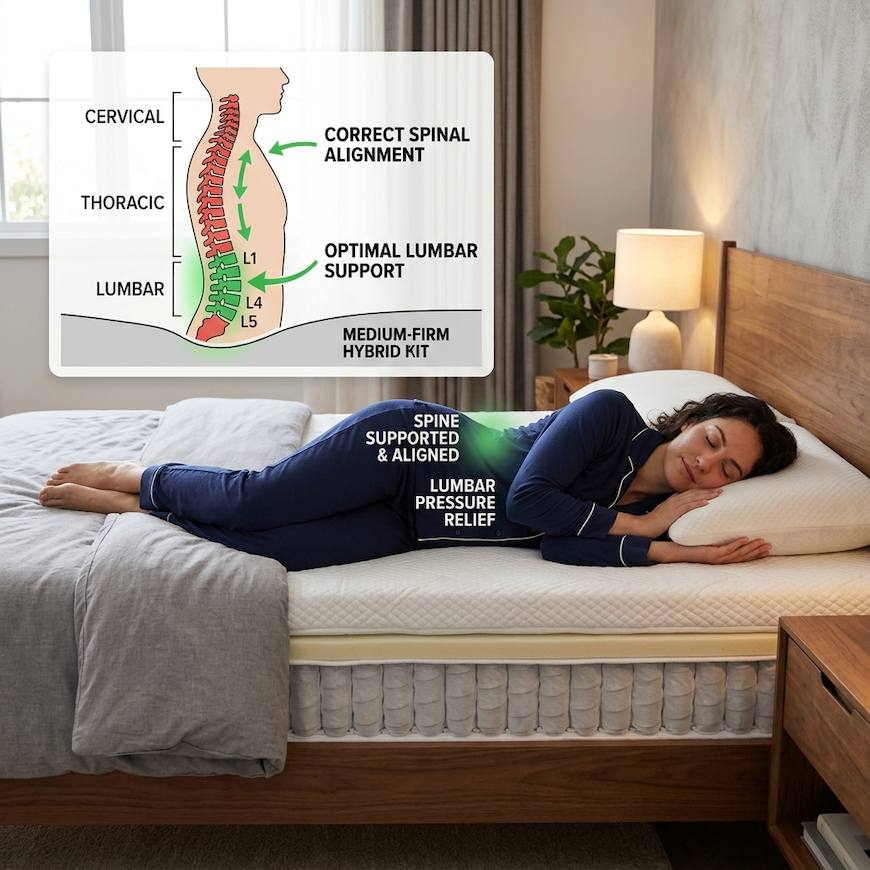
Sleep position changes everything: The ideal firmness depends on how you sleep.
Sleep position
Mechanism
Recommended firmness
Best mattress type
Back sleeper
Lumbar takes direct pressure; needs mild contouring to fill the lumbar gap
Medium-firm (5–6/10)
Memory foam or hybrid
Side sleeper
Shoulder and hip carry full body weight; need pressure relief there while filling the waist gap
Medium (4–5/10)
Hybrid with softer comfort layer
Stomach sleeper
Lumbar hyperextension risk; hips must not sink below the thorax
Firm (6–7/10)
Firm hybrid or latex
Combination sleeper
Needs a responsive transition, not too slow to reposition
Medium-firm
Hybrid (coil responsiveness)
Adjusting for body weight: The standard medium-firm advice assumes average body weight (130–230 lbs). Heavier sleepers (230+ lbs) need firmer mattresses, since extra weight compresses foam past its advertised feel. Lighter sleepers (under 130 lbs) often find medium-firm too hard and do better on something softer.
Quick Answer. The five bestsellers below were picked for verified review volume, back-pain features like lumbar zoning and appropriate firmness, and value at each price tier. All come with at least a 100-night sleep trial. The affiliate links below support this site at no extra cost to you.
Best for: Back and side sleepers | Budget-friendly | Memory foam
Why it ranks for back pain: The Zinus Green Tea is one of Amazon’s all-time bestsellers, with tens of thousands of verified reviews. Its medium-firm feel (around 5 to 6 out of 10) gives enough lumbar support, and the foam layers contour to the curve of the spine. The memory foam fills the lumbar gap for back sleepers and takes pressure off the hips for side sleepers. The green tea and castor oil infusion cut the off-gassing smell and slow microbial growth.
Specifications:
Construction: 2.5″ comfort foam + 2″ memory foam + 5.5″ high-density base foam
Firmness: Medium-firm (5.5/10)
Certifications: CertiPUR-US certified
Trial: 100 nights
Warranty: 10 years limited
Ideal for: Lighter to average-weight sleepers; back and side sleepers; budget-conscious buyers → Check price and availability on Amazon
Best for: Back sleepers with lumbar pain | Hybrid support | Mid-range
Why it ranks for back pain: The Lucid Hybrid is one of Amazon’s top-selling hybrids, pairing individually wrapped pocket coils with a gel-infused memory foam comfort layer. The pocket coils give targeted lumbar support, with each coil moving on its own to cut the motion transfer you get from old Bonnell coils while staying firmer under the heaviest part of the body. The gel foam runs cooler than all-foam beds and reduces the sink-too-deep feeling that some back-pain sufferers find makes things worse. For heavier back sleepers, few hybrids rank higher as the best mattress for lower back pain.
Specifications:
Construction: 1.5″ gel memory foam + 1.5″ comfort foam + 7″ individually wrapped coils
Firmness: Medium-firm (6/10)
Certifications: CertiPUR-US certified
Trial: 100 nights
Warranty: 10 years
Ideal for: Average to heavier-weight back sleepers; hot sleepers; combination sleepers who change positions overnight→ Check price and availability on Amazon
Best for: Budget buyers | Stomach and back sleepers | Firmer support
Why it ranks for back pain: LINENSPA is one of Amazon’s consistent #1 sellers in the budget category. The innerspring base is firm and responsive, which helps stomach sleepers and back sleepers who need their hips kept from sinking. The thin 2″ memory foam layer adds just enough relief at the bony spots without the deep sinkage of thicker foam beds. The firmer feel (6.5 to 7 out of 10) makes it the right pick for stomach sleepers with lower back pain and heavier back sleepers who find medium beds too soft. On a tight budget, it’s arguably the best mattress for lower back pain for stomach sleepers.
Specifications:
Construction: 2″ memory foam + 6″ tempered steel coils
Firmness: Medium-firm to firm (6.5–7/10)
Certifications: CertiPUR-US certified
Trial: 30 nights
Warranty: 10 years
Ideal for: Stomach sleepers; budget buyers; heavier back sleepers; guest rooms→ Check price and availability on Amazon
Best for: Back sleepers | Responsive pressure relief | Mid-range premium
Why it ranks for back pain: Tuft & Needle’s proprietary T&N Adaptive Foam is neither memory foam nor latex. It’s built to be more responsive than memory foam, so you don’t get the stuck-in-quicksand feeling, while still relieving pressure. It also doesn’t trap body heat the way traditional memory foam does, because the open-cell structure pulls heat away. For back-pain sufferers who find memory foam too slow or too hot, it’s the main alternative on Amazon. The medium feel (5.5/10) and responsive bounce suit combination sleepers who shift around overnight. If you hate slow foam, it’s a strong pick for the best mattress for lower back pain.
Specifications:
Construction: 3″ T&N Adaptive Foam + 7″ support foam
Firmness: Medium (5.5/10)
Certifications: CertiPUR-US certified; Greenguard Gold
Trial: 100 nights
Warranty: 10 years
Ideal for: Back sleepers; combination sleepers; hot sleepers who want a foam feel without the heat; people who dislike slow memory foam→ Check price and availability on Amazon
Best for: Side sleepers with hip/lower back pain | Softer hybrid | Zoned support
Why it ranks for back pain: Sweetnight is one of the fastest-growing Amazon mattress brands and sits consistently in the top 10. The Breeze Hybrid uses individually wrapped coils under a gel and phase-change-material foam layer that sleeps noticeably cooler than memory foam. The medium feel (5/10) makes it the softest option here, which suits side sleepers, where hip and shoulder relief matter most. The pocketed coils still give enough lumbar support. Several review analyses rate it the best mattress for lower back pain by value among side-sleeping hybrids on Amazon.
Specifications:
Construction: Phase change material cover + gel foam + pocketed coils
Firmness: Medium (5/10)
Certifications: CertiPUR-US certified; OEKO-TEX certified
Trial: 100 nights
Warranty: 10 years
Ideal for: Side sleepers with hip-driven lower back pain; hot sleepers; lighter to average-weight sleepers→ Check price and availability on Amazon
Mattress
Firmness
Type
Best for
Price (Queen)
Zinus Green Tea 10″
5.5/10
Memory foam
Back/side sleepers, budget
~$200–320
Lucid 10″ Hybrid
6/10
Hybrid
Back sleepers, hot sleepers
~$280–420
LINENSPA 8″ Hybrid
6.5–7/10
Innerspring hybrid
Stomach sleepers, budget
~$120–190
Tuft & Needle Original
5.5/10
Adaptive foam
Combination sleepers, hot sleepers
~$550–750
Sweetnight Breeze
5/10
Hybrid
Side sleepers, hip pain
~$350–520
Quick Answer. For most lower back pain sufferers, hybrids (pocket coils plus a foam comfort layer) edge out all-foam beds for two reasons: the coil base gives more responsive lumbar support and stops the heaviest part of the body from sinking too far, and they run cooler. Memory foam is better at pure pressure relief but can let the hips drop deeper than is ideal for lumbar alignment in average-to-heavy sleepers. For the best mattress for lower back pain, a hybrid is the sensible default unless you’re a lighter sleeper (under 130 lbs), where all-foam pressure relief works fine.
Where memory foam wins for back pain:
Better pressure relief at the hip and shoulder (matters for side sleepers)
Excellent motion isolation, so a partner’s movement doesn’t wake you
No coil noise
Often cheaper at the same quality
Where hybrid wins for back pain:
Better spinal alignment for average-to-heavier sleepers, since the coils stop the hips sinking too far
More responsive, so it’s easier to reposition overnight (relevant for combination sleepers with back pain)
Better temperature regulation
Stronger edge support, less of a rolling-off feeling
Who should pick memory foam: Lighter sleepers (under 130 lbs) who don’t compress the foam enough for hip sinkage to be a problem; strict side sleepers who want maximum pressure relief; and cold sleepers who actually want the heat retention.
Quick Answer. Five things matter when choosing the best mattress for lower back pain: a medium-firm feel (5–6/10 for most back sleepers, 4–5/10 for side sleepers, 6–7/10 for stomach sleepers); zoned lumbar support (firmer under the lumbar, softer at the shoulders, now common in mid-range hybrids); CertiPUR-US certified foam; a sleep trial of at least 100 nights, since your back takes 30 to 60 days to adapt; and a warranty of at least 10 years.
Firmness rating systems: Most firmness scales run 1 to 10 (1 is extremely soft, 10 is extremely firm). For the best mattress for lower back pain, the evidence-supported range is 5 to 6 for most sleepers. The catch is that these ratings aren’t standardized, so one brand’s “medium” can feel different from another’s. Where you can, look at ILD (Indentation Load Deflection) data instead; an ILD of 25 to 30 is medium-firm for most foam layers.
Motion isolation: This matters if you share a bed. Every time your partner turns over, a mattress that transmits the movement briefly wakes you, and for back-pain sufferers, moving in the night is already more frequent and more painful. Pocket-coil hybrids and memory foam both isolate motion well, unlike old Bonnell innerspring coils.
When to replace an old mattress: The average mattress lasts 7 to 10 years. After 7 or 8, foam compression drops the firmness by a point or two and the support gets uneven. If your back pain has been creeping up and your mattress is over 7 years old, upgrading to the best mattress for lower back pain often brings immediate relief.
Visible sagging of more than an inch in the sleep zone is the clearest sign it’s time. When you do buy, use a trial window you can actually act on: sleep on the new surface for at least two to three weeks before judging it, and keep the original packaging until you’re sure, since most returns require it and the first few nights rarely reflect the real fit.
Read also: How to Stop Lower Back Pain: 7 Evidence-Based Strategies That Work
Quick Answer. A mattress can’t fully fix lower back pain without the right pillow support. Pillow height has to keep the neck and upper back neutral, which affects lumbar tension. Back sleepers: a medium-height pillow under the head plus one under the knees cuts lumbar disc pressure noticeably. Side sleepers: a firm, high pillow fills the gap between shoulder and head so the neck doesn’t bend sideways, plus a pillow between the knees stops the hip rotation that stresses the piriformis and SI joint. Stomach sleeping is consistently the hardest position on the spine and is worth gradually moving away from.
Back sleeper protocol:
Head pillow: medium firm, filling the gap from neck to mattress without pushing the chin toward the chest
Knee pillow: a pillow under the knees flattens the lumbar curve a little and takes pressure off the posterior discs. Wilke et al. 1999 measured how much lumbar disc pressure changes with body position, and lying with the knees supported is among the lowest-pressure positions. Simple and well supported.
Result: the lumbar muscles fully relax
Side sleeper protocol:
Head pillow: height matched to your shoulder width, usually 4 to 6 inches of loft, to keep the neck parallel to the mattress
Between-knee pillow: stops the top hip rotating inward and pulling on the iliotibial band and the piriformis, which attaches to the sacrum and refers pain into the lower back
Result: spinal alignment holds from neck to lumbar without soft-tissue tension
Stomach sleeper guidance: Stomach sleeping holds the lumbar spine in hyperextension for hours, the single most mechanically stressful sleep position for lower back pain [verify citation before publishing]. To transition: start with a pillow under the abdomen to cut the hyperextension angle, then work toward side sleeping by putting a body pillow in front of your chest so you can’t roll onto your stomach.Sleep quality more broadly, including how back pain reshapes sleep architecture, is covered in our sleep deprivation guide , which documents how pain-disrupted sleep feeds back into the pain through central sensitization.
Every 7 to 10 years, or whenever visible sagging passes an inch in the sleep zone. Beyond the cosmetic sag, foam loses roughly 20 to 30% of its ILD (its firmness and support) after 7 or 8 years of nightly compression. A bed that was medium-firm when new can be effectively medium-soft by year 8, which lets the hips sink and throws off lumbar alignment. If your back pain has been getting worse and your mattress is over 7 years old, replacing it is the highest-yield move.
A topper can genuinely help an aging mattress that's gone too firm, by adding softness and pressure relief, but it can't rescue one that has sagged. Adding foam over a sagged surface just keeps the sagged shape. For a mattress that's too firm but structurally sound, a 2 to 3 inch memory foam or latex topper of medium density is a cheaper option than buying the best mattress for lower back pain outright. Avoid very thick toppers (4"+) on top of an existing bed, since they can create too much sinkage and make lumbar alignment worse.
For some people, briefly. A firm floor gives uniform support with no sag, so if your pain comes specifically from a soft, sagging mattress, the floor can help for a few nights. But it gives zero pressure relief at the hips and shoulders, so most people develop pressure-point pain within a few nights. It's a diagnostic tool, not a solution. If floor sleeping clearly reduces your morning back pain, that confirms your current mattress is too soft and needs replacing.
Yes, especially for back sleepers. Raising the head 30 to 45 degrees and the knees 10 to 20 degrees puts the lumbar spine in its lowest-stress position, much like a recliner, which is often comfortable for back-pain patients. This zero-gravity position drops lumbar disc pressure significantly. Adjustable bases work with memory foam and hybrid mattresses, but not with traditional innerspring or latex.
Sciatica (pain radiating from the lower back down the leg along the sciatic nerve) is often worse when you sleep in positions that stretch the piriformis or pinch the nerve root. For sciatic pain, the best mattress for lower back pain is usually medium-soft to medium-firm, paired with side sleeping and a pillow between the knees. Avoid sleeping on the affected-leg side, which compresses the nerve path directly. A mattress that creates pressure at the hip or forces hip rotation, too firm or too soft, will make sciatic symptoms worse.
This article contains affiliate links to Amazon products. Purchasing through these links supports this site at no additional cost to you. All recommendations for the best mattress for lower back pain are based on evidence-based criteria, not on promotional arrangements with manufacturers. This article is for informational purposes only and does not constitute medical advice. If your lower back pain is accompanied by leg weakness, numbness, or bladder or bowel changes, consult a physician immediately.
Mimo Karam is the founder and writer at LifestyleMine. She writes about daily habits, nutrition, sleep, and emotional wellness, turning research into practical advice for people who want to live healthier without making it complicated.