What Are the Side Effects of Ozempic?
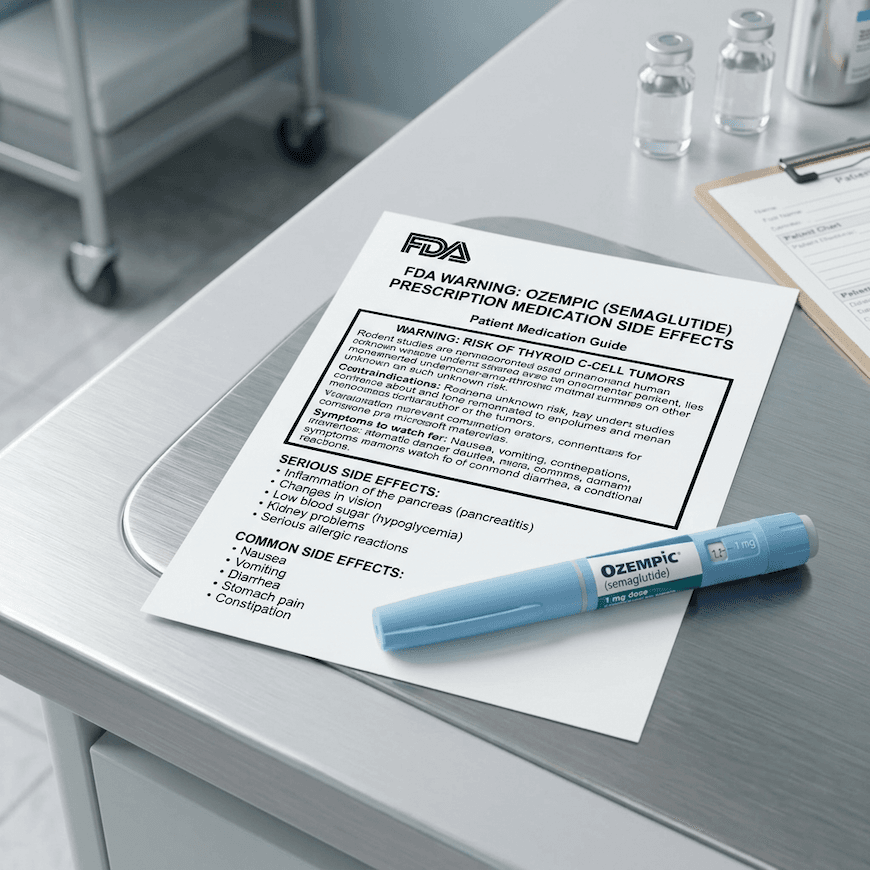
Quick Answer: Ozempic (semaglutide) causes GI side effects in most users: nausea (44%), diarrhea (30%), vomiting (24%), and constipation (24%) based on the SUSTAIN clinical trials. These are typically worst during dose escalation and improve for most patients after 4–8 weeks. Serious but rare side effects include pancreatitis, kidney injury, and gallstones. Ozempic carries an FDA black box warning for thyroid C-cell tumors (medullary thyroid carcinoma) and is contraindicated in patients with a personal or family history of MTC or multiple endocrine neoplasia type 2 (MEN 2).
Ozempic launched in the United States in late 2017 as a weekly injectable for type 2 diabetes. By 2022 it had become one of the most talked-about prescription drugs in the country, and not mainly for its diabetes use. People taking it were losing serious weight and describing something they called their “food noise” going quiet.
The Ozempic side effects are real, though, and some are serious enough that anyone considering semaglutide needs the full clinical picture first. That means more than the common stomach complaints. It means the FDA black box warning, the 2023 gastroparesis alert, the muscle loss problem, and what happens to your body when you stop.
One thing upfront: this is a prescription-only medication, and everything here is informational. It doesn’t replace a conversation with the physician who knows your full history. But walking into that conversation already knowing what to ask, about pancreatitis risk, thyroid history, and anesthesia timing, tends to get you better care. Knowing the Ozempic side effects in advance is part of that preparation.
Common semaglutide side effects: what most users experience
Quick Answer: Most Ozempic side effects are gastrointestinal, depend on the dose, and hit hardest in the first 4 to 12 weeks. The most reported are nausea (44%), diarrhea (30%), vomiting (24%), and constipation (24%). Most people adapt as their body adjusts, though roughly 5 to 10% stop treatment because the GI effects are intolerable. The main way to limit them is to start at the lowest dose and step up slowly. Slow titration is the single best lever you have over Ozempic side effects.
Ozempic side effects frequency table (SUSTAIN clinical trial data):
| Side effect | Ozempic users | Placebo | Clinical notes |
|---|---|---|---|
| Nausea | 44% | 16% | Peaks weeks 4–8; improves substantially by week 12 |
| Diarrhea | 30% | 16% | Often loose stool, not severe diarrhea |
| Vomiting | 24% | 6% | Most common in first 4 weeks; rarely severe |
| Constipation | 24% | 11% | From slowed gastric transit; responds to hydration and fiber |
| Abdominal pain | 20% | 10% | Usually mild; persistent severe pain can signal pancreatitis |
| Decreased appetite | 38% | 11% | Partly the therapeutic mechanism, not purely a side effect |
| Fatigue | 15% | 9% | Often related to the caloric deficit from reduced appetite |
Why GI side effects happen: Semaglutide activates GLP-1 receptors in the gut and brain. That slows gastric emptying, so food moves more slowly from the stomach to the intestine, and it signals fullness. The nausea comes from that slowdown plus direct receptor activation in the brainstem. Because the effect tracks with dose, the FDA-approved schedule starts at 0.25mg weekly, a ramp-up dose below the therapeutic level for type 2 diabetes, for four weeks before any increase. Most early Ozempic side effects trace back to this gut-and-brain signaling.
Dose titration schedule (FDA-approved):
- Weeks 1–4: 0.25mg weekly (ramp-up only, not therapeutic)
- Weeks 5–8: 0.5mg weekly (first therapeutic dose)
- As needed: 1mg weekly after at least 4 weeks at 0.5mg
- As needed: 2mg weekly after at least 4 weeks at 1mg (the maximum approved Ozempic dose)
- Wegovy: a separate 5-step titration up to 2.4mg weekly over 16 or more weeks
These steps exist mainly to keep Ozempic side effects manageable as the dose climbs.
Practical management of GI side effects:
- Eat small, frequent meals rather than one or two big ones.
- Skip high-fat, fried, or greasy foods. They already slow gastric emptying, and semaglutide compounds that.
- Eat slowly and stop at the first sign of fullness.
- Avoid alcohol (see the drug interaction section).
- Stay hydrated. The GI effects cause fluid loss, and dehydration makes everything worse while raising kidney risk.
- Real ginger tea, not just ginger-flavored, has solid evidence for nausea through 5-HT3 receptor antagonism in the gut.
Serious Ozempic side effects: when to stop and call a doctor
Quick Answer: The serious Ozempic side effects that need immediate attention are pancreatitis (severe abdominal pain radiating to the back; stop the drug and call your physician or go to the ER), acute kidney injury (from severe dehydration after GI side effects), gallstones (formation speeds up during rapid weight loss), and vision changes (worsening diabetic retinopathy in people who already have it). Any thyroid lump or neck change needs prompt evaluation under the black box warning. These serious Ozempic side effects are uncommon, but catching them early matters.
Pancreatitis, the most important serious side effect: Acute pancreatitis has happened in people taking GLP-1 receptor agonists, semaglutide included. It usually shows up as severe, persistent abdominal pain that often radiates to the back, along with nausea, vomiting, and fever. If that happens,
stop Ozempic and contact your physician or go to the ER right away. Pancreatitis can become a life-threatening emergency. In the SUSTAIN trials the rate ran about 0.3 to 0.4% on semaglutide versus 0.1 to 0.2% on placebo, so it’s rare but meaningfully higher. Pancreatitis is the most urgent of the Ozempic side effects to rule out.Ozempic should not be restarted after confirmed pancreatitis. It’s the rare Ozempic side effects case with a hard stop.
Gallstones: Rapid weight loss from any cause speeds up gallstone formation. As calorie intake drops, the gallbladder gets less stimulation, bile sits, and cholesterol crystals clump together. GLP-1 drugs may also directly reduce gallbladder motility. In the SUSTAIN and STEP trials, gallstone formation showed up more often on semaglutide than placebo. Watch for right upper quadrant pain, especially after fatty meals, plus nausea and vomiting. Our guide to gallstones covers diagnosis, treatment, and what counts as a gallbladder emergency.
Kidney injury (AKI): Ozempic isn’t directly toxic to the kidneys. But severe vomiting and diarrhea can dehydrate you enough to cut kidney perfusion and trigger acute kidney injury. The FDA has logged AKI reports, some needing dialysis, in GLP-1 patients whose dehydration wasn’t managed well. Warning signs include a sharp drop in urination, swelling in the legs or feet, unusual fatigue, and confusion.
If GI side effects leave you severely dehydrated, get medical care. Don’t try to push through it. Dehydration is how mild Ozempic side effects turn into a hospital visit.
Diabetic retinopathy: The SUSTAIN 6 cardiovascular outcomes trial (Marso 2016, NEJM) found more diabetic retinopathy complications among semaglutide patients who already had retinopathy. The likely reason is that lowering blood glucose quickly can worsen retinopathy in the short term through ischemia-reperfusion effects. If you have diabetic retinopathy, tell your ophthalmologist before you start semaglutide.
Emergency symptoms that need 911 or an immediate ER visit:
- Severe abdominal pain with vomiting that doesn’t improve (pancreatitis)
- Signs of severe dehydration: extreme dizziness, very little urine, fainting
- A neck lump with hoarseness and trouble swallowing (the thyroid warning from the black box)
- An allergic reaction: severe rash, swelling of the face, tongue, or throat, trouble breathing (anaphylaxis, rare but documented)
Ozempic and gastroparesis: the 2023 FDA safety alert
Quick Answer: In October 2023 the FDA updated Ozempic and Wegovy labeling to list gastroparesis, a condition where the stomach can’t empty normally, as a possible side effect after reports of serious cases. This isn’t the same as the normal gastric slowing Ozempic causes. Gastroparesis is a prolonged, possibly permanent loss of gastric motility. It’s rare, but the risk is why Ozempic has to be stopped before any procedure under general anesthesia, because of aspiration risk.
Gastroparesis means the stomach muscles stop working properly, so food doesn’t move into the small intestine on schedule. Symptoms include nausea, vomiting of undigested food (sometimes hours after eating), filling up very fast, bloating, and upper abdominal pain. In severe cases people become malnourished and need tube feeding. It sits at the severe end of the Ozempic side effects spectrum.Ozempic already slows gastric emptying by design. For most people that slowing is moderate and helpful, so they feel full sooner and for longer.
Gastroparesis is the pathological extreme, where the stomach basically stops working efficiently. Some FDA reports involved people with no prior stomach problems who developed lasting gastroparesis symptoms on GLP-1 drugs that didn’t fully resolve after they stopped.
What to watch for: If nausea and vomiting haven’t eased after the first 4 to 8 weeks at a stable dose, or you’re throwing up food hours after eating, ask your physician about a gastroparesis evaluation. The standard test is a gastric emptying study (nuclear medicine scintigraphy). Lingering symptoms are the clearest warning among the Ozempic side effects.
Anesthesia and surgery, a critical safety point: Because Ozempic slows gastric emptying so much, there’s a real risk of aspiration during general anesthesia, where undigested stomach contents enter the lungs at intubation. The American Society of Anesthesiologists issued 2023 guidance recommending that you:
- Hold weekly GLP-1 injections for at least one week before elective surgery under general anesthesia.
- Hold daily dosing for at least one day.
- Treat the patient as if the stomach is full whenever pre-procedure fasting can’t be confirmed by imaging.
Tell every surgeon, anesthesiologist, and procedure team that you take Ozempic. This is a non-negotiable safety disclosure. Anesthesia risk is one of the Ozempic side effects most people never hear about.
Ozempic face: why it happens and what to do about it
Quick Answer: “Ozempic face” isn’t a direct toxicity. It’s facial volume loss from rapid, significant weight loss. The face sheds subcutaneous fat (the buccal, temporal, and periorbital fat pads) faster than skin can tighten to keep up, which leaves a gaunt, hollow, or prematurely aged look. It happens with any rapid weight loss. How severe it gets depends on how much weight you lose, how fast, and your age, since older skin has less elasticity to draw on. Losing weight more gradually reduces the effect but doesn’t erase it. It’s one of the most visible Ozempic side effects.
When semaglutide drives a 10 to 25% drop in body weight, that fat comes off everywhere, including the face. The face starts with relatively little fat compared with the abdomen or thighs, so a proportional loss shows more. The buccal fat pad in the cheeks and the temporal fat pad at the temples usually take the most visible hit. Unlike the GI complaints, this is one of the Ozempic side effects that’s purely about lost volume.It’s why plastic surgeons report a jump in requests for facial fillers, fat grafting, and deep plane facelift consultations among GLP-1 patients. The changes are structural, and they need structural fixes.
Minimizing “Ozempic face”:
- Slower weight loss: A gentler titration, staying at 0.5mg longer before stepping up, trades some speed for better skin adaptation. Talk it over with your physician.
- Resistance training: Keeping muscle mass won’t directly stop facial fat loss, but it slows the overall rate of body composition change.
- Protein and collagen: Enough dietary protein (see the next section) supports the skin’s matrix. Collagen peptides have modest evidence for skin elasticity, not a guaranteed fix but a reasonable add-on.
- No rushed fixes: Wait 6 to 12 months after your weight stabilizes before any permanent facial procedure, since some facial fat may redistribute as the body adapts. None of these erase facial changes, but they soften this subset of Ozempic side effects.
Wegovy vs Ozempic: same drug, important differences
Quick Answer: Ozempic and Wegovy are both semaglutide from Novo Nordisk, but the FDA approved them for different uses at different doses. Ozempic is for type 2 diabetes, up to 2mg weekly. Wegovy is for obesity, or overweight with a related condition, up to 2.4mg weekly. The higher Wegovy dose produces more weight loss, averaging 15 to 17% of body weight in STEP 1 versus the roughly 6 to 8% typically seen at Ozempic doses. The side effect profile is similar, though GI effects run a bit stronger at Wegovy’s higher dose. The Ozempic side effects and Wegovy’s overlap almost entirely, since it’s the same molecule.
The “Ozempic for weight loss” reality: Doctors prescribe Ozempic off-label for weight loss in people without diabetes all the time. That demand is a big reason for the severe national shortage that has hit diabetic patients who rely on it. Ozempic isn’t FDA-approved for obesity; Wegovy is. Even so, physicians can and do legally prescribe Ozempic off-label for weight management. The Ozempic side effects are identical whether it’s prescribed on-label or off.The practical differences:
| Feature | Ozempic | Wegovy |
|---|---|---|
| Active drug | Semaglutide | Semaglutide |
| FDA indication | Type 2 diabetes | Obesity (BMI ≥30) or overweight with comorbidity |
| Maximum approved dose | 2mg/week | 2.4mg/week |
| Average weight loss (trials) | 6–10% body weight | 15–17% body weight (STEP 1) |
| Cardiovascular approval | SUSTAIN 6 (T2D CV outcomes) | SELECT trial (CV event reduction in obese adults) |
| Titration period | ~8–12 weeks to therapeutic dose | ~16–20 weeks to 2.4mg dose |
| Insurance coverage for weight loss | Usually not covered (off-label) | Often covered if obesity criteria met |
| Black box warning | Yes (thyroid C-cell tumors) | Yes (same) |
Tirzepatide comparison (Mounjaro, Zepbound): Tirzepatide from Eli Lilly is a dual GLP-1/GIP receptor agonist, so it activates two receptors instead of semaglutide’s one. The SURMOUNT-1 trial showed an average 20.9% weight reduction at 72 weeks, well above Wegovy’s 15% in STEP 1. Head-to-head data from SURMOUNT-5 confirms tirzepatide beats semaglutide at their respective maximum doses. The side effect profiles are similar and mostly GI. Tirzepatide still carries the same rodent thyroid C-cell tumor warning. For people who don’t respond well enough to semaglutide, tirzepatide may be the next thing to raise with an endocrinologist. Its profile resembles the Ozempic side effects most users report, mostly gastrointestinal.
Muscle loss on Ozempic: the hidden risk
Quick Answer: Without a deliberate plan, roughly 25 to 40% of the weight lost on semaglutide can be lean mass, not just fat. That isn’t unique to Ozempic, since it happens in any large calorie deficit, but the drug’s strong appetite suppression makes it easy to fall short on protein because you don’t feel hungry enough to hit your targets. The evidence-based fix is resistance training plus 1.2 to 1.6g of protein per kg of body weight a day to hold onto muscle while you lose fat.
This is the underreported side effect that matters most for long-term health outcomes. Of all the Ozempic side effects, this one quietly shapes what happens after you stop.Losing muscle during weight loss, by any method, has knock-on effects: a lower resting metabolic rate (which makes regain more likely once the drug stops), less functional strength and mobility, higher fall risk, and lower bone density. Someone who stops Ozempic and regains weight can land at the same scale number with less muscle and more fat than before, which is a worse body composition.
Why this happens on Ozempic specifically: The appetite suppression is so strong that people often eat 50 to 70% fewer calories than their baseline. In that state the body pulls energy from both fat stores and muscle protein, and without enough dietary protein to drive muscle protein synthesis, it breaks down muscle preferentially. High-protein snacks help a lot here. Our guide to high-protein snacks covers the leucine threshold (2 to 3g of leucine per meal triggers muscle protein synthesis) and the best options for hitting protein targets without big meals. Protein is your main defense against this category of Ozempic side effects.
Evidence-based protocol for keeping muscle on GLP-1 drugs:
- Protein intake: 1.2 to 1.6g per kg of current body weight per day. A 200-pound (91kg) person needs 109 to 146g daily. Doable, but it takes planning when your appetite is flat.
- Leucine-rich sources: Whey protein, chicken breast, canned tuna, egg whites, and Greek yogurt give the most leucine per gram of protein.
- Resistance training: At least two sessions a week with progressive overload. The training supplies the mechanical signal for muscle protein synthesis, and protein alone won’t do it without that stimulus.
- Creatine monohydrate: 3 to 5g a day is the best-supported supplement for holding muscle during a calorie deficit. Cheap, well evidenced. Our guide to supplements for healthy aging covers it.
Ozempic weight loss: evidence, stopping, and what comes after
Quick Answer: The STEP 1 trial (Wilding 2021, NEJM) showed an average 14.9% drop in body weight at 68 weeks on Wegovy 2.4mg in adults with obesity, about 33 pounds for a 220-pound person. But the STEP 1 extension (Wilding 2022) found that two-thirds of that weight came back within a year of stopping. Semaglutide treats obesity while you take it, and stopping it restores the biology that drove the weight gain in the first place. Weight regain isn’t one of the Ozempic side effects exactly, but it’s the most common letdown.
The Wilding 2021 STEP 1 trial in the New England Journal of Medicine enrolled 1,961 adults with a BMI of 30 or higher (or 27 with a related condition) and randomized them to Wegovy 2.4mg or placebo for 68 weeks. The key findings:
- Mean weight loss of 14.9% on semaglutide versus 2.4% on placebo
- 86.4% of semaglutide patients lost at least 5% of body weight
- 50.5% lost at least 15%
- Meaningful improvements in blood pressure, fasting glucose, and cholesterol
The Wilding 2022 extension followed those same patients after they stopped:
- A year after stopping, they had regained about 11.6% of their original body weight, roughly two-thirds of what they’d lost.
- Cardiovascular risk markers and blood glucose drifted back toward pre-treatment levels.
- The takeaway is that semaglutide is a long-term therapy for a long-term condition, not a one-year course that cures obesity.
Managing weight regain after stopping: For keeping weight off after Ozempic or Wegovy, our 3-month weight loss guide covers the behavioral and dietary habits that support maintenance without medication. One consistent finding from cessation studies is that people who paired the drug with behavioral changes kept off more weight than those who used the drug alone. Habits, not just the drug, decide how the Ozempic side effects and benefits net out over time.
Drug interactions and who should avoid Ozempic
Quick Answer: Ozempic’s most significant interactions are with insulin and sulfonylureas (hypoglycemia risk, so doses may need lowering when you add semaglutide); with oral medications that depend on consistent absorption timing, since Ozempic’s gastric slowing delays all oral drugs, which matters most for oral contraceptives, thyroid medications, and narrow-therapeutic-index drugs; and with alcohol, which worsens both hypoglycemia risk and GI effects. The absolute contraindications are a personal or family history of medullary thyroid carcinoma or MEN2, a history of pancreatitis, and known hypersensitivity to semaglutide. These interactions can amplify the usual Ozempic side effects, so your full medication list matters.
Who should avoid Ozempic:
- Personal or family history of medullary thyroid carcinoma (an absolute contraindication)
- Multiple Endocrine Neoplasia type 2 (an absolute contraindication)
- History of pancreatitis (a relative contraindication; discuss with your physician)
- Severe gastroparesis (a relative contraindication, since it can worsen)
- Pregnancy or trying to conceive (stop semaglutide at least two months before a planned pregnancy)
- Type 1 diabetes (not indicated, and it may worsen outcomes)
- A very low BMI (the wrong context for this dosing)
Alcohol interaction: Ozempic and alcohol stack several risks. Hypoglycemia risk rises because alcohol impairs gluconeogenesis, the liver’s ability to make glucose, which matters most if you’re also on insulin or a sulfonylurea. Alcohol also slows gastric emptying on its own, adding to Ozempic’s gastroparesis risk. And it clearly worsens nausea and vomiting. There’s no absolute ban on alcohol with Ozempic, but cutting back sharply or skipping it is wise, especially while you’re escalating the dose. Alcohol reliably worsens the gastrointestinal Ozempic side effects.
Frequently Asked Questions
Can Ozempic cause hair loss?
A fair number of Ozempic and Wegovy users report hair loss (telogen effluvium). It isn't a direct toxicity from semaglutide. It comes from rapid weight loss and calorie restriction, which push hair follicles into a resting phase. Hair usually starts regrowing 6 to 9 months after your weight stabilizes. To support it, get enough dietary protein (hair is keratin), check ferritin if the shedding is severe, and cover zinc and biotin. It's the same process you see after major surgery, illness, or a crash diet. Hair shedding is among the more distressing Ozempic side effects, though it's usually temporary.
Does Ozempic cause depression or mood changes?
In 2024 the FDA added a warning about reports of suicidal thoughts and behaviors in some GLP-1 users and opened a review. That review didn't confirm a causal link, but it didn't fully rule one out either. The current FDA position is that no causal relationship is established, while patients and prescribers should still watch for mood changes. On the other side, many users report a psychological upside: the "food noise," the intrusive cravings and constant thoughts about eating, quiets down, which a lot of people describe as a real relief. The mental experience on semaglutide varies a lot from person to person. Mood is among the less predictable Ozempic side effects.
Can I take Ozempic and not change my diet?
Technically yes, since Ozempic suppresses appetite strongly enough that you'll lose weight without changing what you eat. But that wastes the opportunity. People who pair it with a protein-rich, nutrient-dense diet hold onto more muscle, get fewer GI side effects (especially when they cut fat), see better metabolic results, and keep off more weight after stopping. Skipping any dietary awareness also raises the muscle-loss risk described above. The drug creates the calorie deficit; your diet decides whether that deficit comes mostly from fat or from a mix of fat and muscle. Diet won't remove the Ozempic side effects, but it changes what you get out of the deficit.
Is Ozempic safe long term?
The longest continuous semaglutide trials run about 2 to 5 years, and within that window no new serious safety signals have shown up beyond the documented ones. The 2023 SELECT trial, with 17,604 patients who had obesity and cardiovascular disease and a 5-year follow-up, found that semaglutide cut major cardiovascular events (heart attack, stroke, cardiovascular death) by 20%. That's the strongest long-term benefit-and-safety data we have. The open question is thyroid cancer, since the human C-cell tumor risk can only be settled by population-level surveillance over decades.
What should I do about the nausea?
Start low and go slow. If nausea is bad at 0.5mg, ask your physician about staying longer on the 0.25mg ramp-up dose or pausing the titration. Beyond that, eat very small portions (think half a normal meal), skip high-fat foods, eat slowly, stay upright for an hour or two afterward, and keep hydrated between meals. For over-the-counter help, vitamin B6 (pyridoxine) at 10 to 25mg has evidence for nausea, and a physician may prescribe promethazine (Phenergan) or ondansetron for severe cases. Ginger in any form (tea, capsules, candied) provides 5-HT3 receptor antagonism with real evidence for nausea across several settings. Nausea is the most common of all the Ozempic side effects, and also the most manageable.
This article is for informational purposes only and does not constitute medical advice. Ozempic (semaglutide) is a prescription-only medication that carries an FDA black box warning for thyroid C-cell tumors and requires physician oversight for appropriate use. Do not start, stop, or adjust your Ozempic dose without guidance from your prescribing physician. If you experience severe abdominal pain, signs of dehydration, neck swelling or hoarseness, or symptoms of a severe allergic reaction while taking Ozempic, seek emergency medical care immediately. The risks and benefits of semaglutide are individual, and this article cannot substitute for a personalized medical evaluation.

Mimo Karam is the founder and writer at LifestyleMine. She writes about daily habits, nutrition, sleep, and emotional wellness, turning research into practical advice for people who want to live healthier without making it complicated.