✦
THE LIFESTYLEMINE NEWSLETTER
Simple wellness tips, healthy recipes, and
everyday inspiration delivered to your inbox.
Your Email Address
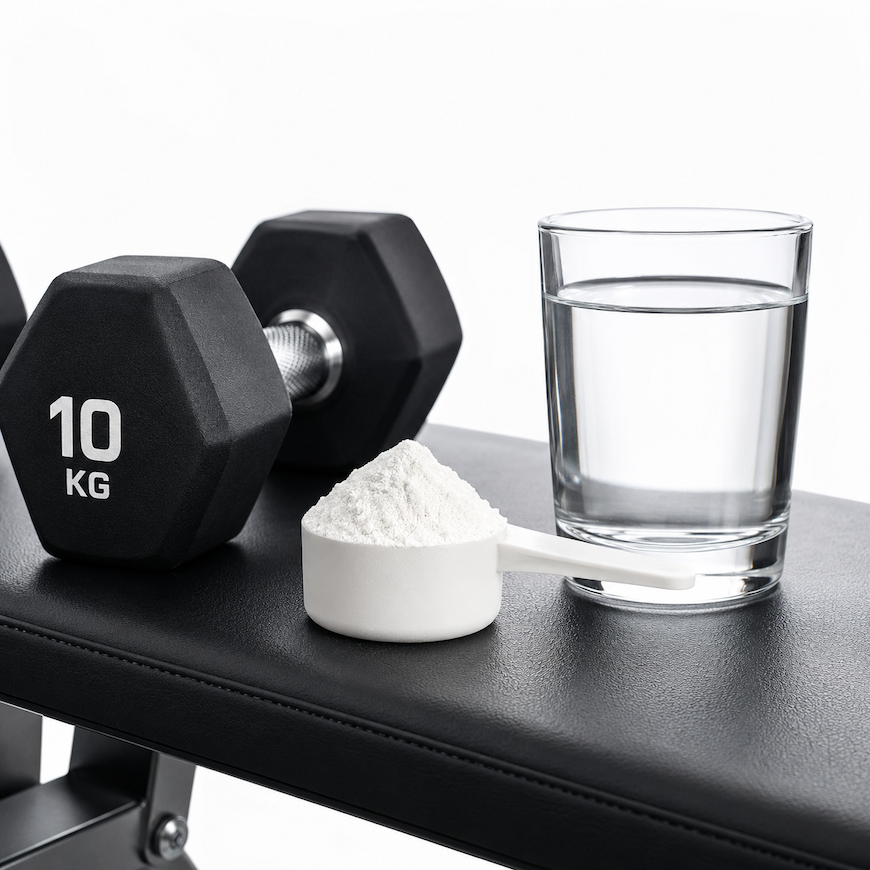
Quick Answer : Creatine monohydrate is the form used in more than 95% of published research and remains the evidence-based gold standard. Newer forms (creatine HCl, buffered creatine or Kre-Alkalyn, creatine ethyl ester, micronized creatine) are marketed as better on absorption, bloating, or dosing. No randomized head-to-head trial has shown superior outcomes for any of them versus standard monohydrate. Monohydrate is also the cheapest form by a wide margin.
The supplement industry has put out at least a dozen “advanced” creatine forms over the past two decades, each pitched as fixing some problem with plain monohydrate. The claims don’t hold up, and none of these forms delivers creatine benefits that plain monohydrate doesn’t.
Creatine HCl. Marketed as needing a smaller dose (750mg vs 5g) thanks to better absorption. That absorption data comes from in-vitro (test tube) work, not human trials. No published RCT shows HCl reaching equivalent or better intramuscular saturation at a lower dose. It runs 3–5x more per serving than monohydrate.
Buffered creatine (Kre-Alkalyn). Marketed as more stable at higher pH and producing less creatinine breakdown in the stomach. A head-to-head comparison in the Journal of the International Society of Sports Nutrition (2012) found no significant difference in muscle creatine, strength, or body composition between Kre-Alkalyn and monohydrate over 28 days.
Creatine ethyl ester. A direct comparison trial found it less effective than monohydrate at raising intramuscular creatine, and it converted to creatinine (the inactive waste product) at a higher rate in the gut.
Micronized monohydrate. This is standard monohydrate milled to a smaller particle size for easier mixing. It’s still monohydrate: functionally identical, slightly more convenient, with the same creatine benefits.
The best creatine supplement for most people is standard monohydrate, 3–5g a day, from any reputable brand with third-party testing (Informed Sport, NSF Certified for Sport). It should be cheap: 5g a day of monohydrate should cost under $0.50 a serving from a quality source, the cheapest route to the full creatine benefits.
Quick Answer : The standard creatine dose is 3–5g a day, taken consistently, with no need for a loading phase. A loading phase (20g a day split into 4 doses for 5–7 days) saturates muscle stores in about a week instead of the 3–4 weeks daily maintenance takes, but the endpoint (full saturation) is the same. Loading is optional; it speeds up the onset but reaches the same result. Timing matters less than consistency: same time daily, with or without food.
The dosage question generates more confusion than it should, considering how little the creatine benefits depend on getting it perfect. The facts that matter:
Maintenance dose. 3–5g a day. This is the evidence-supported range that keeps muscle creatine saturated in most adults. 3g is enough for lighter individuals; 5g is standard for most people. Higher doses (10g+/day) don’t add performance benefit or extra creatine benefits, and raise the odds of GI side effects.
Loading phase. 20g a day (5g × 4 doses) for 5–7 days, then drop to 3–5g maintenance. This saturates stores about 3 weeks faster than going straight to maintenance. Loading is useful if you’re prepping for a competition or a specific event, but it only changes how fast the creatine benefits arrive, not how big they get. For general long-term use, it’s unnecessary.
Before or after a workout. A 2013 JISSN meta-analysis found a slight edge for post-workout timing on lean mass and strength versus pre-workout, roughly 1.7kg more lean mass over 4 weeks. The practical guidance, especially if you’re new to it, is simpler: pick a consistent time and take it daily. On rest days, take it with a meal. Creatine’s half-life in muscle is long, so missing one dose doesn’t reset your stores.
With what? Early research suggested taking creatine with simple carbohydrates boosted uptake through insulin-mediated transport. More recent data shows protein and carbohydrate together get you similar uptake. Taking it post-workout with your usual protein shake or meal is plenty to lock in the creatine benefits.
Quick Answer : Creatine plus resistance training consistently beats resistance training alone for lean mass, strength, and power across multiple meta-analyses. The effect is largest in activities built on repeated high-intensity efforts (weightlifting, sprinting, court sports) and minimal in pure endurance. The mechanism is indirect: creatine lets you train at higher volume (more reps, more sets, shorter rest), which drives muscle protein synthesis through mechanical tension and metabolic stress.
This is the core of the creatine benefits for muscle, and it’s more nuanced than “creatine builds muscle.”
A 2003 meta-analysis in the Journal of Strength and Conditioning Research covering 22 studies found creatine during resistance training produced an average 8% gain in maximal strength and a 14% gain in weightlifting performance versus placebo. The effects accumulated over 4–12 weeks of consistent supplementation and training, and they’re the clearest creatine benefits in the performance literature.
The mechanism runs through training volume:
Creatine raises phosphocreatine stores.
More phosphocreatine means more ATP regeneration during sets.
You complete more reps at the same weight before failure.
More volume puts more mechanical tension on the muscle fibers.
More mechanical tension drives more myofibrillar protein synthesis.
Over weeks, that adds up to measurably more lean mass than unsupplemented training.
Where creatine doesn’t help much: marathon running, cycling, swimming, the endurance events where the aerobic pathway dominates. The creatine benefits are minimal in pure endurance. For sports that mix aerobic and anaerobic demands (football, basketball, tennis, soccer), the creatine benefits show up in the high-intensity bursts without hurting aerobic performance.
One counterintuitive finding: creatine is highly effective for older adults. Sarcopenia (age-related muscle loss) speeds up after 50, and resistance training in older adults tends to produce a smaller hypertrophic response than in younger adults. Several studies show creatine amplifies the training stimulus in older adults more than in younger people, which means the creatine benefits arguably matter more for someone over 50 than for a 25-year-old gym regular.
Quick Answer : The brain uses phosphocreatine to resynthesize ATP the same way skeletal muscle does. A double-blind crossover trial (Rae et al., 2003; 45 vegetarians, 5g/day for 6 weeks) found creatine produced a 50% improvement on backward digit span, a working memory test, versus placebo. Vegetarians showed the largest effect (lowest baseline brain creatine); benefits in omnivores are smaller but present. Emerging research suggests creatine may buffer against traumatic brain injury and support cognition under sleep deprivation.
The creatine benefits for the brain are the least-covered angle in most creatine articles and maybe the most important.
The brain is an energy-hungry organ: it uses about 20% of total body energy while making up only 2% of body weight, which is why the creatine benefits extend past muscle. Neurons rely on the phosphocreatine/ATP system to hold ion gradients, support synaptic transmission, and meet the metabolic demands of active thinking. As in muscle, phosphocreatine is the rapid ATP buffer when demand spikes, and that’s the mechanism behind the cognitive creatine benefits.
The Rae et al. 2003 study is the key reference: a randomized, double-blind, placebo-controlled crossover trial at the University of Sydney. 45 vegetarians took 5g/day creatine or placebo for 6 weeks. The creatine group improved 50% on backward digit span (a working memory measure) and significantly on a Raven’s Advanced Progressive Matrices subset (fluid intelligence). Vegetarians were chosen because their low dietary creatine leaves more room to improve, which makes them the clearest human model of what brain creatine loading does.
Subsequent research has extended this:
Cognition under sleep deprivation: a 2006 study found creatine significantly reduced the decline in reaction time and mood after 24 hours without sleep.
Mild traumatic brain injury: animal and early human work suggests creatine reduces neurological damage from TBI, probably by keeping brain phosphocreatine stores up during the post-injury energy crisis.
Depression and mood: there’s an emerging hypothesis that brain energy deficits feed depressive symptoms, and creatine’s ATP support may be relevant, though the creatine benefits for mood are still preliminary in RCT data.
For anyone doing cognitively demanding work, not just physical training, the creatine benefits here are worth knowing. The signs of magnesium deficiency article covers an adjacent pathway: magnesium is also needed to activate ATP (Mg-ATP is the functional form), so the two nutrients work through neighboring mechanisms in brain energy metabolism.
Quick Answer : Women have roughly 70–80% lower endogenous creatine stores than men at equivalent body weight, which makes supplementation proportionally more impactful. The ATP-replenishment mechanism works identically in women’s muscle. Postmenopausal women show especially clear benefits: a University of Saskatchewan 52-week trial found women aged 50+ who combined creatine (0.1g/kg/day) with resistance training kept significantly more lean mass and gained more bone mineral density than training alone. Premenopausal women benefit mainly through the performance and lean-mass effects seen across the general research base.
The creatine benefits for women are one of the most-searched creatine topics and one of the worst served by existing content. Most creatine articles quietly assume a male reader. The research in women is strong.
Why women may respond proportionally more than men. Women make less endogenous creatine and get less from food (lower average meat intake), so there’s a bigger gap between their natural stores and maximum saturation. The creatine benefits scale with how far below saturation you start.
Performance benefits in women. Multiple RCTs show the creatine benefits hold in premenopausal women: creatine plus resistance training beats training alone on upper- and lower-body strength, sprint performance, and lean mass, with effect sizes similar to men’s despite the absolute strength differences.
The menopause angle. Falling estrogen after menopause weakens the anabolic signaling that maintains muscle and bone, which leaves older women especially exposed to sarcopenia and osteoporosis. A University of Saskatchewan trial (2019) randomized women over 50 to creatine or placebo during a year-long resistance training program. The creatine group kept significantly more lean mass and improved more in hip bone mineral density, a meaningful finding given that hip fracture is a leading cause of disability and death in older women.
Menstrual cycle considerations. Limited research hints that creatine may blunt exercise-induced muscle damage a bit differently across the cycle, but nothing suggests women need to cycle off creatine or adjust the dose by cycle phase. The standard 3–5g/day applies, and the creatine benefits don’t change by cycle phase.
The “bulking” worry. A common reason women skip creatine. The relevant fact: creatine pulls water into the muscle (intramuscular water retention, which makes muscles look fuller), not under the skin (subcutaneous retention, the kind that blurs definition). Women who strength train with creatine don’t get “bulky”; they get more defined, so the creatine benefits show up as definition, not bulk, because more training volume at the same calorie intake favors lean mass over fat.
Quick Answer : At 3–5g/day, creatine monohydrate is consistently rated safe in long-term studies, including trials running up to 5 years of continuous use. The International Society of Sports Nutrition position stand finds no adverse health effects in healthy adults at this dose. The common worries (kidney damage, hair loss, cramping, dehydration) have been studied directly and the evidence doesn’t support them as real risks at standard doses, with the partial exception of hair-loss risk in genetically susceptible men based on limited DHT data.
Weighed against the creatine benefits, the safety concerns are mostly manageable, and several are myths.
Creatine and the kidneys, the most common concern. Creatine raises serum creatinine on a standard blood panel. Creatinine is just the breakdown product of creatine, so the more creatine you metabolize, the more creatinine shows up in the blood. That’s a normal metabolic consequence, not kidney damage. In people with healthy kidneys, eGFR (estimated glomerular filtration rate, the actual measure of kidney function) is unaffected by creatine. People with existing kidney disease or a single kidney should talk to a physician first, since the kidneys will process a larger creatinine load.
Does creatine cause hair loss, the honest answer. One 2009 study of 20 collegiate rugby players found that creatine loading (25g/day for 7 days, then 5g/day for 14 days) raised DHT (dihydrotestosterone) 56% above baseline during the loading phase [verify URL before publishing]. DHT is the androgen mainly responsible for male pattern baldness in genetically susceptible men. But this is a single small study, measuring DHT rather than hair loss, during a loading dose rather than standard maintenance. No later study has replicated the DHT finding at maintenance doses, and none has directly measured hair loss from creatine.
The honest read: if you have a strong family history of male pattern baldness, there’s a biologically plausible but weakly evidenced route by which creatine, especially loading phases, could speed up hair loss. If hair retention matters to you, skip the loading phase and go straight to 3g/day maintenance, which produces a smaller transient DHT bump.
Water retention, the misunderstood weight gain. Starting creatine usually adds 1–2kg of body weight in the first week or two. That’s intramuscular water; creatine is osmotically active and draws water into the muscle cells. It’s actually beneficial: better-hydrated muscle cells show improved protein synthesis and power output, one of the quieter creatine benefits. It isn’t the subcutaneous retention that blurs definition and looks puffy. The gain is essentially muscle volumization, and once the saturation phase is done, no further water retention happens.
GI distress. The most genuinely common side effect. Taking the full daily dose at once (especially during loading, when 20g is split into 5g × 4) can cause nausea, cramping, or diarrhea in some people. The fix: take it with food, split the dose, and stay well hydrated. Micronized monohydrate (smaller particles, dissolves more fully) tends to cause fewer GI issues than standard bulk monohydrate. For most people, the creatine benefits come with none of these problems.
Quick Answer : Creatine helps anyone doing resistance training, high-intensity intervals, or repeated-sprint sports, from beginners to elite athletes. It also helps vegetarians and vegans (lowest natural stores), adults over 50 (muscle and bone preservation), and people in cognitively demanding work (brain ATP support). People who should check with a physician first: anyone with pre-existing kidney disease, kidney stones, or a single kidney. Creatine is not a steroid, doesn’t raise testosterone, and isn’t banned in any major sporting body.
The creatine benefits reach a wider group than most people assume.
Take creatine if:
You do resistance training or any high-intensity activity. This is the clearest case.
You’re vegetarian or vegan. Lowest dietary creatine, largest potential response.
You’re over 50. The muscle and bone preservation benefits are disproportionately large here.
You want cognitive support for demanding mental work. The brain ATP mechanism is real, particularly for working memory under fatigue.
You’re coming back from injury and want to hold onto muscle during reduced activity. Creatine helps maintain lean mass through detraining.
Think it through first if:
You have a strong family history of male pattern baldness and plan to load.
You have pre-existing kidney disease. Talk to your physician; the extra creatinine load needs monitoring.
You’re in the first trimester of pregnancy. Safety data is limited; discuss it with your OB.
What creatine isn’t:
An anabolic steroid. It has no androgenic activity (beyond the limited DHT finding during loading).
A testosterone booster. Multiple studies confirm it doesn’t raise testosterone.
Banned in sport. WADA, the NCAA, and the IOC place no restriction on creatine.
Only for men. See the section on women above.
Pairing notes: you can stack the creatine benefits with fish oil supplements , since fish oil lowers exercise-induced inflammation, which may help recovery between sessions. Best supplements for energy covers a broader stack. You also keep the creatine benefits even with your usual coffee: there’s no known interaction between creatine and caffeine at moderate doses, despite an older belief that caffeine blunts creatine uptake, which later research didn’t support.
With a loading phase (20g/day for 5–7 days), you reach full muscle saturation in about a week, and the performance effects become noticeable in week 2. Without loading (straight to 3–5g/day), full saturation takes 3–4 weeks. Most people first notice it in the final reps of their working sets, finishing reps 9 and 10 where they used to fail at 7 or 8. The initial weight gain (1–2kg of intramuscular water) shows up in the first week either way.
No. There's no evidence that continuous use requires cycling. The "3 months on, 1 month off" advice has no scientific basis and came from unfounded speculation about tolerance. Long-term studies of up to 5 years of continuous use show no adverse effects and steady creatine benefits throughout. The only practical reason to stop is the temporary first-week weight gain, if you're prepping for a weigh-in in a weight-class sport.
Muscle creatine stores return to baseline over roughly 4–6 weeks. The intramuscular water you held during supplementation is lost (a 1–2kg drop), and training performance gradually settles back to its pre-supplement level over the same period. There's no rebound effect or downside to stopping; you simply return to your natural baseline.
Creatine without training won't produce meaningful body composition changes, since the performance effects need training to translate into muscle adaptation. That said, the cognitive and muscle-preservation creatine benefits (in sedentary older adults) are partly exercise-independent. For most people, though, the best-supported reason to take it is to improve training performance and results.
Research specifically in adolescents is limited. Adult safety data is robust, but the ISSN recommends creatine in under-18s only with healthcare or certified-sports-dietitian supervision, a well-monitored training program in place, and a clear fit for the sport. For most teenage athletes, nailing diet and training fundamentals before adding supplements is the better starting point.
They work through entirely different mechanisms and aren't interchangeable. Protein powder supplies amino acids, the raw material for muscle protein synthesis; you need enough protein to build tissue. Creatine supplies an energy substrate (phosphocreatine) that lets you train harder, which creates the stimulus for protein synthesis. Protein builds the house; creatine gives you the energy to do more of the work. Both rest on strong evidence, so you can stack protein's building blocks with creatine benefits rather than choosing between them.
The information in this article is for educational purposes and does not constitute medical advice. Creatine is a dietary supplement, not a medication. People with kidney disease, kidney stones, or other renal conditions should consult a physician before using creatine. Do not use creatine as a substitute for medical treatment or professional dietary guidance.